 Add to Chrome
 Add to Firefox
 Add to Edge
DeVAR: Low-Dose CT Denoising via Visual Autoregressive Modeling
Jun 26, 2026
Computed tomography (CT) plays a crucial role in medical diagnosis, but minimizing radiation exposure while maintaining image quality remains a critical challenge. Low-dose CT (LDCT) protocols reduce radiation risks but inevitably suffer from severe noise and artifacts that compromise diagnostic accuracy. While existing deep learning methods have achieved promising results, there remains a continuous quest for generative paradigms that intrinsically capture global-to-local structural dependencies to better preserve fine anatomical details. To this end, we propose DeVAR, a novel generative framework that applies visual autoregressive modeling (VAR) to LDCT denoising for the first time. Conditioned on global context provided by LDCT prefix tokens, DeVAR progressively generates discrete token maps of the target normal-dose CT (NDCT) via next-scale prediction. Because quantization inherently discards high-frequency information, we introduce a residual refiner to capture subtle anatomical structures beyond the capacity of a discrete codebook. Finally, empowered by a dual-representation hybrid training strategy, our hybrid NDCT decoder seamlessly integrates continuous and discrete latents to reconstruct high-fidelity, detail-preserved images. Extensive experiments on two public datasets demonstrate that DeVAR consistently achieves superior qualitative and quantitative performance compared to state-of-the-art LDCT denoising methods.

Geometry-aware Active Learning of Spatiotemporal Dynamic Systems
May 01, 2025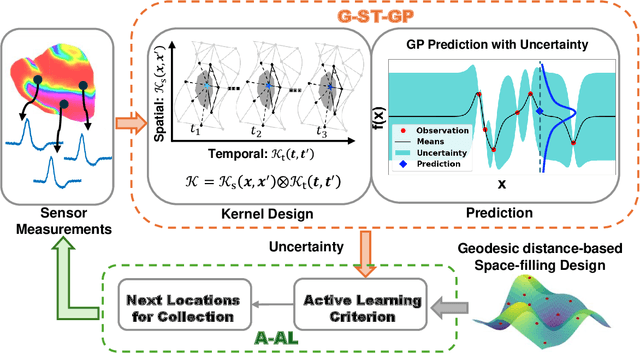
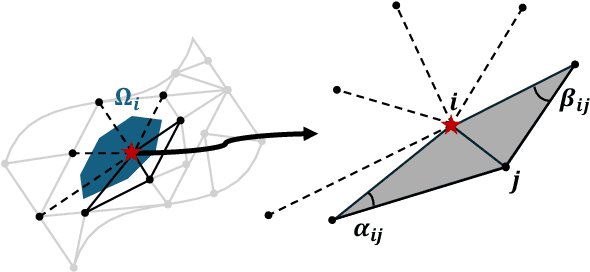
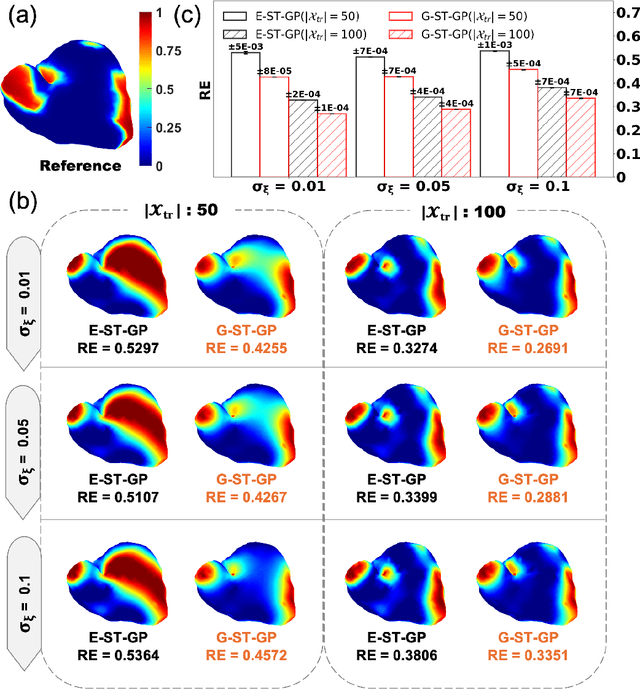
Rapid developments in advanced sensing and imaging have significantly enhanced information visibility, opening opportunities for predictive modeling of complex dynamic systems. However, sensing signals acquired from such complex systems are often distributed across 3D geometries and rapidly evolving over time, posing significant challenges in spatiotemporal predictive modeling. This paper proposes a geometry-aware active learning framework for modeling spatiotemporal dynamic systems. Specifically, we propose a geometry-aware spatiotemporal Gaussian Process (G-ST-GP) to effectively integrate the temporal correlations and geometric manifold features for reliable prediction of high-dimensional dynamic behaviors. In addition, we develop an adaptive active learning strategy to strategically identify informative spatial locations for data collection and further maximize the prediction accuracy. This strategy achieves the adaptive trade-off between the prediction uncertainty in the G-ST-GP model and the space-filling design guided by the geodesic distance across the 3D geometry. We implement the proposed framework to model the spatiotemporal electrodynamics in a 3D heart geometry. Numerical experiments show that our framework outperforms traditional methods lacking the mechanism of geometric information incorporation or effective data collection.