 Add to Chrome
 Add to Firefox
 Add to Edge
RF-Agent: Automated Reward Function Design via Language Agent Tree Search
Feb 27, 2026
Designing efficient reward functions for low-level control tasks is a challenging problem. Recent research aims to reduce reliance on expert experience by using Large Language Models (LLMs) with task information to generate dense reward functions. These methods typically rely on training results as feedback, iteratively generating new reward functions with greedy or evolutionary algorithms. However, they suffer from poor utilization of historical feedback and inefficient search, resulting in limited improvements in complex control tasks. To address this challenge, we propose RF-Agent, a framework that treats LLMs as language agents and frames reward function design as a sequential decision-making process, enhancing optimization through better contextual reasoning. RF-Agent integrates Monte Carlo Tree Search (MCTS) to manage the reward design and optimization process, leveraging the multi-stage contextual reasoning ability of LLMs. This approach better utilizes historical information and improves search efficiency to identify promising reward functions. Outstanding experimental results in 17 diverse low-level control tasks demonstrate the effectiveness of our method. The source code is available at https://github.com/deng-ai-lab/RF-Agent.

Image Restoration via Multi-domain Learning
May 07, 2025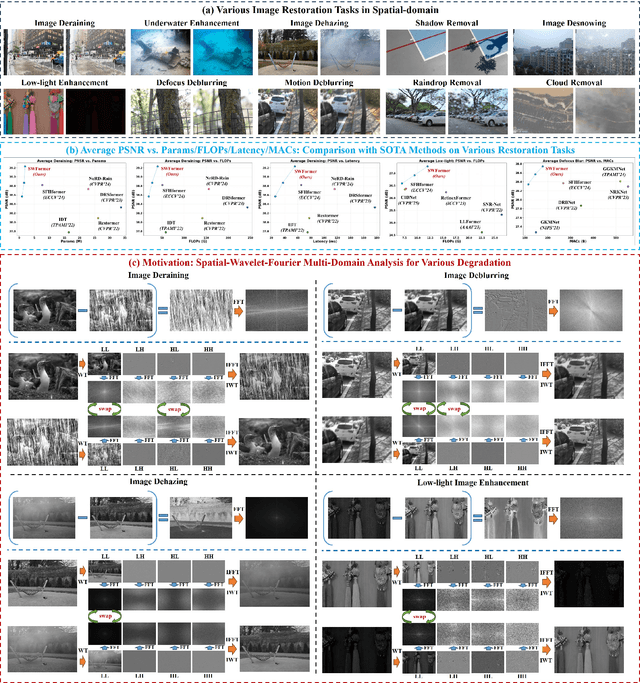
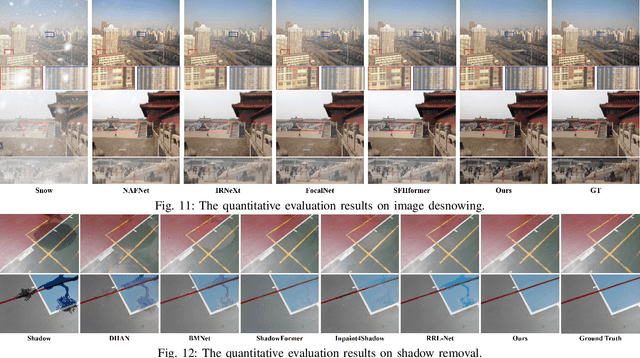
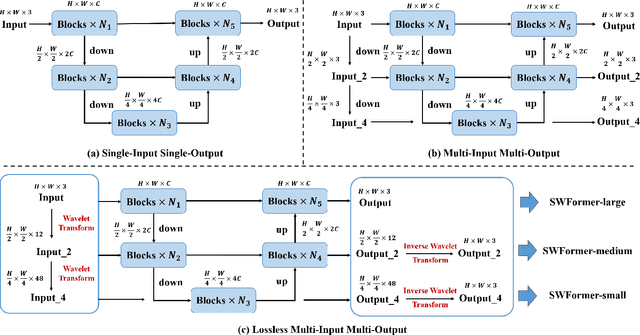
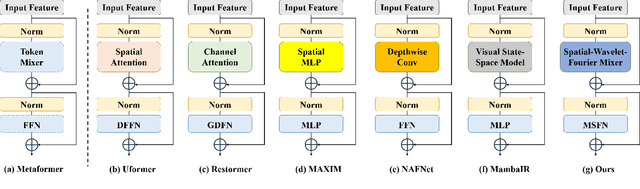
Due to adverse atmospheric and imaging conditions, natural images suffer from various degradation phenomena. Consequently, image restoration has emerged as a key solution and garnered substantial attention. Although recent Transformer architectures have demonstrated impressive success across various restoration tasks, their considerable model complexity poses significant challenges for both training and real-time deployment. Furthermore, instead of investigating the commonalities among different degradations, most existing restoration methods focus on modifying Transformer under limited restoration priors. In this work, we first review various degradation phenomena under multi-domain perspective, identifying common priors. Then, we introduce a novel restoration framework, which integrates multi-domain learning into Transformer. Specifically, in Token Mixer, we propose a Spatial-Wavelet-Fourier multi-domain structure that facilitates local-region-global multi-receptive field modeling to replace vanilla self-attention. Additionally, in Feed-Forward Network, we incorporate multi-scale learning to fuse multi-domain features at different resolutions. Comprehensive experimental results across ten restoration tasks, such as dehazing, desnowing, motion deblurring, defocus deblurring, rain streak/raindrop removal, cloud removal, shadow removal, underwater enhancement and low-light enhancement, demonstrate that our proposed model outperforms state-of-the-art methods and achieves a favorable trade-off among restoration performance, parameter size, computational cost and inference latency. The code is available at: https://github.com/deng-ai-lab/SWFormer.