 Add to Chrome
 Add to Firefox
 Add to Edge
OctCGS: Octree-Contextual Gaussian Splatting with Explicit Multi-Order Propagation Modeling for Channel Knowledge Map Construction
May 21, 2026
Channel knowledge maps (CKMs) learn the relation between transmitter (Tx) and receiver (Rx) positions and channel knowledge to support environment-aware wireless communications. Implicit neural methods can model continuous channel variation but often incur high training and inference cost, while existing Gaussian-splatting-based CKM methods improve efficiency yet still compress wireless multipath interactions into aggregated scattering representations. Consequently, explicit modeling of multi-bounce wireless propagation remains absent from CKM construction. We propose OctCGS, an octree-contextual Gaussian splatting framework that explicitly models the order of bounce jointly over Tx/Rx positions and carrier frequencies. OctCGS partitions the environment into a multi-resolution octree and anchors one Gaussian primitive to each leaf node. Rather than having each Gaussian independently encode all multi-path propagations, it models complex electromagnetic interactions among scatterers through tree attention over the octree hierarchy with controlled complexity. Experiments on simulated benchmarks show that OctCGS achieves a 2.99 dB channel-gain mean absolute error (MAE) and 0.065 channel gain normalized mean absolute error (NMAE), outperforming the strongest baseline by 0.88 dB MAE and 0.021 NMAE.

Towards Integrated Sensing and Communications for 6G
Jan 12, 2022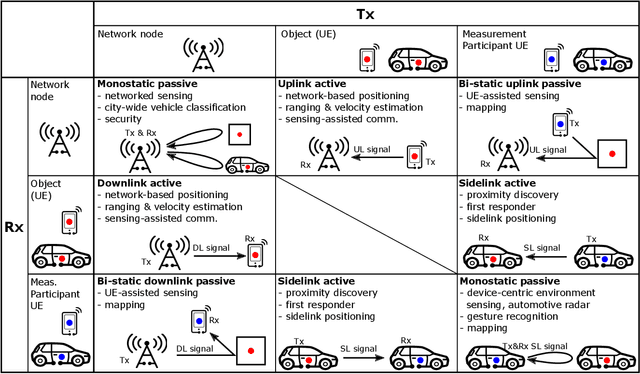
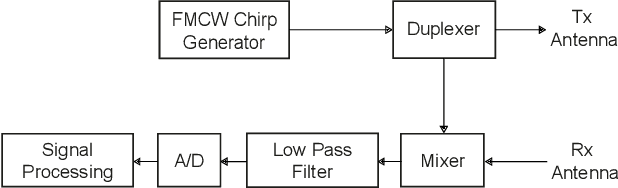
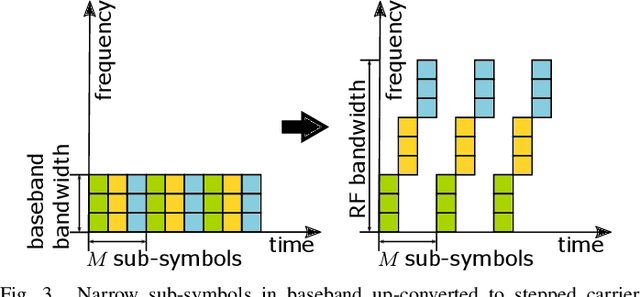
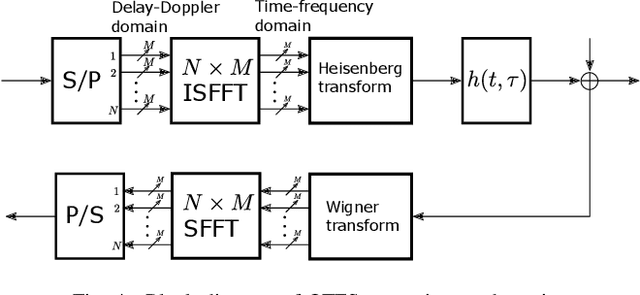
For the next generation of mobile communications systems, the integration of sensing and communications promises benefits in terms of spectrum utilization, cost, latency, area and weight. In this paper, we categorize and summarize the key features and technical considerations for different integration approaches and discuss related waveform design issues for a future 6G system. We provide results on new candidate waveforms for monostatic sensing and finally highlight important open issues and directions that deserve future in-depth research.