 Add to Chrome
 Add to Firefox
 Add to Edge
PAUSE: A User-Centric Benchmark for Personal AI Assistants in Unified Service Environments
Jul 29, 2026
Personal AI assistants are increasingly deployed as task-oriented, tool-augmented agents that operate within unified service environments to support everyday user activities. In realistic settings, such assistants must reason over persistent user state, respect user-specific configurations and permissions, and sustain long-horizon, constraint-aware interactions across multiple services. Existing benchmarks, however, often fragment service contexts or abstract away user state, limiting their ability to evaluate user-centric personal assistant behavior in realistic service settings. We introduce PAUSE, a user-centric benchmark for evaluating personal AI assistants in stateful, service-integrated environments. PAUSE captures core challenges of real-world assistant deployment by requiring agents to coordinate actions across heterogeneous user-owned resources while maintaining consistency with environment state, authorization constraints over multi-turn interactions. The benchmark incorporates explicit user-agent interaction via realistic user simulation, enabling evaluation beyond static tool execution. To support principled and reproducible evaluation, PAUSE adopts a multi-regime evaluation framework aligned with task characteristics. Open-ended service management tasks are assessed using semantic and trajectory-level behavioral metrics, while constraint-intensive tasks admit deterministic, state-based verification. Benchmark results show that even state-of-the-art proprietary models fail to reach 70% task completion on scenarios requiring stateful reasoning and configuration awareness, revealing consistent and interpretable failure patterns. Finally, we present a user-centric synthesis pipeline that enables scalable generation of coherent service environments, user configurations, and reliably annotated tasks, supporting benchmark extensibility and future research.

FODMP: Fast One-Step Diffusion of Movement Primitives Generation for Time-Dependent Robot Actions
Mar 25, 2026Diffusion models are increasingly used for robot learning, but current designs face a clear trade-off. Action-chunking diffusion policies like ManiCM are fast to run, yet they only predict short segments of motion. This makes them reactive, but unable to capture time-dependent motion primitives, such as following a spring-damper-like behavior with built-in dynamic profiles of acceleration and deceleration. Recently, Movement Primitive Diffusion (MPD) partially addresses this limitation by parameterizing full trajectories using Probabilistic Dynamic Movement Primitives (ProDMPs), thereby enabling the generation of temporally structured motions. Nevertheless, MPD integrates the motion decoder directly into a multi-step diffusion process, resulting in prohibitively high inference latency that limits its applicability in real-time control settings. We propose FODMP (Fast One-step Diffusion of Movement Primitives), a new framework that distills diffusion models into the ProDMPs trajectory parameter space and generates motion using a single-step decoder. FODMP retains the temporal structure of movement primitives while eliminating the inference bottleneck through single-step consistency distillation. This enables robots to execute time-dependent primitives at high inference speed, suitable for closed-loop vision-based control. On standard manipulation benchmarks (MetaWorld, ManiSkill), FODMP runs up to 10 times faster than MPD and 7 times faster than action-chunking diffusion policies, while matching or exceeding their success rates. Beyond speed, by generating fast acceleration-deceleration motion primitives, FODMP allows the robot to intercept and securely catch a fast-flying ball, whereas action-chunking diffusion policy and MPD respond too slowly for real-time interception.
FRMD: Fast Robot Motion Diffusion with Consistency-Distilled Movement Primitives for Smooth Action Generation
Mar 03, 2025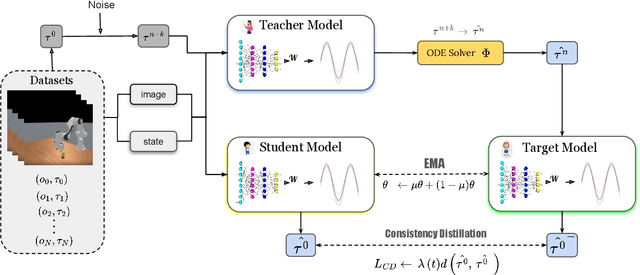
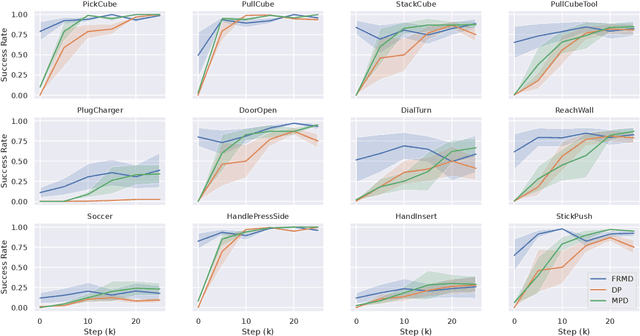
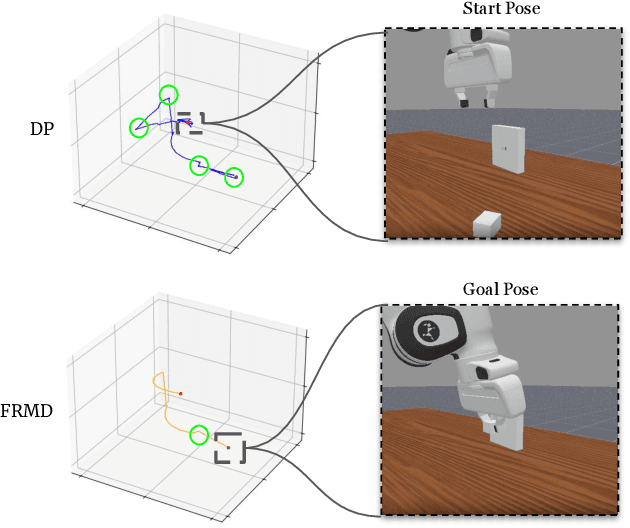
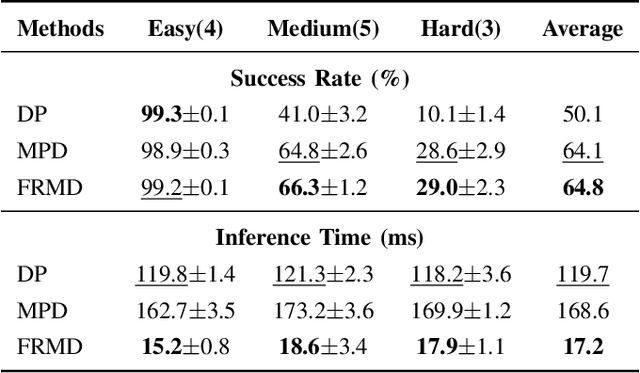
We consider the problem of using diffusion models to generate fast, smooth, and temporally consistent robot motions. Although diffusion models have demonstrated superior performance in robot learning due to their task scalability and multi-modal flexibility, they suffer from two fundamental limitations: (1) they often produce non-smooth, jerky motions due to their inability to capture temporally consistent movement dynamics, and (2) their iterative sampling process incurs prohibitive latency for many robotic tasks. Inspired by classic robot motion generation methods such as DMPs and ProMPs, which capture temporally and spatially consistent dynamic of trajectories using low-dimensional vectors -- and by recent advances in diffusion-based image generation that use consistency models with probability flow ODEs to accelerate the denoising process, we propose Fast Robot Motion Diffusion (FRMD). FRMD uniquely integrates Movement Primitives (MPs) with Consistency Models to enable efficient, single-step trajectory generation. By leveraging probabilistic flow ODEs and consistency distillation, our method models trajectory distributions while learning a compact, time-continuous motion representation within an encoder-decoder architecture. This unified approach eliminates the slow, multi-step denoising process of conventional diffusion models, enabling efficient one-step inference and smooth robot motion generation. We extensively evaluated our FRMD on the well-recognized Meta-World and ManiSkills Benchmarks, ranging from simple to more complex manipulation tasks, comparing its performance against state-of-the-art baselines. Our results show that FRMD generates significantly faster, smoother trajectories while achieving higher success rates.