 Add to Chrome
 Add to Firefox
 Add to Edge
Baseband-Efficient WMMSE Precoding: From a Signal Weighting Cost Perspective
May 18, 2026
For downlink transmission in massive multi-user multiple-input multiple-output (MU-MIMO) systems, conventional precoding research heavily focuses on reducing the computational complexity of precoding matrix design, while largely overlooking another critical bottleneck: the substantial signal weighting cost incurred by repeatedly applying the precoder to high-speed data streams. To address both challenges simultaneously, this paper proposes a novel sparse precoding framework tailored for fully-digital architectures. Within this framework, from the sum-rate maximization perspective, we design two sparse precoding architectures: a common-support row-sparse architecture and a user-specific row-sparse architecture, so as to reduce the number of multiplication operations required in baseband signal weighting without sacrificing system capacity. For the formulated mixed-integer non-linear programming (MINLP) problem, we rigorously prove, for the first time, that the optimal precoder under both sparse architectures strictly resides in a specific low-dimensional subspace determined by the channel matrices, thereby reducing the dimensionality of the optimization variables. Based on this insight, an alternating optimization algorithm is developed within the weighted minimum mean square error (WMMSE) framework to jointly optimize sparse beam selection and low-dimensional precoding coefficients. The combinatorial beam selection problem is handled using an efficient penalty-based majorize-minimization (MM) method, yielding a low-complexity closed-form solution. Simulation results demonstrate that the proposed scheme achieves near-optimal sum-rate performance while substantially reducing both the precoding computation complexity and the overall signal weighting cost.

A Physics-based and Data-driven Approach for Localized Statistical Channel Modeling
Mar 04, 2023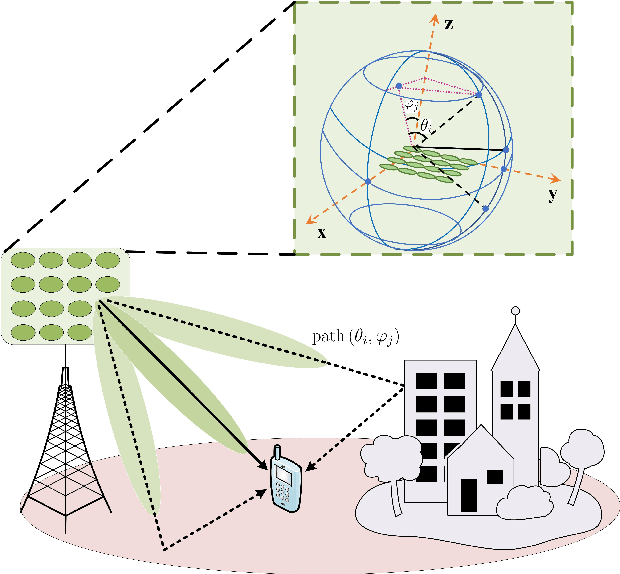

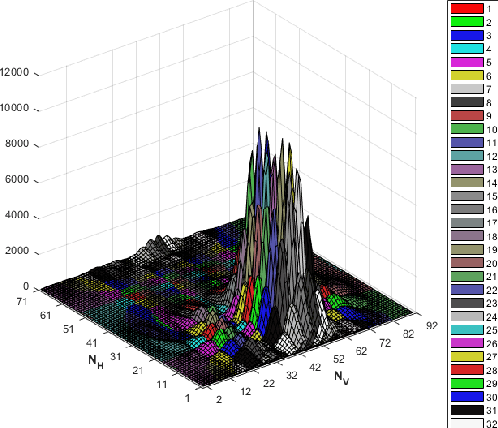
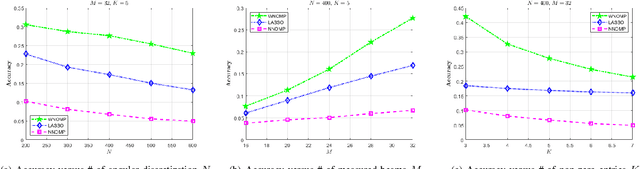
Localized channel modeling is crucial for offline performance optimization of 5G cellular networks, but the existing channel models are for general scenarios and do not capture local geographical structures. In this paper, we propose a novel physics-based and data-driven localized statistical channel modeling (LSCM), which is capable of sensing the physical geographical structures of the targeted cellular environment. The proposed channel modeling solely relies on the reference signal receiving power (RSRP) of the user equipment, unlike the traditional methods which use full channel impulse response matrices. The key is to build the relationship between the RSRP and the channel's angular power spectrum. Based on it, we formulate the task of channel modeling as a sparse recovery problem where the non-zero entries of the sparse vector indicate the channel paths' powers and angles of departure. A computationally efficient weighted non-negative orthogonal matching pursuit (WNOMP) algorithm is devised for solving the formulated problem. Finally, experiments based on synthetic and real RSRP measurements are presented to examine the performance of the proposed method.