 Add to Chrome
 Add to Firefox
 Add to Edge
Verifiable User Simulation for Search and Recommendation Systems
Jun 12, 2026
Large-language-model (LLM) based user simulation is increasingly adopted for evaluating search engines, recommender systems, and retrieval-augmented generation pipelines, yet most simulators remain opaque: it is difficult to determine why a simulated user made a particular choice or whether that choice is consistent with the intended user profile. Compounding this, recent research shows that LLMs can produce biased or discriminatory responses depending on user background characteristics such as language, education level, and cultural context, raising concerns about the equitable treatment of minority and disadvantaged groups. This half-day, in-person tutorial introduces a proposed design-and-audit framework that treats a user simulator as a verifiable engineering artefact composed of seven auditable components - structured Persona, task-aware Contract, matched human-vs-agent Execution, auditable Trace, persona-aligned Verification, structured Feedback, and a Refinement loop that updates personas and contracts. Through two hands-on mini-labs on recommendation-list evaluation and search-query formulation, participants will inspect simulator behaviour end-to-end, distinguish diagnostic discrepancy analysis from statistical validation, and apply checks for fidelity, credibility, and demographic bias. The tutorial targets information retrieval and recommender systems researchers and practitioners interested in user behaviour simulation and responsible AI.
* Presented as a half-day tutorial at SIGIR 2026, 4 pages

Task-Aware Automated User Profile Generation for Recommendation Simulation Using Large Language Models
May 13, 2026Large Language Model (LLM)-based agent simulation has emerged as a promising approach to meet the increasing demand for real-time and rigorous evaluation in modern recommender systems. A typical LLM-driven simulation framework comprises three essential components: the profile module, memory module, and action module. However, existing studies have primarily concentrated on enhancing the memory and action modules, with limited attention to profile generation, which plays a pivotal role in ensuring realistic agent behaviours and aligning simulated interactions with real user dynamics. Moreover, the scarcity of datasets specifically designed for recommendation simulations has led to heavy reliance on manually crafted profiles, significantly limiting the scalability and generalisability of simulation frameworks across different datasets. To address these challenges, this work proposes an Automated Profile Generation Framework for Recommendation Simulation, APG4RecSim, that constructs realistic, coherent, and robust user profiles with minimal supervision. Extensive experiments on three benchmark datasets demonstrate that APG4RecSim achieves the best overall performance on discrimination, ranking, and rating tasks, improving ranking quality by up to 7% in nDCG@10 and reducing rating distribution divergence by 8% in JSD compared to existing profile-generation baselines. Beyond overall performance gains, our results show that profiles generated by APG4RecSim are resilient to popularity- and position-induced biases and maintain stable performance across datasets and different LLMs.
Scalable Label-efficient Footpath Network Generation Using Remote Sensing Data and Self-supervised Learning
Sep 18, 2023

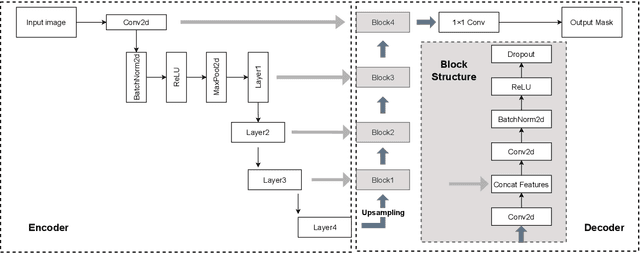
Footpath mapping, modeling, and analysis can provide important geospatial insights to many fields of study, including transport, health, environment and urban planning. The availability of robust Geographic Information System (GIS) layers can benefit the management of infrastructure inventories, especially at local government level with urban planners responsible for the deployment and maintenance of such infrastructure. However, many cities still lack real-time information on the location, connectivity, and width of footpaths, and/or employ costly and manual survey means to gather this information. This work designs and implements an automatic pipeline for generating footpath networks based on remote sensing images using machine learning models. The annotation of segmentation tasks, especially labeling remote sensing images with specialized requirements, is very expensive, so we aim to introduce a pipeline requiring less labeled data. Considering supervised methods require large amounts of training data, we use a self-supervised method for feature representation learning to reduce annotation requirements. Then the pre-trained model is used as the encoder of the U-Net for footpath segmentation. Based on the generated masks, the footpath polygons are extracted and converted to footpath networks which can be loaded and visualized by geographic information systems conveniently. Validation results indicate considerable consistency when compared to manually collected GIS layers. The footpath network generation pipeline proposed in this work is low-cost and extensible, and it can be applied where remote sensing images are available. Github: https://github.com/WennyXY/FootpathSeg.
FireRisk: A Remote Sensing Dataset for Fire Risk Assessment with Benchmarks Using Supervised and Self-supervised Learning
Mar 13, 2023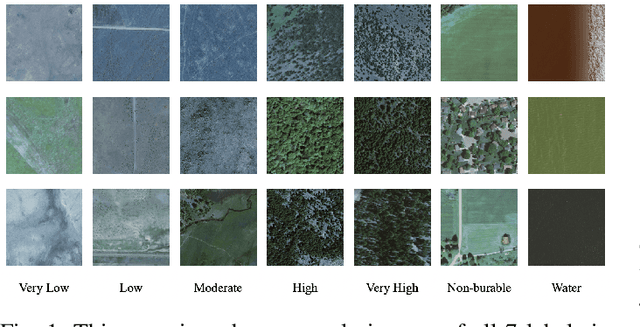
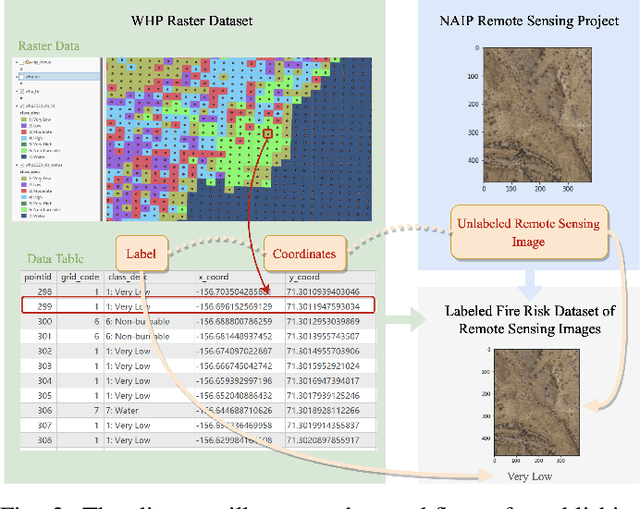
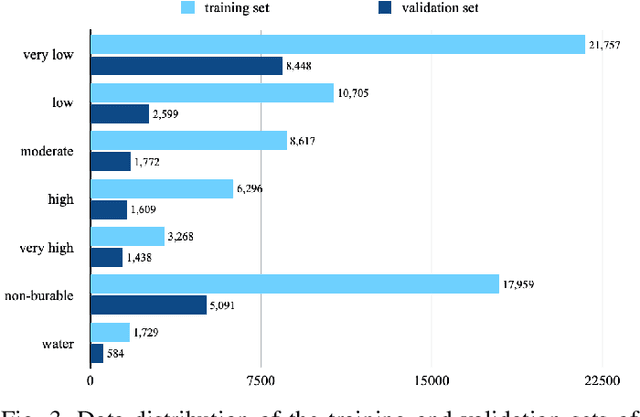
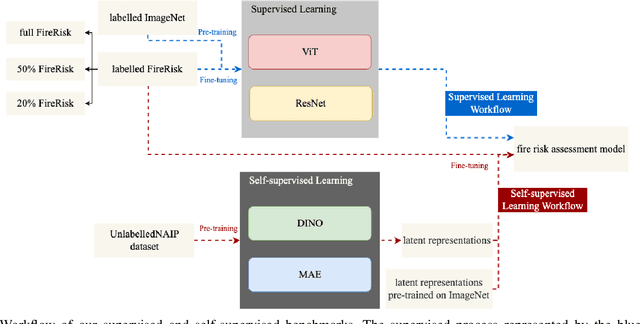
In recent decades, wildfires, as widespread and extremely destructive natural disasters, have caused tremendous property losses and fatalities, as well as extensive damage to forest ecosystems. Many fire risk assessment projects have been proposed to prevent wildfires, but GIS-based methods are inherently challenging to scale to different geographic areas due to variations in data collection and local conditions. Inspired by the abundance of publicly available remote sensing projects and the burgeoning development of deep learning in computer vision, our research focuses on assessing fire risk using remote sensing imagery. In this work, we propose a novel remote sensing dataset, FireRisk, consisting of 7 fire risk classes with a total of 91872 labelled images for fire risk assessment. This remote sensing dataset is labelled with the fire risk classes supplied by the Wildfire Hazard Potential (WHP) raster dataset, and remote sensing images are collected using the National Agriculture Imagery Program (NAIP), a high-resolution remote sensing imagery program. On FireRisk, we present benchmark performance for supervised and self-supervised representations, with Masked Autoencoders (MAE) pre-trained on ImageNet1k achieving the highest classification accuracy, 65.29%. This remote sensing dataset, FireRisk, provides a new direction for fire risk assessment, and we make it publicly available on https://github.com/CharmonyShen/FireRisk.
DINO-MC: Self-supervised Contrastive Learning for Remote Sensing Imagery with Multi-sized Local Crops
Mar 12, 2023


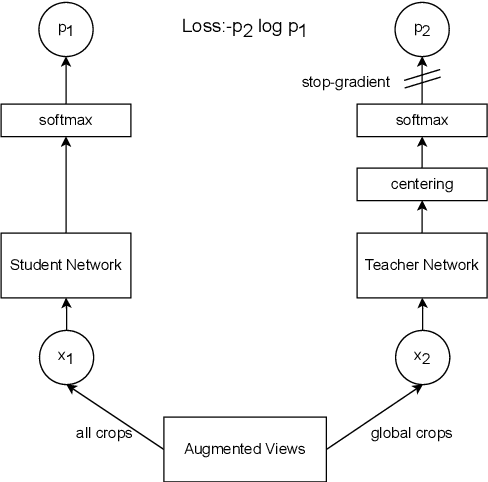
Due to the costly nature of remote sensing image labeling and the large volume of available unlabeled imagery, self-supervised methods that can learn feature representations without manual annotation have received great attention. While prior works have explored self-supervised learning in remote sensing tasks, pretext tasks based on local-global view alignment remain underexplored. Inspired by DINO, which employs an effective representation learning structure with knowledge distillation based on global-local view alignment, we formulate two pretext tasks for use in self-supervised learning on remote sensing imagery (SSLRS). Using these tasks, we explore the effectiveness of positive temporal contrast as well as multi-sized views on SSLRS. Moreover, we extend DINO and propose DINO-MC which uses local views of various sized crops instead of a single fixed size. Our experiments demonstrate that even when pre-trained on only 10% of the dataset, DINO-MC performs on par or better than existing state of the art SSLRS methods on multiple remote sensing tasks, while using less computational resources. All codes, models and results are available at https://github.com/WennyXY/DINO-MC.