 Add to Chrome
 Add to Firefox
 Add to Edge
Mr3D-VL: A generalist vision language foundation model for Multiparametric 3D Magnetic Resonance Imaging
Aug 13, 2026
Multi-parametric magnetic resonance imaging (mpMRI) is a cornerstone for brain tumor diagnosis and treatment, yet current AI models face critical limitations: their lack of natural language interaction and interpretability impedes spatial information integration and cross-modal reasoning required clinically. Key challenges arise from significant physical meaning differences across modalities, spatial misalignment due to scan intervals, and the need for complex multi-feature interpretation in tasks like glioma grading. While visual-language models (VLMs) show promise in cross-modal understanding, existing methods focus mainly on 2D image modeling, neglecting direct perception of 3D volumetric space. Although 3D VLMs have been proposed for report generation and feature alignment in 3D CT imaging, mpMRI applications demand collaborative inference across multiple imaging modalities-a requirement unmet by current solutions. To address this, we introduce Mr3D-VL, a dedicated visual-language foundation model for multi-parametric 3D MRI. With 4 billion parameters, it employs an unsupervised pre-trained shared 3D encoder and 4D rotational positional embedding for dual modality-spatial integration. Its cross-modal projection layer uses a multi-resolution feature implantation strategy to enhance feature perception across resolutions. Experimental results show significant improvements over existing 4B/7B/30B domain-specific and general-purpose models in text generation tasks, achieving a BERTScore of 0.856 for report generation, with question-answering accuracy at 0.713 and multiple-choice accuracy at 0.912.

POIROT: Investigating Direct Tangible vs. Digitally Mediated Interaction and Attitude Moderation in Multi-party Murder Mystery Games
Mar 09, 2026As social robots take on increasingly complex roles like game masters (GMs) in multi-party games, the expectation that physicality universally enhances user experience remains debated. This study challenges the "one-size-fits-all" view of tangible interaction by identifying a critical boundary condition: users' Negative Attitudes towards Robots (NARS). In a between-subjects experiment (N = 67), a custom-built robot GM facilitated a multi-party murder mystery game (MMG) by delivering clues either through direct tangible interaction or a digitally mediated interface. Baseline multivariate analysis (MANOVA) showed no significant main effect of delivery modality, confirming that tangibility alone does not guarantee superior engagement. However, primary analysis using multilevel linear models (MLM) revealed a reliable moderation: participants high in NARS experienced markedly lower narrative immersion under tangible delivery, whereas those with low NARS scores showed no such decrement. Qualitative findings further illuminate this divergence: tangibility provides novelty and engagement for some but imposes excessive proxemic friction for anxious users, for whom the digital interface acts as a protective social buffer. These results advance a conditional model of HRI and emphasize the necessity for adaptive systems that can tailor interaction modalities to user predispositions.
TaskSense: Cognitive Chain Modeling and Difficulty Estimation for GUI Tasks
Nov 12, 2025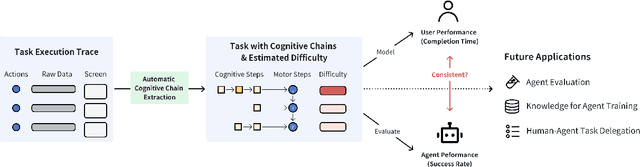
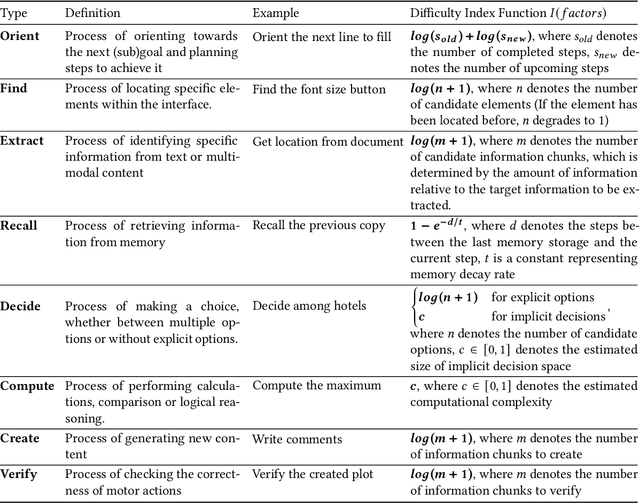
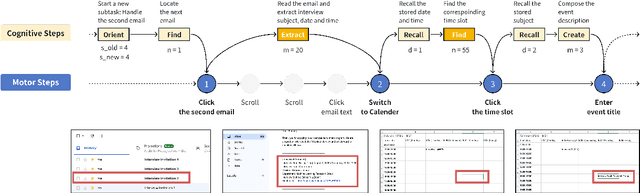

Measuring GUI task difficulty is crucial for user behavior analysis and agent capability evaluation. Yet, existing benchmarks typically quantify difficulty based on motor actions (e.g., step counts), overlooking the cognitive demands underlying task completion. In this work, we propose Cognitive Chain, a novel framework that models task difficulty from a cognitive perspective. A cognitive chain decomposes the cognitive processes preceding a motor action into a sequence of cognitive steps (e.g., finding, deciding, computing), each with a difficulty index grounded in information theories. We develop an LLM-based method to automatically extract cognitive chains from task execution traces. Validation with linear regression shows that our estimated cognitive difficulty correlates well with user completion time (step-level R-square=0.46 after annotation). Assessment of state-of-the-art GUI agents shows reduced success on cognitively demanding tasks, revealing capability gaps and Human-AI consistency patterns. We conclude by discussing potential applications in agent training, capability assessment, and human-agent delegation optimization.