 Add to Chrome
 Add to Firefox
 Add to Edge
The finite expression method for turbulent dynamics with high-order moment recovery
May 11, 2026
Turbulent dynamical systems are characterized by nonlinear interactions and stochastic effects that generate coupled statistical quantities, such as non-zero higher-order moments, which are difficult to capture from data with accuracy. We propose a two-stage data-driven modeling framework that combines symbolic regression with generative models to jointly identify the governing dynamics and predict their key statistical quantities. In Stage I of the framework, the Finite Expression Method (FEX) is adopted to discover closed-form expressions of the deterministic dynamics, recovering nonlinear interaction terms and external forcing without predefined libraries. In Stage II, generative models are introduced to learn the residual stochastic components as a refined correction to the model error from the Stage I approximation, enabling accurate characterization of higher-order statistics. Theoretical analysis establishes the consistency of the symbolic estimator and quantifies the estimation error in terms of data size and numerical discretization. The model performance is verified through detailed numerical experiments on the stochastic triad models across multiple regimes, demonstrating that the framework successfully recovers interaction terms and forcing expressions, and accurately predicts statistical moments up to order five. These results highlight the potential of integrating interpretable symbolic discovery with data-driven stochastic modeling for complex turbulent systems.

Identifying Unknown Stochastic Dynamics via Finite expression methods
Apr 09, 2025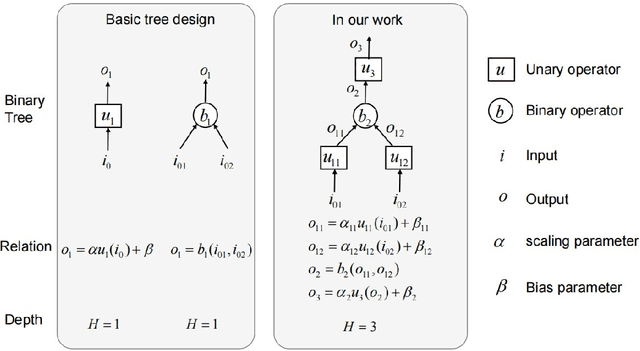
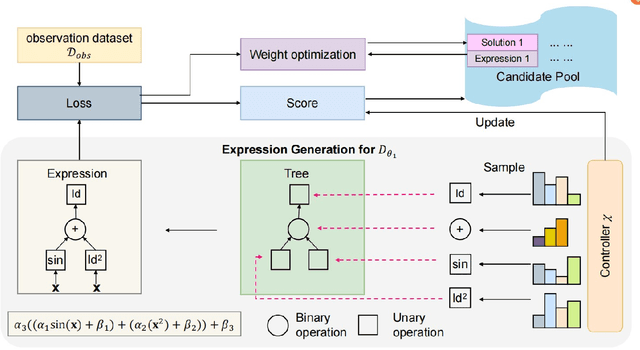

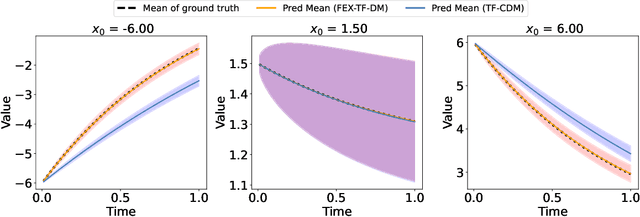
Modeling stochastic differential equations (SDEs) is crucial for understanding complex dynamical systems in various scientific fields. Recent methods often employ neural network-based models, which typically represent SDEs through a combination of deterministic and stochastic terms. However, these models usually lack interpretability and have difficulty generalizing beyond their training domain. This paper introduces the Finite Expression Method (FEX), a symbolic learning approach designed to derive interpretable mathematical representations of the deterministic component of SDEs. For the stochastic component, we integrate FEX with advanced generative modeling techniques to provide a comprehensive representation of SDEs. The numerical experiments on linear, nonlinear, and multidimensional SDEs demonstrate that FEX generalizes well beyond the training domain and delivers more accurate long-term predictions compared to neural network-based methods. The symbolic expressions identified by FEX not only improve prediction accuracy but also offer valuable scientific insights into the underlying dynamics of the systems, paving the way for new scientific discoveries.