 Add to Chrome
 Add to Firefox
 Add to Edge
Beyond Retrieval: Modeling Confidence Decay and Deterministic Agentic Platforms in Generative Engine Optimization
Apr 04, 2026
Generative Engine Optimization (GEO) is rapidly reshaping digital marketing paradigms in the era of Large Language Models (LLMs). However, current GEO strategies predominantly rely on Retrieval-Augmented Generation (RAG), which inherently suffers from probabilistic hallucinations and the "zero-click" paradox, failing to establish sustainable commercial trust. In this paper, we systematically deconstruct the probabilistic flaws of existing RAG-based GEO and propose a paradigm shift towards deterministic multi-agent intent routing. First, we mathematically formulate Semantic Entropy Drift (SED) to model the dynamic decay of confidence curves in LLMs over continuous temporal and contextual perturbations. To rigorously quantify optimization value in black-box commercial engines, we introduce the Isomorphic Attribution Regression (IAR) model, leveraging a Multi-Agent System (MAS) probe with strict human-in-the-loop physical isolation to enforce hallucination penalties. Furthermore, we architect the Deterministic Agent Handoff (DAH) protocol, conceptualizing an Agentic Trust Brokerage (ATB) ecosystem where LLMs function solely as intent routers rather than final answer generators. We empirically validate this architecture using EasyNote, an industrial AI meeting minutes product by Yishu Technology. By routing the intent of "knowledge graph mapping on an infinite canvas" directly to its specialized proprietary agent via DAH, we demonstrate the reduction of vertical task hallucination rates to near zero. This work establishes a foundational theoretical framework for next-generation GEO and paves the way for a well-ordered, deterministic human-AI collaboration ecosystem.

Architecting AgentOS: From Token-Level Context to Emergent System-Level Intelligence
Feb 24, 2026The paradigm of Large Language Models is undergoing a fundamental transition from static inference engines to dynamic autonomous cognitive systems.While current research primarily focuses on scaling context windows or optimizing prompt engineering the theoretical bridge between micro scale token processing and macro scale systemic intelligence remains fragmented.This paper proposes AgentOS,a holistic conceptual framework that redefines the LLM as a "Reasoning Kernel" governed by structured operating system logic.Central to this architecture is Deep Context Management which conceptualizes the context window as an Addressable Semantic Space rather than a passive buffer.We systematically deconstruct the transition from discrete sequences to coherent cognitive states introducing mechanisms for Semantic Slicing and Temporal Alignment to mitigate cognitive drift in multi-agent orchestration.By mapping classical OS abstractions such as memory paging interrupt handling and process scheduling onto LLM native constructs, this review provides a rigorous roadmap for architecting resilient scalable and self-evolving cognitive environments.Our analysis asserts that the next frontier of AGI development lies in the architectural efficiency of system-level coordination.
Contrastive Psudo-supervised Classification for Intra-Pulse Modulation of Radar Emitter Signals Using data augmentation
Oct 13, 2022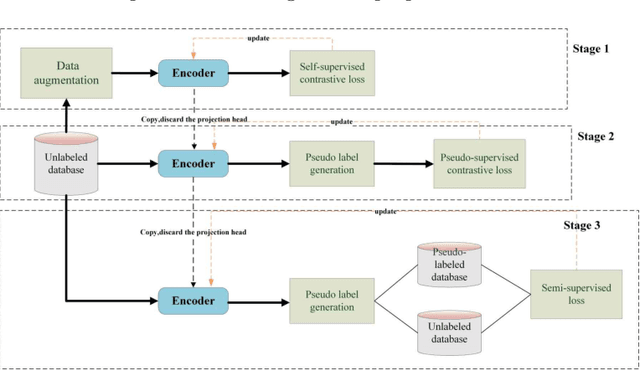
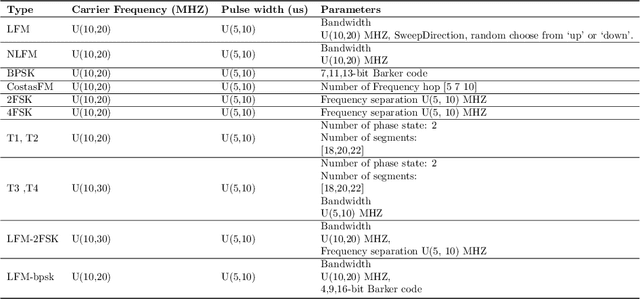
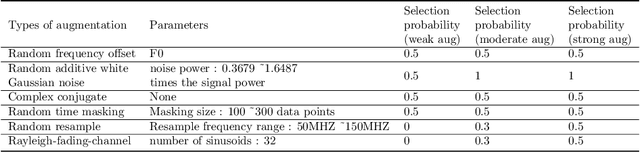
The automatic classification of radar waveform is a fundamental technique in electronic countermeasures (ECM).Recent supervised deep learning-based methods have achieved great success in a such classification task.However, those methods require enough labeled samples to work properly and in many circumstances, it is not available.To tackle this problem, in this paper, we propose a three-stages deep radar waveform clustering(DRSC) technique to automatically group the received signal samples without labels.Firstly, a pretext model is trained in a self-supervised way with the help of several data augmentation techniques to extract the class-dependent features.Next,the pseudo-supervised contrastive training is involved to further promote the separation between the extracted class-dependent features.And finally, the unsupervised problem is converted to a semi-supervised classification problem via pseudo label generation. The simulation results show that the proposed algorithm can effectively extract class-dependent features, outperforming several unsupervised clustering methods, even reaching performance on par with the supervised deep learning-based methods.