 Add to Chrome
 Add to Firefox
 Add to Edge
Minimax Nonparametric Two-sample Test
Nov 08, 2019
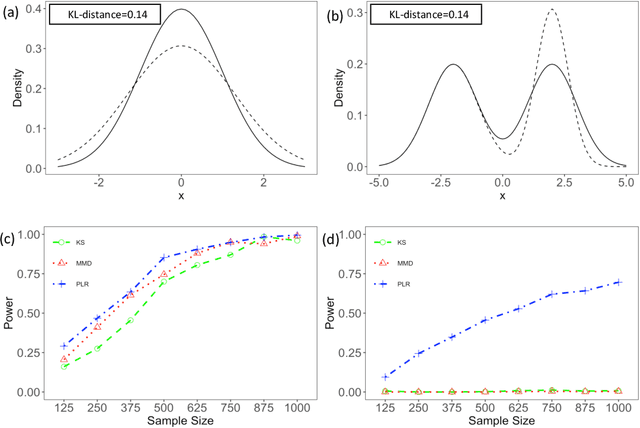
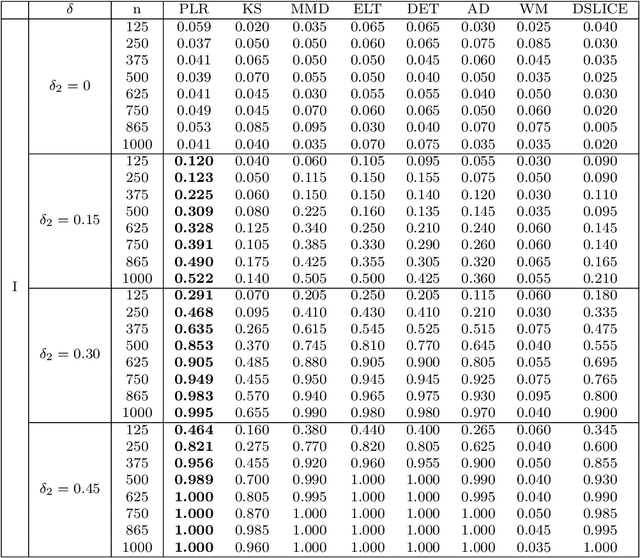
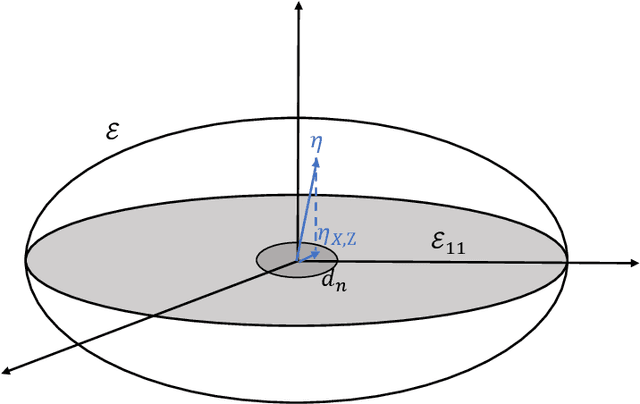
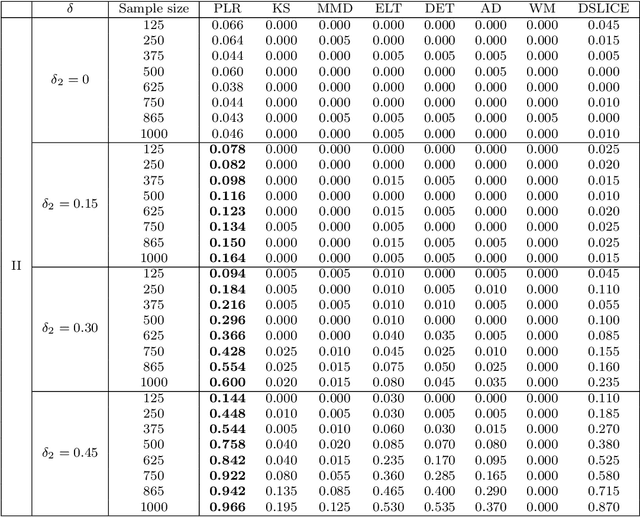
We consider the problem of comparing probability densities between two groups. To model the complex pattern of the underlying densities, we formulate the problem as a nonparametric density hypothesis testing problem. The major difficulty is that conventional tests may fail to distinguish the alternative from the null hypothesis under the controlled type I error. In this paper, we model log-transformed densities in a tensor product reproducing kernel Hilbert space (RKHS) and propose a probabilistic decomposition of this space. Under such a decomposition, we quantify the difference of the densities between two groups by the component norm in the probabilistic decomposition. Based on the Bernstein width, a sharp minimax lower bound of the distinguishable rate is established for the nonparametric two-sample test. We then propose a penalized likelihood ratio (PLR) test possessing the Wilks' phenomenon with an asymptotically Chi-square distributed test statistic and achieving the established minimax testing rate. Simulations and real applications demonstrate that the proposed test outperforms the conventional approaches under various scenarios.

Deep Spatio-Temporal Neural Networks for Click-Through Rate Prediction
Jul 19, 2019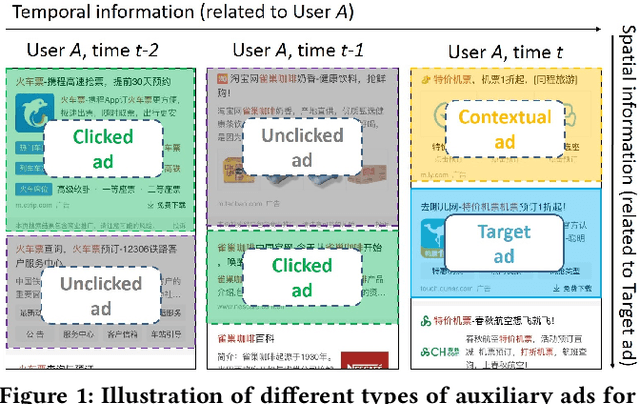

Click-through rate (CTR) prediction is a critical task in online advertising systems. A large body of research considers each ad independently, but ignores its relationship to other ads that may impact the CTR. In this paper, we investigate various types of auxiliary ads for improving the CTR prediction of the target ad. In particular, we explore auxiliary ads from two viewpoints: one is from the spatial domain, where we consider the contextual ads shown above the target ad on the same page; the other is from the temporal domain, where we consider historically clicked and unclicked ads of the user. The intuitions are that ads shown together may influence each other, clicked ads reflect a user's preferences, and unclicked ads may indicate what a user dislikes to certain extent. In order to effectively utilize these auxiliary data, we propose the Deep Spatio-Temporal neural Networks (DSTNs) for CTR prediction. Our model is able to learn the interactions between each type of auxiliary data and the target ad, to emphasize more important hidden information, and to fuse heterogeneous data in a unified framework. Offline experiments on one public dataset and two industrial datasets show that DSTNs outperform several state-of-the-art methods for CTR prediction. We have deployed the best-performing DSTN in Shenma Search, which is the second largest search engine in China. The A/B test results show that the online CTR is also significantly improved compared to our last serving model.