 Add to Chrome
 Add to Firefox
 Add to Edge
SAMBA: A Scatter-Guided Masked Bidirectional Mamba Foundation Model for SAR Target Recognition
Jun 30, 2026
Synthetic aperture radar automatic target recognition (SAR ATR) is critical for Earth observation and defense, but its practical deployment is constrained by scarce annotated training data. Self-supervised pre-training alleviates this label bottleneck, yet prevailing Transformer architectures incur prohibitive quadratic computational complexity, and conventional universal masking neglects the unique electromagnetic scattering properties intrinsic to SAR imagery. To address these limitations, we propose SAMBA (Scattering-Guided Bidirectional Mamba), an efficient self-supervised pre-training foundation model for SAR target interpretation. Our framework features three core innovations: (i) a linear-complexity Mamba encoder with a mid-sequence class token to mitigate computational bottlenecks; (ii) a three-level hierarchical Scattering-Guided Masked Autoencoder (SG-MAE) masking strategy guided by SAR physical priors, aligning the pretext task with SAR's intrinsic imaging mechanism; (iii) a lightweight SpatialMix feature interaction module to enhance cross-region feature fusion. We also design a two-stage cross-domain pre-training pipeline to optimize the overall pre-training process. Extensive evaluations demonstrate that SAMBA consistently delivers superior performance across all pre-training configurations, with substantially fewer parameters than both CNN and Transformer baselines. Compared with the default masking strategy in standard MAE, the proposed SG-MAE strategy further boosts the model's few-shot transfer capability. Benchmarking on seven downstream datasets covering classification and detection tasks shows SAMBA achieves state-of-the-art (SOTA) performance on most metrics, fully validating its robust generalizability across diverse SAR interpretation tasks. Source code and pre-trained weights are publicly available at https://github.com/mynswkk/SAMBA.

Underdetermined 2D-DOD and 2D-DOA Estimation for Bistatic Coprime EMVS-MIMO Radar: From the Difference Coarray Perspective
Jun 06, 2022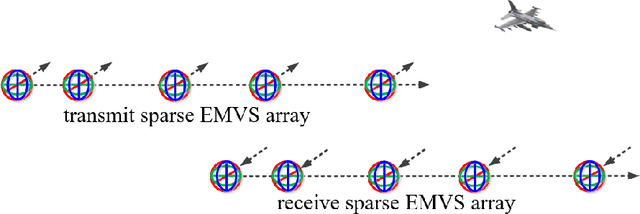
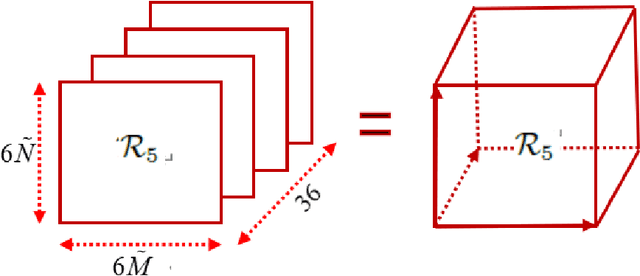
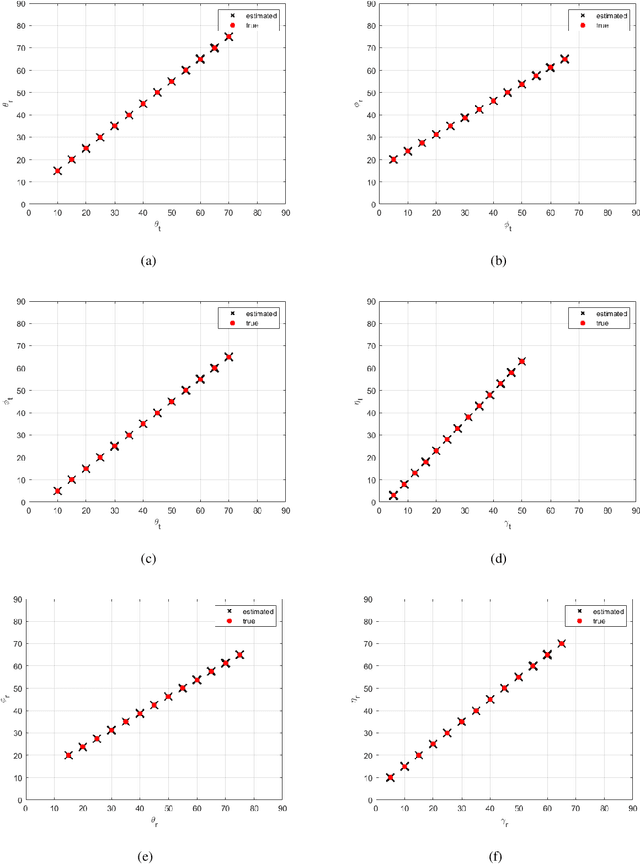
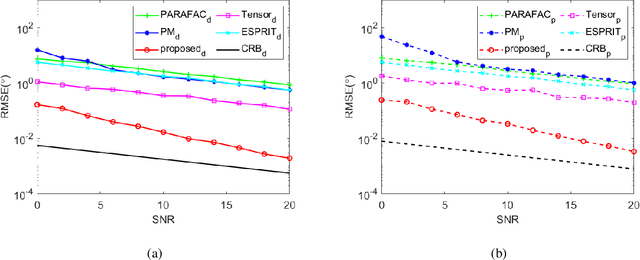
In this paper, the underdetermined 2D-DOD and 2D-DOA estimation for bistatic coprime EMVS-MIMO radar is considered. Firstly, a 5-D tensor model was constructed by using the multi-dimensional space-time characteristics of the received data. Then, an 8-D tensor has been obtained by using the auto-correlation calculation. To obtain the difference coarrays of transmit and receive EMVS, the de-coupling process between the spatial response of EMVS and the steering vector is inevitable. Thus, a new 6-D tensor can be constructed via the tensor permutation and the generalized tensorization of the canonical polyadic decomposition. {According} to the theory of the Tensor-Matrix Product operation, the duplicated elements in the difference coarrays can be removed by the utilization of two designed selection matrices. Due to the centrosymmetric geometry of the difference coarrays, two DFT beamspace matrices were subsequently designed to convert the complex steering matrices into the real-valued ones, whose advantage is to improve the estimation accuracy of the 2D-DODs and 2D-DOAs. Afterwards, a third-order tensor with the third-way fixed at 36 was constructed and the Parallel Factor algorithm was deployed, which can yield the closed-form automatically paired 2D-DOD and 2D-DOA estimation. The simulation results show that the proposed algorithm can exhibit superior estimation performance for the underdetermined 2D-DOD and 2D-DOA estimation.
8D Parameters Estimation for Bistatic EMVS-MIMO Radar via the nested PARAFAC
Jun 04, 2022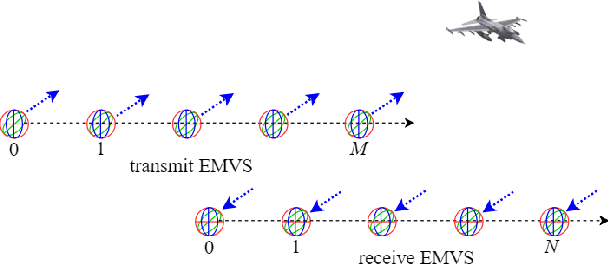
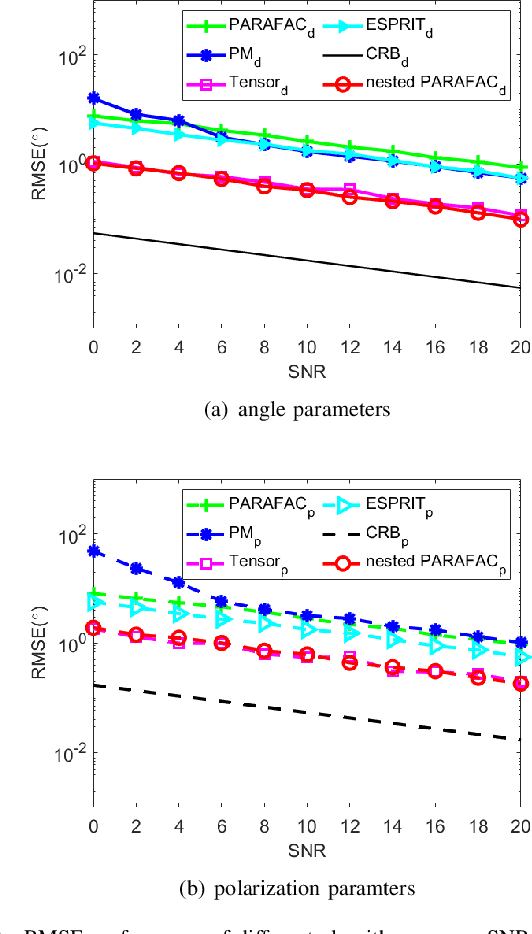
In this letter, a novel nested PARAFAC algorithm was proposed to improve the 8D parameters estimation performance for the bistatic EMVS-MIMO radar. Firstly, the outer part PARAFAC algorithm was carried out to estimate the receive spatial response matrix and its first way factor matrix. For the estimated first way factor matrix, a theory is given to rearrange its data into an new matrix, which is the mode-1 unfolding matrix of a three-way tensor. Then, the inner part PARAFAC algorithm was used to estimate the transmit steering vector matrix, the transmit spatial response matrix and the receive steering vector matrix. Thus, the transmit 4D parameters and receive 4D parameters can be accurately located via the abovementioned process. Compared with the original PARAFAC algorithm, the proposed nested PARAFAC algorithm can avoid additional reconstruction process when estimating the transmit/receive spatial response matrix. Moreover, the proposed algorithm can offer a highly-accurate 8D parameters estimaiton than that of the original PARAFAC algorithm. Simulated results verify the effectiveness of the proposed algorithm.