 Add to Chrome
 Add to Firefox
 Add to Edge
Variable Importance Identification Through Lazy Training for Binary Classification
Jul 25, 2026
Deep neural networks have been widely used in many applications (e.g., computer vision and natural language processing); however, understanding their explainability remains a challenging task. Recently, substantial research has been devoted to improving the explainability of deep neural networks, with most of this work focusing on the regression framework. In this paper, we instead focus on the binary classification framework and adopt a variable-importance framework combined with the idea of lazy training to propose an efficient algorithm for identifying important features. From a theoretical perspective, our method relies on only a minimal set of assumptions and achieves well-controlled error rates. The validity of the proposed method and algorithm is examined through extensive simulation studies and real-data applications.

Statistical Guarantees for Distributionally Robust Optimization with Optimal Transport and OT-Regularized Divergences
Mar 29, 2026We study finite-sample statistical performance guarantees for distributionally robust optimization (DRO) with optimal transport (OT) and OT-regularized divergence model neighborhoods. Specifically, we derive concentration inequalities for supervised learning via DRO-based adversarial training, as commonly employed to enhance the adversarial robustness of machine learning models. Our results apply to a wide range of OT cost functions, beyond the $p$-Wasserstein case studied by previous authors. In particular, our results are the first to: 1) cover soft-constraint norm-ball OT cost functions; soft-constraint costs have been shown empirically to enhance robustness when used in adversarial training, 2) apply to the combination of adversarial sample generation and adversarial reweighting that is induced by using OT-regularized $f$-divergence model neighborhoods; the added reweighting mechanism has also been shown empirically to further improve performance. In addition, even in the $p$-Wasserstein case, our bounds exhibit better behavior as a function of the DRO neighborhood size than previous results when applied to the adversarial setting.
A Sieve Quasi-likelihood Ratio Test for Neural Networks with Applications to Genetic Association Studies
Dec 16, 2022Neural networks (NN) play a central role in modern Artificial intelligence (AI) technology and has been successfully used in areas such as natural language processing and image recognition. While majority of NN applications focus on prediction and classification, there are increasing interests in studying statistical inference of neural networks. The study of NN statistical inference can enhance our understanding of NN statistical proprieties. Moreover, it can facilitate the NN-based hypothesis testing that can be applied to hypothesis-driven clinical and biomedical research. In this paper, we propose a sieve quasi-likelihood ratio test based on NN with one hidden layer for testing complex associations. The test statistic has asymptotic chi-squared distribution, and therefore it is computationally efficient and easy for implementation in real data analysis. The validity of the asymptotic distribution is investigated via simulations. Finally, we demonstrate the use of the proposed test by performing a genetic association analysis of the sequencing data from Alzheimer's Disease Neuroimaging Initiative (ADNI).
Consistency of Neural Networks with Regularization
Jun 22, 2022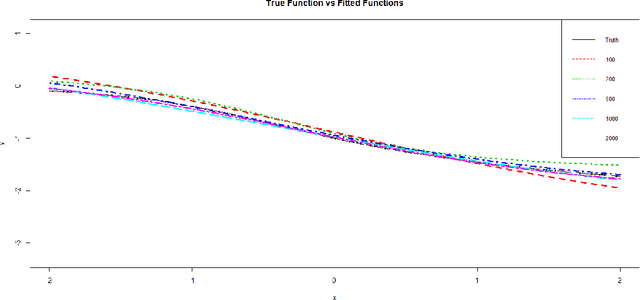
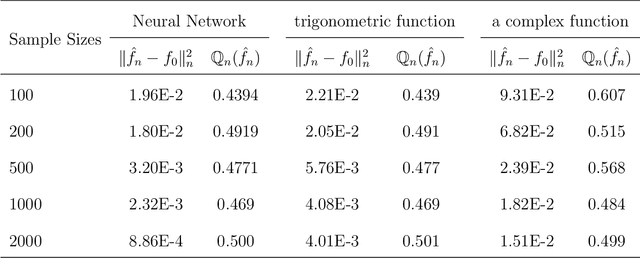
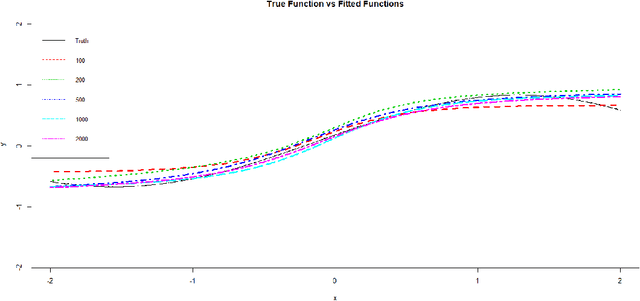
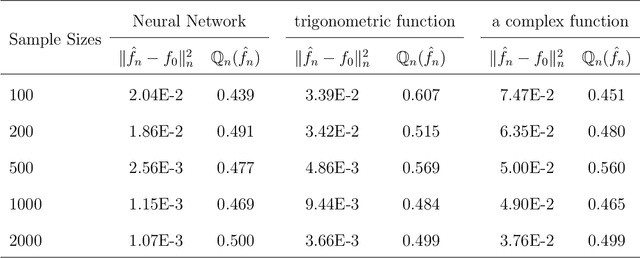
Neural networks have attracted a lot of attention due to its success in applications such as natural language processing and computer vision. For large scale data, due to the tremendous number of parameters in neural networks, overfitting is an issue in training neural networks. To avoid overfitting, one common approach is to penalize the parameters especially the weights in neural networks. Although neural networks has demonstrated its advantages in many applications, the theoretical foundation of penalized neural networks has not been well-established. Our goal of this paper is to propose the general framework of neural networks with regularization and prove its consistency. Under certain conditions, the estimated neural network will converge to true underlying function as the sample size increases. The method of sieves and the theory on minimal neural networks are used to overcome the issue of unidentifiability for the parameters. Two types of activation functions: hyperbolic tangent function(Tanh) and rectified linear unit(ReLU) have been taken into consideration. Simulations have been conducted to verify the validation of theorem of consistency.