 Add to Chrome
 Add to Firefox
 Add to Edge
VitaminP: cross-modal learning enables whole-cell segmentation from routine histology
Apr 26, 2026
Accurate whole-cell and nuclear segmentation is essential for precision pathology and spatial omics, yet routine hematoxylin and eosin (H&E) staining provides limited cytoplasmic contrast, restricting analyses to nuclei. Multiplex immunofluorescence (mIF) facilitates precise whole-cell delineation but remains constrained by cost and accessibility. We introduce VitaminP, a cross-modal learning framework enabling whole cell segmentation from H&E images. By learning from paired H&E-mIF data, VitaminP transfers molecular boundary information from mIF to overcome cytoplasmic contrast in H&E, establishing cross-modal supervision as a general strategy for recovering missing biological structure. We train VitaminP on 14 public datasets covering 34 cancer types and over 7 million instances, integrating publicly available labels with extensive annotations generated in this study, forming one of the largest resources for segmentation. VitaminP outperforms four state-of-the-art methods and generalizes to unseen datasets, including an in-house dataset spanning 24 rare cancer types. We further developed VitaminPScope, an open-source platform providing an interface for scalable inference and enabling broad adoption.

Prototype-driven fusion of pathology and spatial transcriptomics for interpretable survival prediction
Feb 12, 2026Whole slide images (WSIs) enable weakly supervised prognostic modeling via multiple instance learning (MIL). Spatial transcriptomics (ST) preserves in situ gene expression, providing a spatial molecular context that complements morphology. As paired WSI-ST cohorts scale to population level, leveraging their complementary spatial signals for prognosis becomes crucial; however, principled cross-modal fusion strategies remain limited for this paradigm. To this end, we introduce PathoSpatial, an interpretable end-to-end framework integrating co-registered WSIs and ST to learn spatially informed prognostic representations. PathoSpatial uses task-guided prototype learning within a multi-level experts architecture, adaptively orchestrating unsupervised within-modality discovery with supervised cross-modal aggregation. By design, PathoSpatial substantially strengthens interpretability while maintaining discriminative ability. We evaluate PathoSpatial on a triple-negative breast cancer cohort with paired ST and WSIs. PathoSpatial delivers strong and consistent performance across five survival endpoints, achieving superior or comparable performance to leading unimodal and multimodal methods. PathoSpatial inherently enables post-hoc prototype interpretation and molecular risk decomposition, providing quantitative, biologically grounded explanations, highlighting candidate prognostic factors. We present PathoSpatial as a proof-of-concept for scalable and interpretable multimodal learning for spatial omics-pathology fusion.
CellSymphony: Deciphering the molecular and phenotypic orchestration of cells with single-cell pathomics
Aug 13, 2025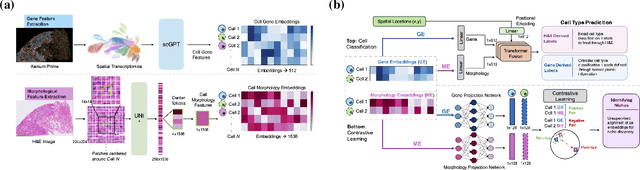
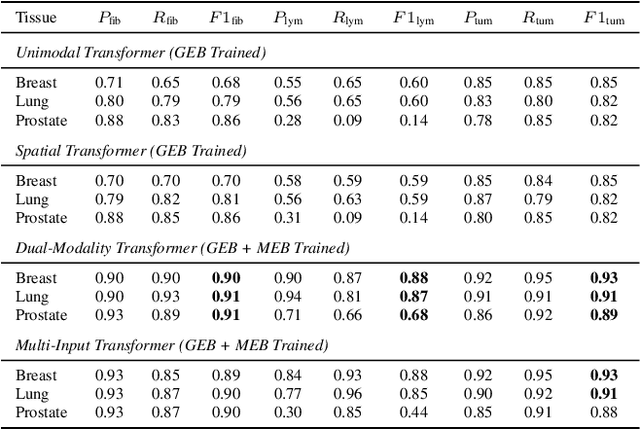
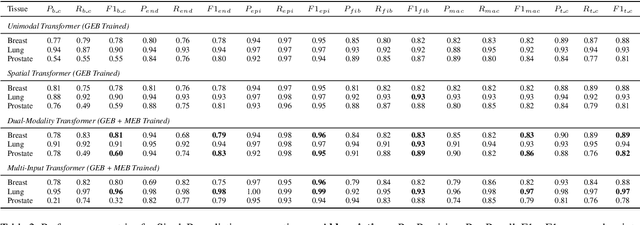
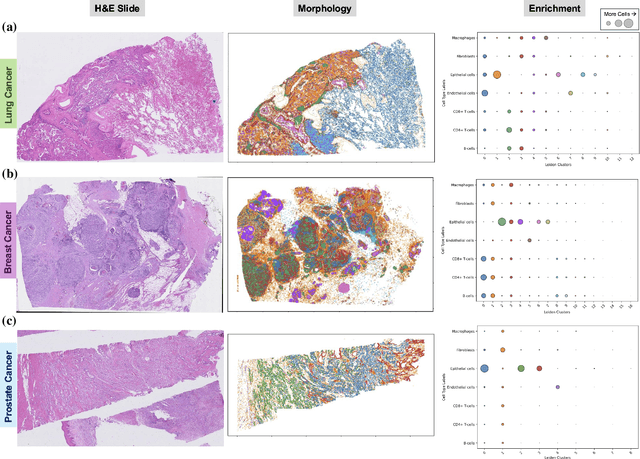
Xenium, a new spatial transcriptomics platform, enables subcellular-resolution profiling of complex tumor tissues. Despite the rich morphological information in histology images, extracting robust cell-level features and integrating them with spatial transcriptomics data remains a critical challenge. We introduce CellSymphony, a flexible multimodal framework that leverages foundation model-derived embeddings from both Xenium transcriptomic profiles and histology images at true single-cell resolution. By learning joint representations that fuse spatial gene expression with morphological context, CellSymphony achieves accurate cell type annotation and uncovers distinct microenvironmental niches across three cancer types. This work highlights the potential of foundation models and multimodal fusion for deciphering the physiological and phenotypic orchestration of cells within complex tissue ecosystems.