 Add to Chrome
 Add to Firefox
 Add to Edge
Efficient Vision-Language Reasoning via Adaptive Token Pruning
Dec 14, 2025


Real-world deployment of Vision-Language Models (VLMs) is hindered by high computational demands, as existing architectures inefficiently process all tokens uniformly. We introduce Adaptive Token Pruning (ATP), a dynamic inference mechanism that retains only the most informative tokens based on contextual relevance. ATP operates at the vision-language interface, assigning a hybrid importance score combining ViT CLS attention (intra-modal saliency) and CLIP text-image similarity (inter-modal relevance) to keep top-K tokens for the LLM. Unlike static compression, ATP adapts to each input without modifying the backbone. Proposed as a lightweight gating module, ATP is compatible with popular backbones like BLIP-2, LLaVA, and Flamingo. Preliminary evaluations across VQAv2, GQA, and COCO indicate that ATP reduces inference FLOPs by around 40% and achieves roughly 1.5x speedups in end-to-end latency with negligible accuracy loss (less than 1%). Qualitative analyses suggest ATP preserves visual grounding and enhances interpretability. Beyond efficiency, we investigate robustness under corruptions; observations suggest adaptive pruning suppresses spurious correlations, improving stability. These findings imply that resource-constrained inference and model reliability are not competing objectives. Finally, we discuss ATP's role in efficient multimodal edge computing pipelines.

MixLLM: LLM Quantization with Global Mixed-precision between Output-features and Highly-efficient System Design
Dec 19, 2024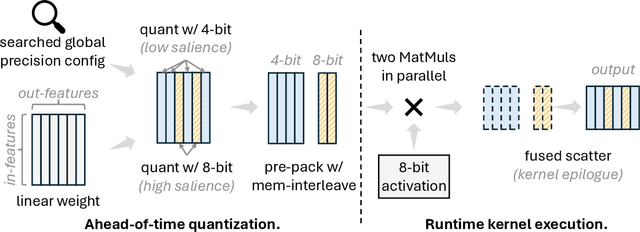
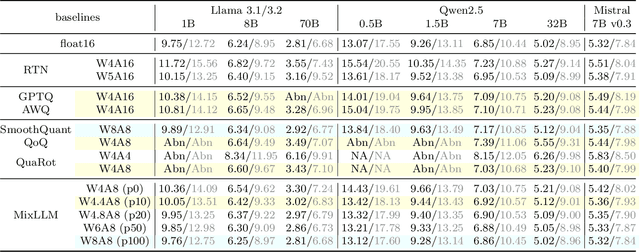


Quantization has become one of the most effective methodologies to compress LLMs into smaller size. However, the existing quantization solutions still show limitations of either non-negligible accuracy drop or system inefficiency. In this paper, we make a comprehensive analysis of the general quantization principles on their effect to the triangle of accuracy, memory consumption and system efficiency. We propose MixLLM that explores the new optimization space of mixed-precision quantization between output features based on the insight that different output features matter differently in the model. MixLLM identifies the output features with high salience in the global view rather than within each single layer, effectively assigning the larger bit-width to output features that need it most to achieve good accuracy with low memory consumption. We present the sweet spot of quantization configuration of algorithm-system co-design that leads to high accuracy and system efficiency. To address the system challenge, we design the two-step dequantization to make use of the int8 Tensor Core easily and fast data type conversion to reduce dequantization overhead significantly, and present the software pipeline to overlap the memory access, dequantization and the MatMul to the best. Extensive experiments show that with only 10% more bits, the PPL increasement can be reduced from about 0.5 in SOTA to within 0.2 for Llama 3.1 70B, while on average MMLU-Pro improves by 0.93 over the SOTA of three popular models. In addition to its superior accuracy, MixLLM also achieves state-of-the-art system efficiency.