 Add to Chrome
 Add to Firefox
 Add to Edge
A Joint Finite-Sample Certificate for Adaptive Selective Conformal Risk Control
Jun 07, 2026
Selective predictors answer on confident inputs and abstain elsewhere; deploying one safely needs a single finite-sample certificate that simultaneously upper-bounds the selected risk, lower-bounds the acceptance probability $\pacc$ above a floor $\pmin$, and lower-bounds the deployment utility. This certificate must be valid under adaptive threshold selection from a finite grid of $m$ pairs on $\ncert$ samples. We give such a certificate for bounded, possibly non-monotone losses by treating the selected risk directly as a ratio rather than through a Hoeffding-style range bound. The construction couples three confidence bounds: a variance-adaptive empirical-Bernstein bound on the ratio risk, a Clopper--Pearson bound on acceptance, and a two-sided closeness bound on utility. Together they lower-bound the certified policy's utility absolutely and to within $2\gammau$ of the best over the \emph{certified set}, both non-vacuous whenever feasible; a regime-scoped third leg matches an external oracle, informative only where the risk margin $\gammar < α$ and vacuous at the headline operating points. Relative to the range-only Hoeffding-ratio construction this sharpens the acceptance-floor dependence from $1/\pmin$ to $1/\sqrt{\pmin}$, and a closed-form corollary identifies a per-pair regime in which our risk bound dominates a Hoeffding conformal risk control (Hoeffding--CRC) selective bound. Empirically, on ImageNet (three ResNets) and COCO val 2017 panoptic, the certificate opens a $+22$ pp certified-acceptance frontier over Hoeffding--CRC and is ${\approx}10{\times}$ tighter than a non-vacuous matched-valid baseline; these gains are regime-scoped, not universal, and absent on ADE20K. The certifier runs in $O(\ncert m)$ time.

Energy Management of Multi-mode Plug-in Hybrid Electric Vehicle using Multi-agent Deep Reinforcement Learning
Mar 16, 2023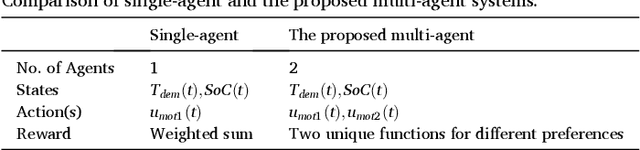
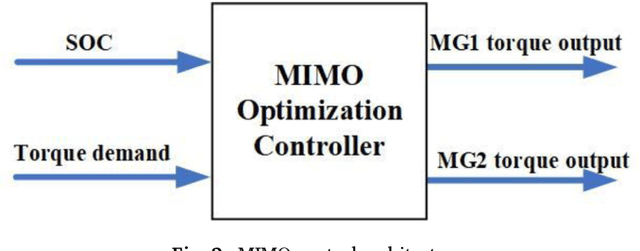


The recently emerging multi-mode plug-in hybrid electric vehicle (PHEV) technology is one of the pathways making contributions to decarbonization, and its energy management requires multiple-input and multiple-output (MIMO) control. At the present, the existing methods usually decouple the MIMO control into single-output (MISO) control and can only achieve its local optimal performance. To optimize the multi-mode vehicle globally, this paper studies a MIMO control method for energy management of the multi-mode PHEV based on multi-agent deep reinforcement learning (MADRL). By introducing a relevance ratio, a hand-shaking strategy is proposed to enable two learning agents to work collaboratively under the MADRL framework using the deep deterministic policy gradient (DDPG) algorithm. Unified settings for the DDPG agents are obtained through a sensitivity analysis of the influencing factors to the learning performance. The optimal working mode for the hand-shaking strategy is attained through a parametric study on the relevance ratio. The advantage of the proposed energy management method is demonstrated on a software-in-the-loop testing platform. The result of the study indiates that learning rate of the DDPG agents is the greatest factor in learning performance. Using the unified DDPG settings and a relevance ratio of 0.2, the proposed MADRL method can save up to 4% energy compared to the single-agent method.