 Add to Chrome
 Add to Firefox
 Add to Edge
When the Judge Changes, So Does the Measurement: Auditing LLM-as-Judge Reliability
Jul 09, 2026
An LLM-as-judge score can move even when the candidate responses stay fixed, simply because the evaluator has changed. We treat this evaluator-replacement ambiguity as a measurement-validity problem. Across four judgment datasets, we compare two upgrade paths available in practice: scaling Qwen3 dense judges from 1.7B to 32B parameters and moving across MiniMax M2-M2.7 released APIs. The main pattern is that judge upgrades are not interchangeable: only Qwen3 1.7B to 4B gives a robust adjacent gain, while MiniMax adjacent releases do not. Stronger judges reduce but do not remove position and verbosity bias. Repeated-sample juries add little when errors are correlated. Structured debate can move decisions substantially, but without parser and fallback logs those shifts cannot be attributed to deliberation. We argue that LLM-as-judge reports should include dataset slices, bias probes, error-dependence estimates, and protocol audit trails.

Degradation-Consistent Paired Training for Robust AI-Generated Image Detection
Apr 11, 2026AI-generated image detectors suffer significant performance degradation under real-world image corruptions such as JPEG compression, Gaussian blur, and resolution downsampling. We observe that state-of-the-art methods, including B-Free, treat degradation robustness as a byproduct of data augmentation rather than an explicit training objective. In this work, we propose Degradation-Consistent Paired Training (DCPT), a simple yet effective training strategy that explicitly enforces robustness through paired consistency constraints. For each training image, we construct a clean view and a degraded view, then impose two constraints: a feature consistency loss that minimizes the cosine distance between clean and degraded representations, and a prediction consistency loss based on symmetric KL divergence that aligns output distributions across views. DCPT adds zero additional parameters and zero inference overhead. Experiments on the Synthbuster benchmark (9 generators, 8 degradation conditions) demonstrate that DCPT improves the degraded-condition average accuracy by 9.1 percentage points compared to an identical baseline without paired training, while sacrificing only 0.9% clean accuracy. The improvement is most pronounced under JPEG compression (+15.7% to +17.9%). Ablation further reveals that adding architectural components leads to overfitting on limited training data, confirming that training objective improvement is more effective than architectural augmentation for degradation robustness.
Dual Long Short-Term Memory Networks for Sub-Character Representation Learning
Jan 04, 2018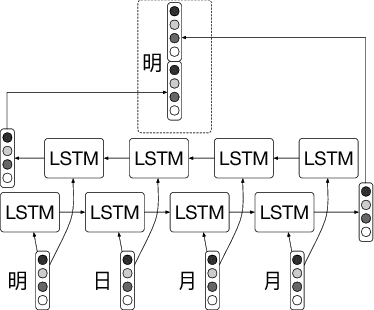
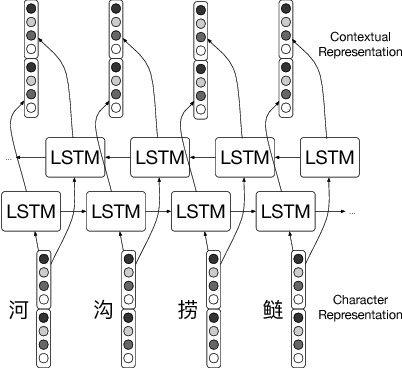
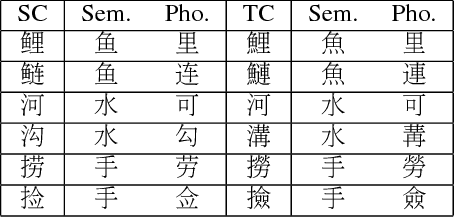
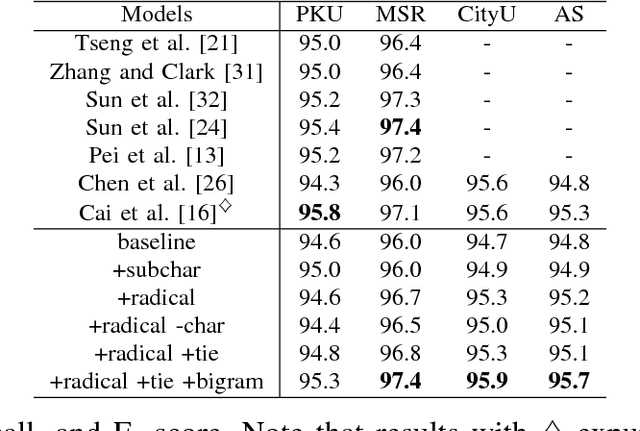
Characters have commonly been regarded as the minimal processing unit in Natural Language Processing (NLP). But many non-latin languages have hieroglyphic writing systems, involving a big alphabet with thousands or millions of characters. Each character is composed of even smaller parts, which are often ignored by the previous work. In this paper, we propose a novel architecture employing two stacked Long Short-Term Memory Networks (LSTMs) to learn sub-character level representation and capture deeper level of semantic meanings. To build a concrete study and substantiate the efficiency of our neural architecture, we take Chinese Word Segmentation as a research case example. Among those languages, Chinese is a typical case, for which every character contains several components called radicals. Our networks employ a shared radical level embedding to solve both Simplified and Traditional Chinese Word Segmentation, without extra Traditional to Simplified Chinese conversion, in such a highly end-to-end way the word segmentation can be significantly simplified compared to the previous work. Radical level embeddings can also capture deeper semantic meaning below character level and improve the system performance of learning. By tying radical and character embeddings together, the parameter count is reduced whereas semantic knowledge is shared and transferred between two levels, boosting the performance largely. On 3 out of 4 Bakeoff 2005 datasets, our method surpassed state-of-the-art results by up to 0.4%. Our results are reproducible, source codes and corpora are available on GitHub.