 Add to Chrome
 Add to Firefox
 Add to Edge
TFGformer: Multivariate Time Series Forecasting via Time-Frequency Graph Learning and Covariate Fusion
Jul 31, 2026
Large-scale multivariate time series from heterogeneous IoT sensors demand accurate long-term forecasting for resource scheduling and predictive maintenance. While recent time series foundation models exhibit strong generalization, they rely on static parametric knowledge and lack dynamic access to external historical patterns during inference. Retrieval-Augmented Generation (RAG) offers a potential remedy, yet its application to time series forecasting is challenged by magnitude variations across heterogeneous sources and the mismatch between historical similarity and future consistency. We propose CrossRAG, a retrieval-augmented forecasting framework that integrates Shape-Aware Memory (SAM) with RevIN normalization for magnitude-robust shape-level retrieval, Future-Consistent Contrastive (FCC) learning to distinguish informative references from hard negatives with similar history but divergent futures, and Cross-Attention Temporal Fusion (CATF) to fuse retrieved historical--future reference pairs into the backbone's representations at the representation level. Experiments on seven public benchmarks show that CrossRAG consistently outperforms both parametric-only baselines and existing retrieval-augmented forecasting methods.

VAN-AD: Visual Masked Autoencoder with Normalizing Flow For Time Series Anomaly Detection
Mar 27, 2026Time series anomaly detection (TSAD) is essential for maintaining the reliability and security of IoT-enabled service systems. Existing methods require training one specific model for each dataset, which exhibits limited generalization capability across different target datasets, hindering anomaly detection performance in various scenarios with scarce training data. To address this limitation, foundation models have emerged as a promising direction. However, existing approaches either repurpose large language models (LLMs) or construct largescale time series datasets to develop general anomaly detection foundation models, and still face challenges caused by severe cross-modal gaps or in-domain heterogeneity. In this paper, we investigate the applicability of large-scale vision models to TSAD. Specifically, we adapt a visual Masked Autoencoder (MAE) pretrained on ImageNet to the TSAD task. However, directly transferring MAE to TSAD introduces two key challenges: overgeneralization and limited local perception. To address these challenges, we propose VAN-AD, a novel MAE-based framework for TSAD. To alleviate the over-generalization issue, we design an Adaptive Distribution Mapping Module (ADMM), which maps the reconstruction results before and after MAE into a unified statistical space to amplify discrepancies caused by abnormal patterns. To overcome the limitation of local perception, we further develop a Normalizing Flow Module (NFM), which combines MAE with normalizing flow to estimate the probability density of the current window under the global distribution. Extensive experiments on nine real-world datasets demonstrate that VAN-AD consistently outperforms existing state-of-the-art methods across multiple evaluation metrics.We make our code and datasets available at https://github.com/PenyChen/VAN-AD.
Time Tracker: Mixture-of-Experts-Enhanced Foundation Time Series Forecasting Model with Decoupled Training Pipelines
May 21, 2025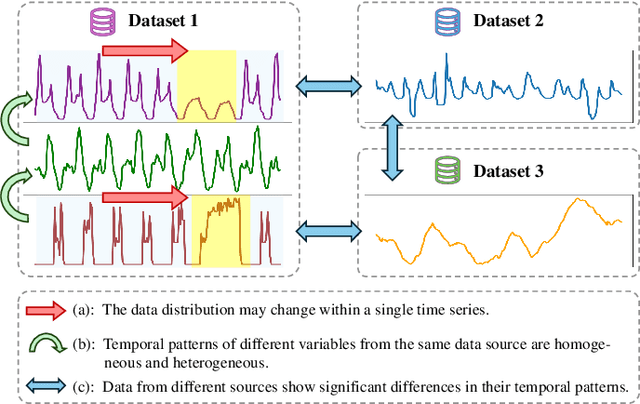
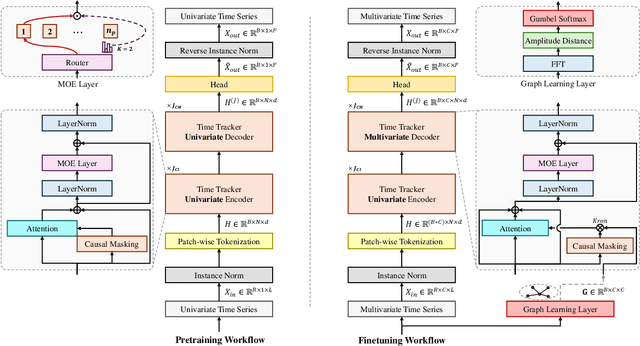
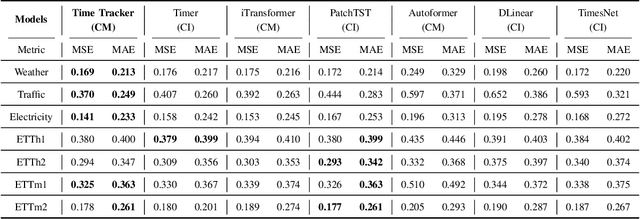
In the past few years, time series foundation models have achieved superior predicting accuracy. However, real-world time series often exhibit significant diversity in their temporal patterns across different time spans and domains, making it challenging for a single model architecture to fit all complex scenarios. In addition, time series data may have multiple variables exhibiting complex correlations between each other. Recent mainstream works have focused on modeling times series in a channel-independent manner in both pretraining and finetuning stages, overlooking the valuable inter-series dependencies. To this end, we propose \textbf{Time Tracker} for better predictions on multivariate time series data. Firstly, we leverage sparse mixture of experts (MoE) within Transformers to handle the modeling of diverse time series patterns, thereby alleviating the learning difficulties of a single model while improving its generalization. Besides, we propose Any-variate Attention, enabling a unified model structure to seamlessly handle both univariate and multivariate time series, thereby supporting channel-independent modeling during pretraining and channel-mixed modeling for finetuning. Furthermore, we design a graph learning module that constructs relations among sequences from frequency-domain features, providing more precise guidance to capture inter-series dependencies in channel-mixed modeling. Based on these advancements, Time Tracker achieves state-of-the-art performance in predicting accuracy, model generalization and adaptability.