 Add to Chrome
 Add to Firefox
 Add to Edge
MUFFLe: Efficient Model Update Compression via Generalized Deduplication for Federated Learning
Jun 12, 2026
Federated learning is well suited to edge environments but is often limited by the uplink cost of transmitting model updates. This Work-in-Progress paper presents MUFFLe, a communication-efficient update compression scheme that integrates generalized deduplication (GD) into the FedAvg pipeline. MUFFLe deduplicates repeated patterns across the update vector, yielding a fixed-rate, variable-count compression scheme. Preliminary experiments on IID MNIST with 20 clients show that MUFFLe reaches the target accuracy of $92.93\%$ with 38~MB cumulative uplink communication, compared with 75~MB for 8-bit quantization, 86~MB for Top-$k$ sparsification, and 310~MB for uncompressed FedAvg. These results demonstrate the feasibility of applying GD to communication-efficient federated learning.

Data-driven Piecewise Affine Decision Rules for Stochastic Programming with Covariate Information
Apr 26, 2023
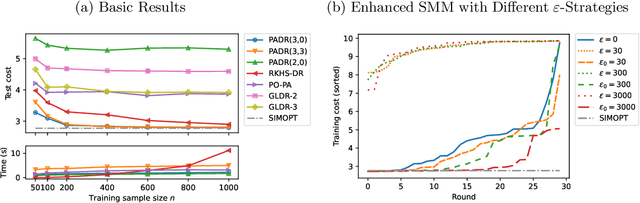

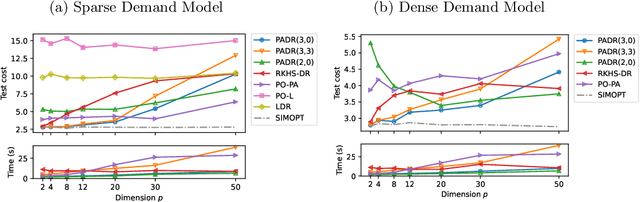
Focusing on stochastic programming (SP) with covariate information, this paper proposes an empirical risk minimization (ERM) method embedded within a nonconvex piecewise affine decision rule (PADR), which aims to learn the direct mapping from features to optimal decisions. We establish the nonasymptotic consistency result of our PADR-based ERM model for unconstrained problems and asymptotic consistency result for constrained ones. To solve the nonconvex and nondifferentiable ERM problem, we develop an enhanced stochastic majorization-minimization algorithm and establish the asymptotic convergence to (composite strong) directional stationarity along with complexity analysis. We show that the proposed PADR-based ERM method applies to a broad class of nonconvex SP problems with theoretical consistency guarantees and computational tractability. Our numerical study demonstrates the superior performance of PADR-based ERM methods compared to state-of-the-art approaches under various settings, with significantly lower costs, less computation time, and robustness to feature dimensions and nonlinearity of the underlying dependency.