 Add to Chrome
 Add to Firefox
 Add to Edge
Urban-ImageNet: A Large-Scale Multi-Modal Dataset and Evaluation Framework for Urban Space Perception
May 11, 2026
We present Urban-ImageNet, a large-scale multi-modal dataset and evaluation benchmark for urban space perception from user-generated social media imagery. The corpus contains over 2 Million public social media images and paired textual posts collected from Weibo across 61 urban sites in 24 Chinese cities across 2019-2025, with controlled benchmark subsets at 1K, 10K, and 100K scale and a full 2M corpus for large-scale training and evaluation. Urban-ImageNet is organized by HUSIC, a Hierarchical Urban Space Image Classification framework that defines a 10-class taxonomy grounded in urban theory. The taxonomy is designed to distinguish activated and non-activated public spaces, exterior and interior urban environments, accommodation spaces, consumption content, portraits, and non-spatial social-media content. Rather than treating urban imagery as generic scene data, Urban-ImageNet evaluates whether machine perception models can capture spatial, social, and functional distinctions that are central to urban studies. The benchmark supports three tasks within one standardized library: (T1) urban scene semantic classification, (T2) cross-modal image-text retrieval, and (T3) instance segmentation. Our experiments evaluate representative vision, vision-language, and segmentation models, revealing strong performance on supervised scene classification but more challenging behavior in cross-modal retrieval and instance-level urban object segmentation. A multi-scale study further examines how model performance changes as balanced training data increases from 1K, 10K to 100K images. Urban-ImageNet provides a unified, theory-grounded, multi-city benchmark for evaluating how AI systems perceive and interpret contemporary urban spaces across modalities, scales, and task formulations. Dataset and benchmark are available at: huggingface.co/datasets/Yiwei-Ou/Urban-ImageNet and github.com/yiasun/dataset-2.

AnchorGK: Anchor-based Incremental and Stratified Graph Learning Framework for Inductive Spatio-Temporal Kriging
Dec 25, 2025Spatio-temporal kriging is a fundamental problem in sensor networks, driven by the sparsity of deployed sensors and the resulting missing observations. Although recent approaches model spatial and temporal correlations, they often under-exploit two practical characteristics of real deployments: the sparse spatial distribution of locations and the heterogeneous availability of auxiliary features across locations. To address these challenges, we propose AnchorGK, an Anchor-based Incremental and Stratified Graph Learning framework for inductive spatio-temporal kriging. AnchorGK introduces anchor locations to stratify the data in a principled manner. Anchors are constructed according to feature availability, and strata are then formed around these anchors. This stratification serves two complementary roles. First, it explicitly represents and continuously updates correlations between unobserved regions and surrounding observed locations within a graph learning framework. Second, it enables the systematic use of all available features across strata via an incremental representation mechanism, mitigating feature incompleteness without discarding informative signals. Building on the stratified structure, we design a dual-view graph learning layer that jointly aggregates feature-relevant and location-relevant information, learning stratum-specific representations that support accurate inference under inductive settings. Extensive experiments on multiple benchmark datasets demonstrate that AnchorGK consistently outperforms state-of-the-art baselines for spatio-temporal kriging.
MMS-VPR: Multimodal Street-Level Visual Place Recognition Dataset and Benchmark
May 18, 2025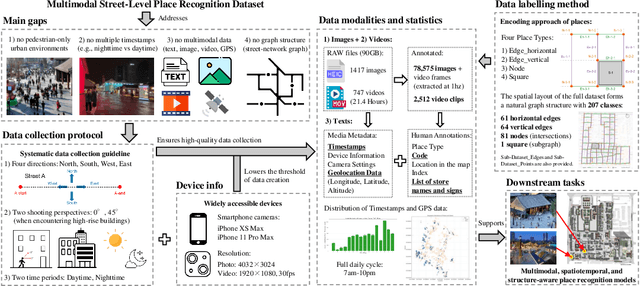
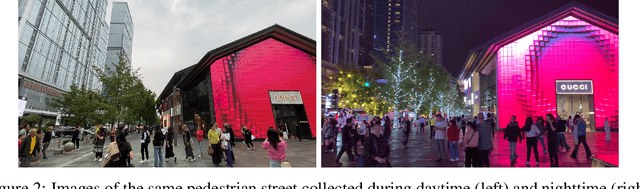

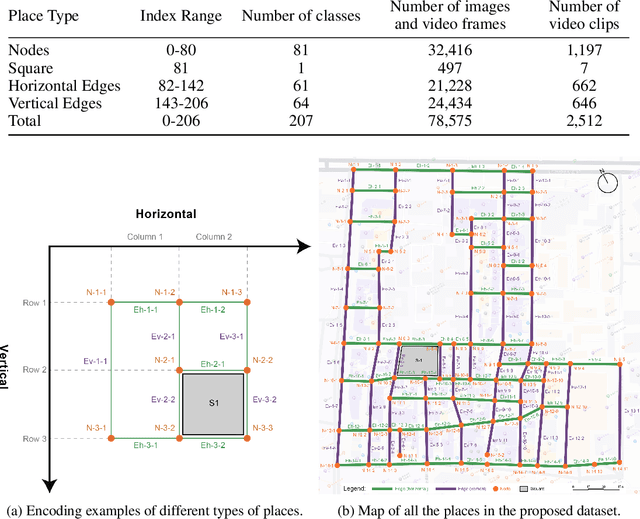
Existing visual place recognition (VPR) datasets predominantly rely on vehicle-mounted imagery, lack multimodal diversity and underrepresent dense, mixed-use street-level spaces, especially in non-Western urban contexts. To address these gaps, we introduce MMS-VPR, a large-scale multimodal dataset for street-level place recognition in complex, pedestrian-only environments. The dataset comprises 78,575 annotated images and 2,512 video clips captured across 207 locations in a ~70,800 $\mathrm{m}^2$ open-air commercial district in Chengdu, China. Each image is labeled with precise GPS coordinates, timestamp, and textual metadata, and covers varied lighting conditions, viewpoints, and timeframes. MMS-VPR follows a systematic and replicable data collection protocol with minimal device requirements, lowering the barrier for scalable dataset creation. Importantly, the dataset forms an inherent spatial graph with 125 edges, 81 nodes, and 1 subgraph, enabling structure-aware place recognition. We further define two application-specific subsets -- Dataset_Edges and Dataset_Points -- to support fine-grained and graph-based evaluation tasks. Extensive benchmarks using conventional VPR models, graph neural networks, and multimodal baselines show substantial improvements when leveraging multimodal and structural cues. MMS-VPR facilitates future research at the intersection of computer vision, geospatial understanding, and multimodal reasoning. The dataset is publicly available at https://huggingface.co/datasets/Yiwei-Ou/MMS-VPR.