 Add to Chrome
 Add to Firefox
 Add to Edge
CD-DPE: Dual-Prompt Expert Network based on Convolutional Dictionary Feature Decoupling for Multi-Contrast MRI Super-Resolution
Nov 18, 2025
Multi-contrast magnetic resonance imaging (MRI) super-resolution intends to reconstruct high-resolution (HR) images from low-resolution (LR) scans by leveraging structural information present in HR reference images acquired with different contrasts. This technique enhances anatomical detail and soft tissue differentiation, which is vital for early diagnosis and clinical decision-making. However, inherent contrasts disparities between modalities pose fundamental challenges in effectively utilizing reference image textures to guide target image reconstruction, often resulting in suboptimal feature integration. To address this issue, we propose a dual-prompt expert network based on a convolutional dictionary feature decoupling (CD-DPE) strategy for multi-contrast MRI super-resolution. Specifically, we introduce an iterative convolutional dictionary feature decoupling module (CD-FDM) to separate features into cross-contrast and intra-contrast components, thereby reducing redundancy and interference. To fully integrate these features, a novel dual-prompt feature fusion expert module (DP-FFEM) is proposed. This module uses a frequency prompt to guide the selection of relevant reference features for incorporation into the target image, while an adaptive routing prompt determines the optimal method for fusing reference and target features to enhance reconstruction quality. Extensive experiments on public multi-contrast MRI datasets demonstrate that CD-DPE outperforms state-of-the-art methods in reconstructing fine details. Additionally, experiments on unseen datasets demonstrated that CD-DPE exhibits strong generalization capabilities.

AdaFuse: Adaptive Medical Image Fusion Based on Spatial-Frequential Cross Attention
Oct 24, 2023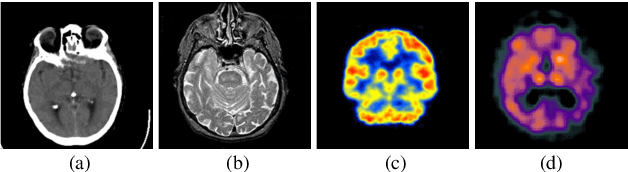
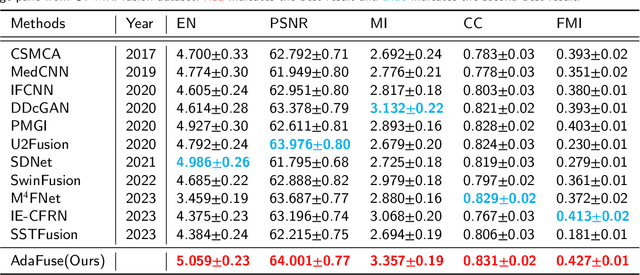

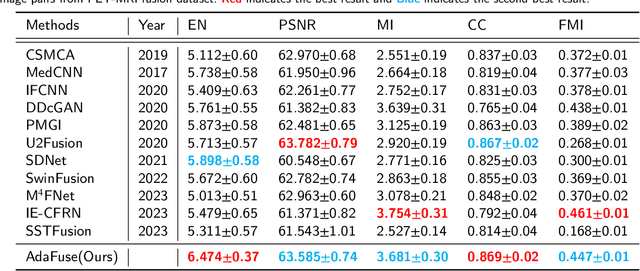
Multi-modal medical image fusion is essential for the precise clinical diagnosis and surgical navigation since it can merge the complementary information in multi-modalities into a single image. The quality of the fused image depends on the extracted single modality features as well as the fusion rules for multi-modal information. Existing deep learning-based fusion methods can fully exploit the semantic features of each modality, they cannot distinguish the effective low and high frequency information of each modality and fuse them adaptively. To address this issue, we propose AdaFuse, in which multimodal image information is fused adaptively through frequency-guided attention mechanism based on Fourier transform. Specifically, we propose the cross-attention fusion (CAF) block, which adaptively fuses features of two modalities in the spatial and frequency domains by exchanging key and query values, and then calculates the cross-attention scores between the spatial and frequency features to further guide the spatial-frequential information fusion. The CAF block enhances the high-frequency features of the different modalities so that the details in the fused images can be retained. Moreover, we design a novel loss function composed of structure loss and content loss to preserve both low and high frequency information. Extensive comparison experiments on several datasets demonstrate that the proposed method outperforms state-of-the-art methods in terms of both visual quality and quantitative metrics. The ablation experiments also validate the effectiveness of the proposed loss and fusion strategy.