 Add to Chrome
 Add to Firefox
 Add to Edge
FedCova: Robust Federated Covariance Learning Against Noisy Labels
Mar 04, 2026
Noisy labels in distributed datasets induce severe local overfitting and consequently compromise the global model in federated learning (FL). Most existing solutions rely on selecting clean devices or aligning with public clean datasets, rather than endowing the model itself with robustness. In this paper, we propose FedCova, a dependency-free federated covariance learning framework that eliminates such external reliances by enhancing the model's intrinsic robustness via a new perspective on feature covariances. Specifically, FedCova encodes data into a discriminative but resilient feature space to tolerate label noise. Built on mutual information maximization, we design a novel objective for federated lossy feature encoding that relies solely on class feature covariances with an error tolerance term. Leveraging feature subspaces characterized by covariances, we construct a subspace-augmented federated classifier. FedCova unifies three key processes through the covariance: (1) training the network for feature encoding, (2) constructing a classifier directly from the learned features, and (3) correcting noisy labels based on feature subspaces. We implement FedCova across both symmetric and asymmetric noisy settings under heterogeneous data distribution. Experimental results on CIFAR-10/100 and real-world noisy dataset Clothing1M demonstrate the superior robustness of FedCova compared with the state-of-the-art methods.

UAV-Assisted Hierarchical Aggregation for Over-the-Air Federated Learning
Sep 23, 2022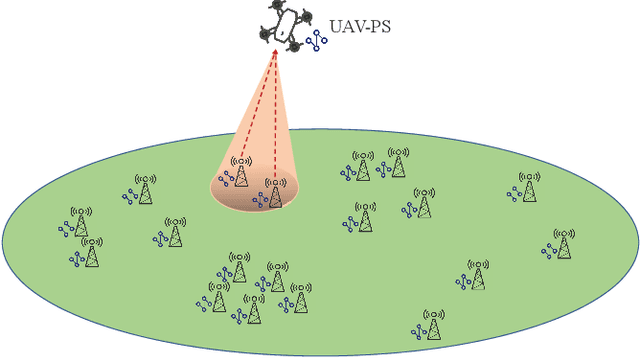
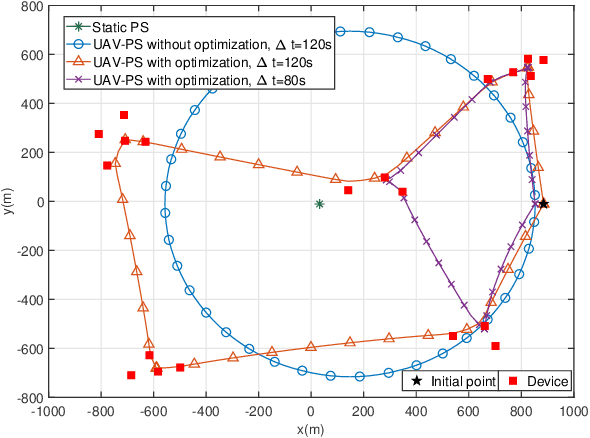
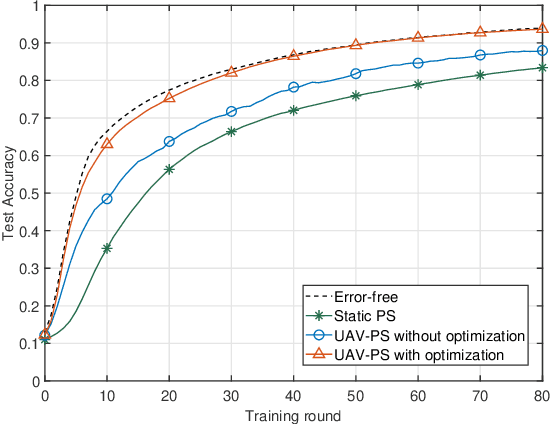
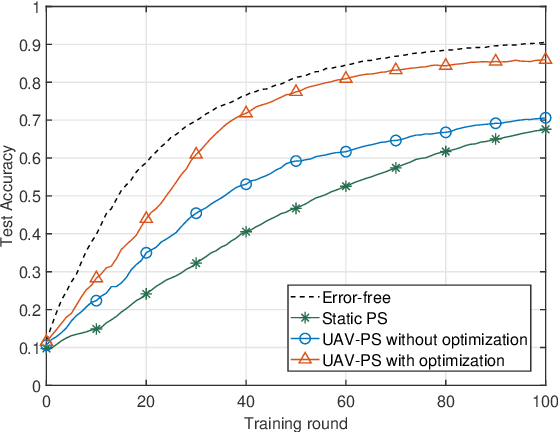
With huge amounts of data explosively increasing in the mobile edge, over-the-air federated learning (OA-FL) emerges as a promising technique to reduce communication costs and privacy leak risks. However, when devices in a relatively large area cooperatively train a machine learning model, the attendant straggler issues will significantly reduce the learning performance. In this paper, we propose an unmanned aerial vehicle (UAV) assisted OA-FL system, where the UAV acts as a parameter server (PS) to aggregate the local gradients hierarchically for global model updating. Under this UAV-assisted hierarchical aggregation scheme, we carry out a gradient-correlation-aware FL performance analysis. We then formulate a mean squared error (MSE) minimization problem to tune the UAV trajectory and the global aggregation coefficients based on the analysis results. An algorithm based on alternating optimization (AO) and successive convex approximation (SCA) is developed to solve the formulated problem. Simulation results demonstrate the great potential of our UAV-assisted hierarchical aggregation scheme.