 Add to Chrome
 Add to Firefox
 Add to Edge
Systematic Scaling Analysis of Jailbreak Attacks in Large Language Models
Mar 11, 2026
Large language models remain vulnerable to jailbreak attacks, yet we still lack a systematic understanding of how jailbreak success scales with attacker effort across methods, model families, and harm types. We initiate a scaling-law framework for jailbreaks by treating each attack as a compute-bounded optimization procedure and measuring progress on a shared FLOPs axis. Our systematic evaluation spans four representative jailbreak paradigms, covering optimization-based attacks, self-refinement prompting, sampling-based selection, and genetic optimization, across multiple model families and scales on a diverse set of harmful goals. We investigate scaling laws that relate attacker budget to attack success score by fitting a simple saturating exponential function to FLOPs--success trajectories, and we derive comparable efficiency summaries from the fitted curves. Empirically, prompting-based paradigms tend to be the most compute-efficient compared to optimization-based methods. To explain this gap, we cast prompt-based updates into an optimization view and show via a same-state comparison that prompt-based attacks more effectively optimize in prompt space. We also show that attacks occupy distinct success--stealthiness operating points with prompting-based methods occupying the high-success, high-stealth region. Finally, we find that vulnerability is strongly goal-dependent: harms involving misinformation are typically easier to elicit than other non-misinformation harms.

Aligning Compound AI Systems via System-level DPO
Feb 24, 2025
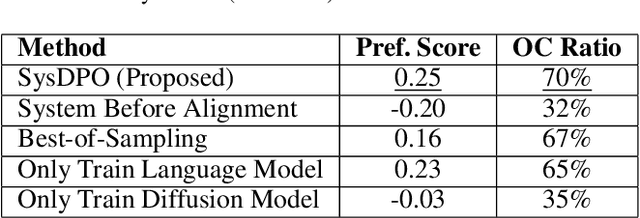
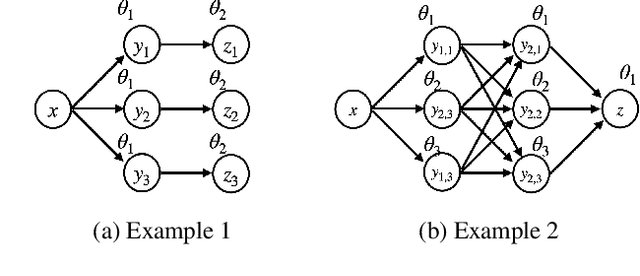

Compound AI systems, comprising multiple interacting components such as LLM agents and external tools, demonstrate state-of-the-art results across diverse tasks. It is hence crucial to align components within the system to produce consistent results that match human expectations. However, conventional alignment methods, such as Direct Preference Optimization (DPO), are not directly applicable to compound AI systems. These challenges include the non-differentiable interactions between components, making end-to-end gradient optimization infeasible. Additionally, system-level preferences cannot be directly translated into component-level preferences, further complicating alignment. We address the issues by formulating compound AI systems as Directed Acyclic Graphs (DAGs), capturing the connections between agents and the data generation processes. We propose a system-level DPO (SysDPO) to jointly align compound systems by adapting the DPO to operate on these DAGs. We study the joint alignment of an LLM and a diffusion model to demonstrate the effectiveness of our approach. Our exploration provides insights into the alignment of compound AI systems and lays a foundation for future advancements.