 Add to Chrome
 Add to Firefox
 Add to Edge
Teleopit: A Full-Embodiment Humanoid Teleoperation System
Aug 03, 2026
Humanoid teleoperation for demonstration collection requires coordinated whole-body motion, continuous dexterous hand control, and viewpoint control. Existing systems either simplify hand commands or depend on dedicated wearable sensors for fine-grained hand motion. We introduce Teleopit, a full-embodiment teleoperation system that maps body, hand, and head signals from VR to a humanoid body, configurable dexterous hands, and a 2-DoF active vision module. A history encoder and failure-aware rewind sampling improve the motion tracker on both motion-capture and live VR references. An optimization-based hand retargeter combines normalized finger directions, fingertip closure, and thumb-frame alignment to map human hand motion to different dexterous hands without tuning hand-specific objective or solver hyperparameters. Component experiments evaluate tracking success rate and retargeting behavior, while real-robot teleoperation demonstrates coordinated locomotion, manipulation, and viewpoint control. ACT and GR00T N1.7 policies trained on 96 successful demonstrations collected with Teleopit achieve task success rates of 90.0% and 95.0%, respectively, when deployed on the humanoid. The project page is available at https://botrunner64.github.io/teleopit-page.

GIFT: Geometry-Invariant Fine-Tuning for Non-Lambertian Monocular Depth Estimation
Aug 03, 2026Monocular depth foundation models, benefiting from large-scale synthetic training data, have demonstrated strong generalization. However, they often hallucinate depth on non-Lambertian surfaces, estimating reflected content in mirrors or transmitted content behind glass rather than the physical surface itself. Adapting these models with real-world data is challenging because conventional depth sensors are also unreliable in such regions. We observe that while the appearance of a non-Lambertian surface varies with its reflected or transmitted environment, its underlying geometry remains unchanged. Based on this observation, we propose GIFT (Geometry-Invariant Fine-Tuning), a parameter-efficient post-training framework that requires no measured depth labels. We collect groups of RGB images under controlled appearance changes while keeping the camera and target geometry fixed. GIFT exploits geometric invariance across these observations to suppress non-Lambertian depth hallucinations while retaining general depth estimation capability. We further construct a controlled benchmark that evaluates non-Lambertian depth recovery, robustness to appearance changes, and performance retention in other regions. Experiments on our benchmark and an independent real-world dataset demonstrate that GIFT improves depth prediction for mirrors and transparent objects while largely preserving the base model's performance, providing a practical and low-cost approach for adapting monocular depth foundation models to non-Lambertian scenes.
TDCNet: Transparent Objects Depth Completion with CNN-Transformer Dual-Branch Parallel Network
Dec 19, 2024
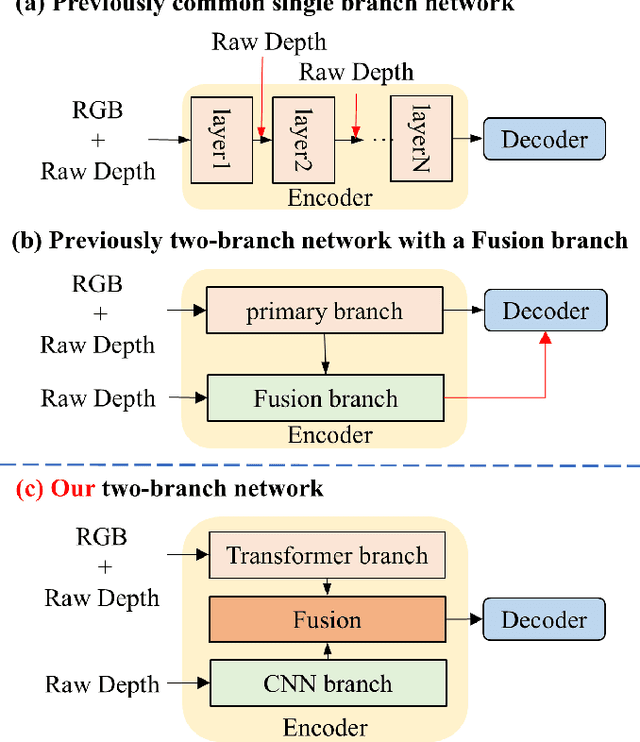

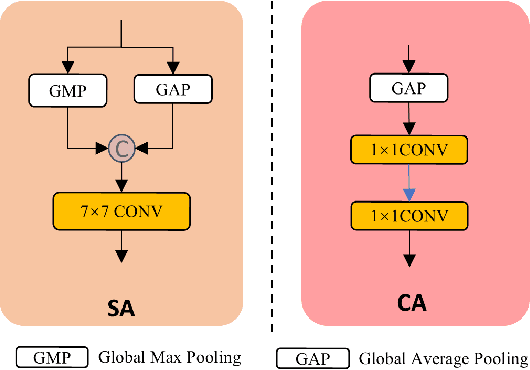
The sensing and manipulation of transparent objects present a critical challenge in industrial and laboratory robotics. Conventional sensors face challenges in obtaining the full depth of transparent objects due to the refraction and reflection of light on their surfaces and their lack of visible texture. Previous research has attempted to obtain complete depth maps of transparent objects from RGB and damaged depth maps (collected by depth sensor) using deep learning models. However, existing methods fail to fully utilize the original depth map, resulting in limited accuracy for deep completion. To solve this problem, we propose TDCNet, a novel dual-branch CNN-Transformer parallel network for transparent object depth completion. The proposed framework consists of two different branches: one extracts features from partial depth maps, while the other processes RGB-D images. Experimental results demonstrate that our model achieves state-of-the-art performance across multiple public datasets. Our code and the pre-trained model are publicly available at https://github.com/XianghuiFan/TDCNet.