 Add to Chrome
 Add to Firefox
 Add to Edge
From Knowledge to Inference: Scaling Laws of Specialized Reasoning on GlobalHealthAtlas
Jan 31, 2026
Public health reasoning requires population level inference grounded in scientific evidence, expert consensus, and safety constraints. However, it remains underexplored as a structured machine learning problem with limited supervised signals and benchmarks. We introduce \textbf{GlobalHealthAtlas}, a large scale multilingual dataset of 280,210 instances spanning 15 public health domains and 17 languages, stratified into three difficulty levels from health literacy to epidemiological and policy reasoning. Instances are derived from openly available public health sources and labeled by language, domain, and difficulty to support supervised learning and slice based evaluation. We further propose large language model (LLM) assisted construction and quality control pipeline with retrieval, duplication, evidence grounding checks, and label validation to improve consistency at scale. Finally, we present a domain aligned evaluator distilled from high confidence judgments of diverse LLMs to assess outputs along six dimensions: Accuracy, Reasoning, Completeness, Consensus Alignment, Terminology Norms, and Insightfulness. Together, these contributions enable reproducible training and evaluation of LLMs for safety critical public health reasoning beyond conventional QA benchmarks.

LRSAA: Large-scale Remote Sensing Image Target Recognition and Automatic Annotation
Nov 26, 2024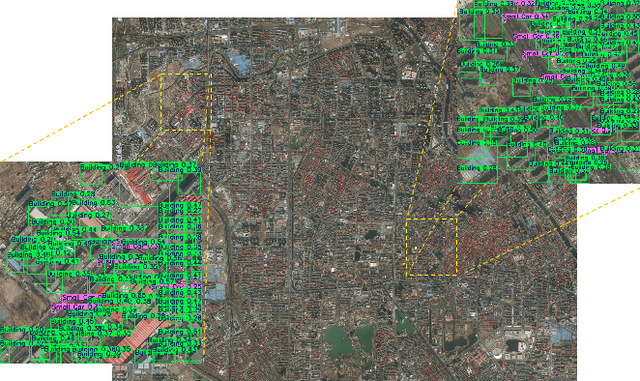
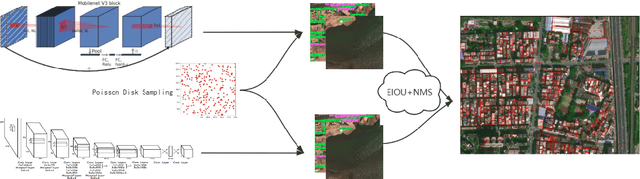
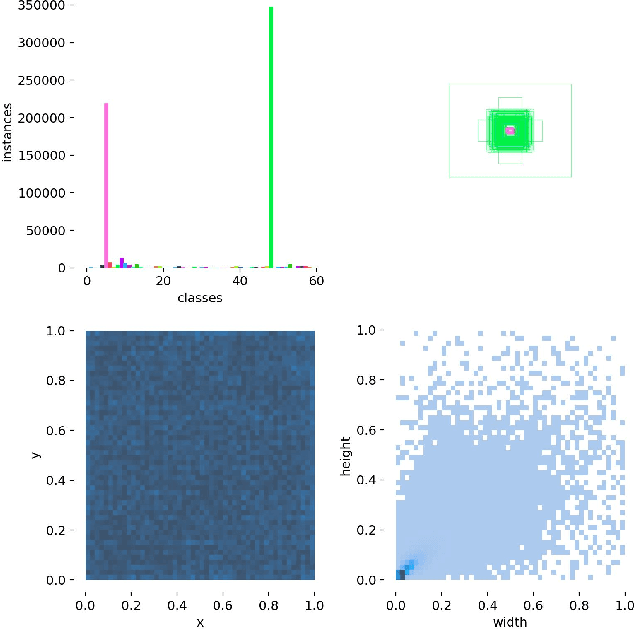
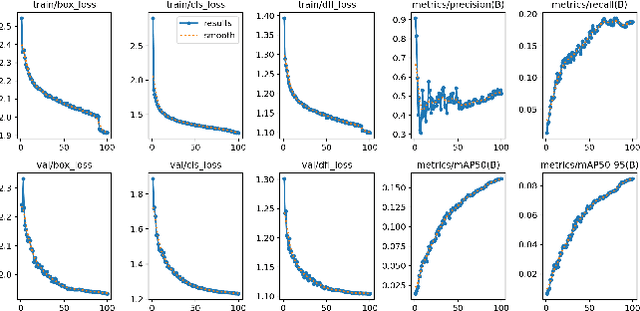
This paper presents a method for object recognition and automatic labeling in large-area remote sensing images called LRSAA. The method integrates YOLOv11 and MobileNetV3-SSD object detection algorithms through ensemble learning to enhance model performance. Furthermore, it employs Poisson disk sampling segmentation techniques and the EIOU metric to optimize the training and inference processes of segmented images, followed by the integration of results. This approach not only reduces the demand for computational resources but also achieves a good balance between accuracy and speed. The source code for this project has been made publicly available on https://github.com/anaerovane/LRSAA.
Large-scale Remote Sensing Image Target Recognition and Automatic Annotation
Nov 12, 2024This paper presents a method for object recognition and automatic labeling in large-area remote sensing images called LRSAA. The method integrates YOLOv11 and MobileNetV3-SSD object detection algorithms through ensemble learning to enhance model performance. Furthermore, it employs Poisson disk sampling segmentation techniques and the EIOU metric to optimize the training and inference processes of segmented images, followed by the integration of results. This approach not only reduces the demand for computational resources but also achieves a good balance between accuracy and speed. The source code for this project has been made publicly available on https://github.com/anaerovane/LRSAA.