 Add to Chrome
 Add to Firefox
 Add to Edge
TwinSegNet: A Digital Twin-Enabled Federated Learning Framework for Brain Tumor Analysis
Dec 19, 2025
Brain tumor segmentation is critical in diagnosis and treatment planning for the disease. Yet, current deep learning methods rely on centralized data collection, which raises privacy concerns and limits generalization across diverse institutions. In this paper, we propose TwinSegNet, which is a privacy-preserving federated learning framework that integrates a hybrid ViT-UNet model with personalized digital twins for accurate and real-time brain tumor segmentation. Our architecture combines convolutional encoders with Vision Transformer bottlenecks to capture local and global context. Each institution fine-tunes the global model of private data to form its digital twin. Evaluated on nine heterogeneous MRI datasets, including BraTS 2019-2021 and custom tumor collections, TwinSegNet achieves high Dice scores (up to 0.90%) and sensitivity/specificity exceeding 90%, demonstrating robustness across non-independent and identically distributed (IID) client distributions. Comparative results against centralized models such as TumorVisNet highlight TwinSegNet's effectiveness in preserving privacy without sacrificing performance. Our approach enables scalable, personalized segmentation for multi-institutional clinical settings while adhering to strict data confidentiality requirements.

Evaluating BiLSTM and CNN+GRU Approaches for Human Activity Recognition Using WiFi CSI Data
Jun 11, 2025This paper compares the performance of BiLSTM and CNN+GRU deep learning models for Human Activity Recognition (HAR) on two WiFi-based Channel State Information (CSI) datasets: UT-HAR and NTU-Fi HAR. The findings indicate that the CNN+GRU model has a higher accuracy on the UT-HAR dataset (95.20%) thanks to its ability to extract spatial features. In contrast, the BiLSTM model performs better on the high-resolution NTU-Fi HAR dataset (92.05%) by extracting long-term temporal dependencies more effectively. The findings strongly emphasize the critical role of dataset characteristics and preprocessing techniques in model performance improvement. We also show the real-world applicability of such models in applications like healthcare and intelligent home systems, highlighting their potential for unobtrusive activity recognition.
DeepAuditor: Distributed Online Intrusion Detection System for IoT devices via Power Side-channel Auditing
Jun 24, 2021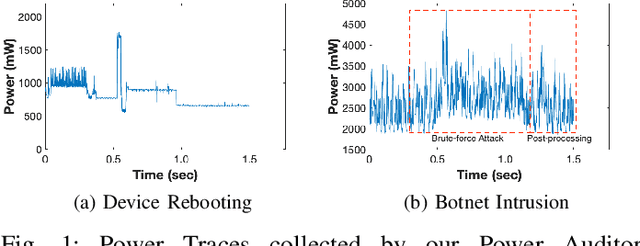
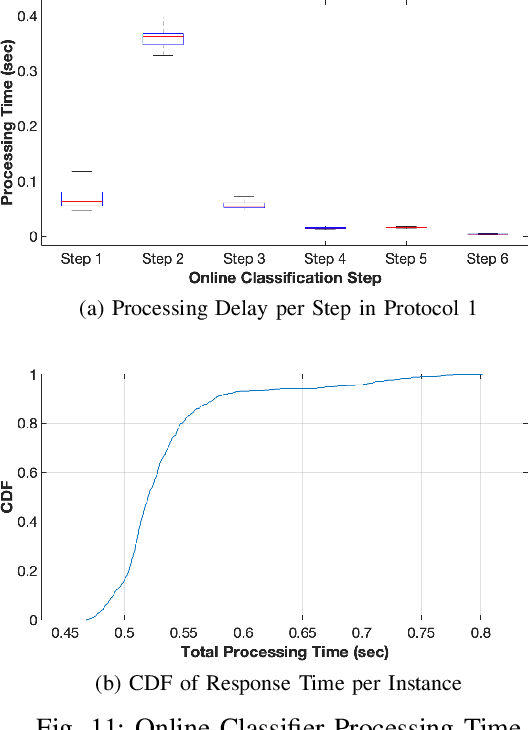
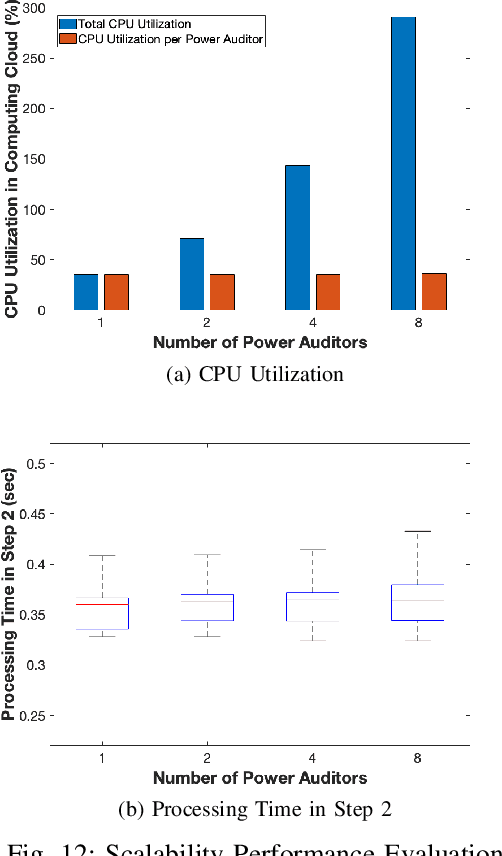
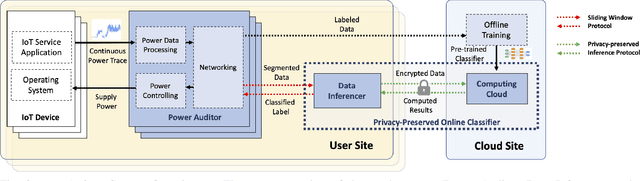
As the number of IoT devices has increased rapidly, IoT botnets have exploited the vulnerabilities of IoT devices. However, it is still challenging to detect the initial intrusion on IoT devices prior to massive attacks. Recent studies have utilized power side-channel information to characterize this intrusion behavior on IoT devices but still lack real-time detection approaches. This study aimed to design an online intrusion detection system called DeepAuditor for IoT devices via power auditing. To realize the real-time system, we first proposed a lightweight power auditing device called Power Auditor. With the Power Auditor, we developed a Distributed CNN classifier for online inference in our laboratory setting. In order to protect data leakage and reduce networking redundancy, we also proposed a privacy-preserved inference protocol via Packed Homomorphic Encryption and a sliding window protocol in our system. The classification accuracy and processing time were measured in our laboratory settings. We also demonstrated that the distributed CNN design is secure against any distributed components. Overall, the measurements were shown to the feasibility of our real-time distributed system for intrusion detection on IoT devices.