 Add to Chrome
 Add to Firefox
 Add to Edge
MoLGE: Mixture of Language Group Experts for Efficient Scaling of Massively Multilingual Speech Recognition
Jul 27, 2026
Massively multilingual automatic speech recognition (ASR) models covering hundreds of languages must maintain robust performance across diverse linguistic and acoustic conditions. However, these models often encounter the curse of multilinguality, where model capacity is diluted across languages. To address this challenge, we propose Mixture of Language Group Experts (MoLGE), built upon speech self-supervised models (S3Ms). MoLGE assigns dedicated expert modules to clusters of similar languages, reducing the number of required submodules compared to conventional language-specific Mixture-of-Experts (MoE) schemes. It further integrates a hierarchical Low-Rank Adaptation (LoRA) strategy into the disentangled acoustic and linguistic components of the S3M architecture, enabling efficient modeling of language-specific characteristics while maintaining parameter efficiency. Further, we investigate the impact of language grouping strategies based on both linguistic and data-driven criteria on overall performance, providing an interpretable perspective on how language structure influences scalability in multilingual speech systems. In experiments, we evaluate MoLGE on a multilingual benchmark encompassing 495 languages. Results demonstrate that MoLGE consistently outperforms dense multilingual baselines with a minimal increase in trainable parameters. Notably, these language grouping strategies yield substantial improvements for both phonetic and orthographic aspects of ASR modeling. Our findings suggest that structured language specialization provides an effective pathway for massively scaling language coverage of multilingual ASR.

UR-BERT: Scaling Text Encoders for Massively Multilingual TTS Through Universal Romanization and Speech Token Prediction
Jun 11, 2026We propose UR-BERT, a Romanized transcription-based text-to-speech (TTS) encoder for massively multilingual TTS systems. Conventional grapheme-to-phoneme (G2P)-based approaches are limited to around 100 languages due to the availability of reliable G2P resources. In contrast, UR-BERT scales to 495 languages by unifying diverse writing systems into a shared Romanization representation. To further enhance phonetic fidelity and text-speech alignment, we introduce a speech token prediction objective during training, which encourages the encoder to learn speech-aware phonetic representations in a data-efficient manner. Experiments show that TTS systems built on UR-BERT consistently outperform recent text encoder baselines across a wide range of languages and resource conditions, and demonstrate strong generalization to unseen languages.
UniverSR: Unified and Versatile Audio Super-Resolution via Vocoder-Free Flow Matching
Oct 01, 2025In this paper, we present a vocoder-free framework for audio super-resolution that employs a flow matching generative model to capture the conditional distribution of complex-valued spectral coefficients. Unlike conventional two-stage diffusion-based approaches that predict a mel-spectrogram and then rely on a pre-trained neural vocoder to synthesize waveforms, our method directly reconstructs waveforms via the inverse Short-Time Fourier Transform (iSTFT), thereby eliminating the dependence on a separate vocoder. This design not only simplifies end-to-end optimization but also overcomes a critical bottleneck of two-stage pipelines, where the final audio quality is fundamentally constrained by vocoder performance. Experiments show that our model consistently produces high-fidelity 48 kHz audio across diverse upsampling factors, achieving state-of-the-art performance on both speech and general audio datasets.
SAGE-LD: Towards Scalable and Generalizable End-to-End Language Diarization via Simulated Data Augmentation
Oct 01, 2025In this paper, we present a neural spoken language diarization model that supports an unconstrained span of languages within a single framework. Our approach integrates a learnable query-based architecture grounded in multilingual awareness, with large-scale pretraining on simulated code-switching data. By jointly leveraging these two components, our method overcomes the limitations of conventional approaches in data scarcity and architecture optimization, and generalizes effectively to real-world multilingual settings across diverse environments. Experimental results demonstrate that our approach achieves state-of-the-art performance on several language diarization benchmarks, with a relative performance improvement of 23% to 52% over previous methods. We believe that this work not only advances research in language diarization but also establishes a foundational framework for code-switching speech technologies.
Neural Spectral Band Generation for Audio Coding
Jun 07, 2025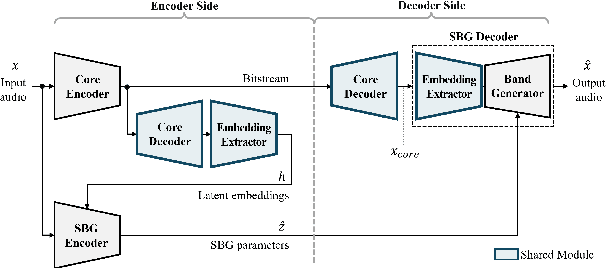
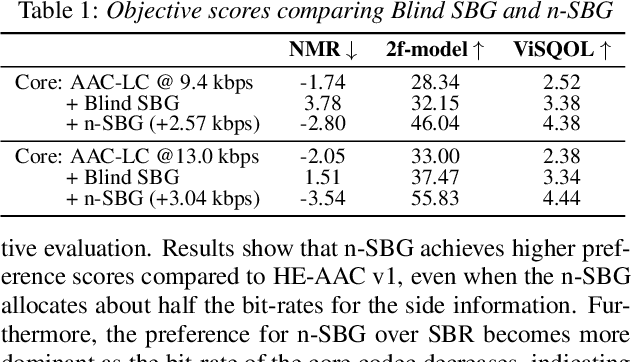
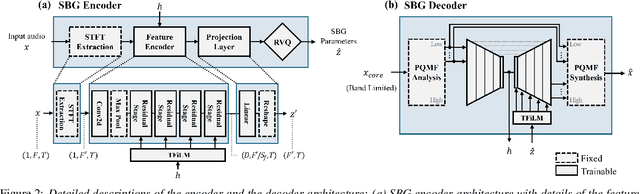
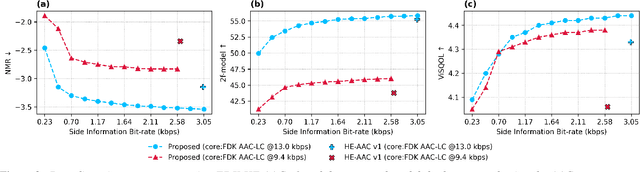
Audio bandwidth extension is the task of reconstructing missing high frequency components of bandwidth-limited audio signals, where bandwidth limitation is a common issue for audio signals due to several reasons, including channel capacity and data constraints. While conventional spectral band replication is a well-established parametric approach to audio bandwidth extension, the SBR usually entails coarse feature extraction and reconstruction techniques, which leads to limitations when processing various types of audio signals. In parallel, numerous deep neural network-based audio bandwidth extension methods have been proposed. These DNN-based methods are usually referred to as blind BWE, as these methods do not rely on prior information extracted from original signals, and only utilize given low frequency band signals to estimate missing high frequency components. In order to replace conventional SBR with DNNs, simply adopting existing DNN-based methodologies results in suboptimal performance due to the blindness of these methods. My proposed research suggests a new approach to parametric non-blind bandwidth extension, as DNN-based side information extraction and DNN-based bandwidth extension are performed only at the front and end of the audio coding pipeline.