 Add to Chrome
 Add to Firefox
 Add to Edge
Be My Tutor: On-Policy Co-Distillation for Mutual LLM Improvement via Peer Feedback
Jun 12, 2026
We study multi-domain LLM training in which two models, each stronger in a different domain, co-evolve by tutoring each other through on-policy feedback. Unlike one-way distillation or single-model fine-tuning, our goal is mutual Pareto improvement: each model improves across domains without losing its original strength. To this end, we propose On-Policy Co-Distillation (OPCoD), where each student's self-distillation is conditioned on its own correct rollout and feedback from its peer. To make feedback exchange effective, OPCoD uses cognizance-based gating to decide when to give feedback and feedback anchoring to ground feedback in the problem. On Science Q\&A tasks, OPCoD consistently outperforms baselines and achieves Pareto improvement across all evaluated domain pairs and students.

Constrained Multi-Objective Reinforcement Learning with Max-Min Criterion
May 29, 2026Multi-Objective Reinforcement Learning (MORL) extends standard RL by optimizing policies with respect to multiple, often conflicting, objectives. While max-min MORL has emerged as an effective approach for promoting fairness, its applicability remains limited, particularly when constraints must be incorporated. In this paper, we propose a MORL framework that integrates the max-min criterion with explicit constraint satisfaction. We establish a theoretical foundation for the proposed framework and validate the resulting algorithm through convergence analysis and experiments in tabular settings. We further demonstrate the practical relevance of our approach in simulated building thermal control, multi-objective locomotion control, and greenhouse-gas-emission-aware traffic management. Across these domains, our method effectively balances fairness and constraint satisfaction in multi-objective decision-making.
The Max-Min Formulation of Multi-Objective Reinforcement Learning: From Theory to a Model-Free Algorithm
Jun 12, 2024
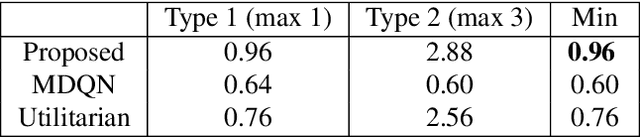
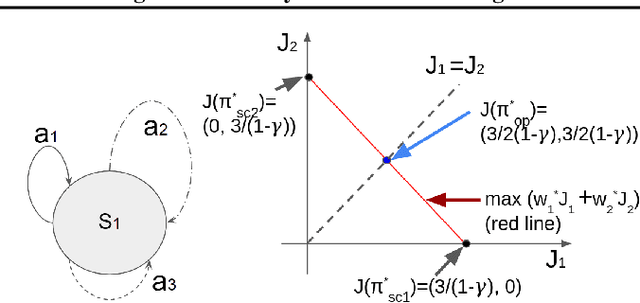
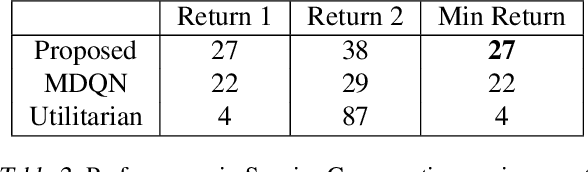
In this paper, we consider multi-objective reinforcement learning, which arises in many real-world problems with multiple optimization goals. We approach the problem with a max-min framework focusing on fairness among the multiple goals and develop a relevant theory and a practical model-free algorithm under the max-min framework. The developed theory provides a theoretical advance in multi-objective reinforcement learning, and the proposed algorithm demonstrates a notable performance improvement over existing baseline methods.