 Add to Chrome
 Add to Firefox
 Add to Edge
Subcortical Shape Variations and Their Associations with Cognition Across the 8th Decade of Life. A Study in the Lothian Birth Cohort 1936
May 28, 2026
The study of brain morphology changes in normal individuals may capture aspects of functionally-relevant brain aging not fully indicated by gross volumetry. Despite the important role of subcortical brain structures in cognition, the associations between their morphological trajectories and cognitive changes in aging have not been documented. We use neuroimaging, demographic, and cognitive data from a large longitudinal study of cognitive aging, the Lothian Birth Cohort 1936, to explore shape changes in subcortical brain structures of community-dwelling individuals across their 8th decade of life. We investigate the association of these changes with cognitive aging using ANCOVA and mixed linear model analyses. Subcortical shape changes were heterogeneous, with varied atrophy patterns across whole period. The hippocampus and the ventral DC experienced varied morphological deformations (from its baseline point) different in left and right hemispheres, while the thalami and globus pallidi shapes, for example, experienced a more uniform volume contraction, nearly symmetrical throughout different timelines. Changes in general cognition were mainly associated with inwards and outwards vertex displacements between the time-points.

Volumetric Conditioning Module to Control Pretrained Diffusion Models for 3D Medical Images
Oct 29, 2024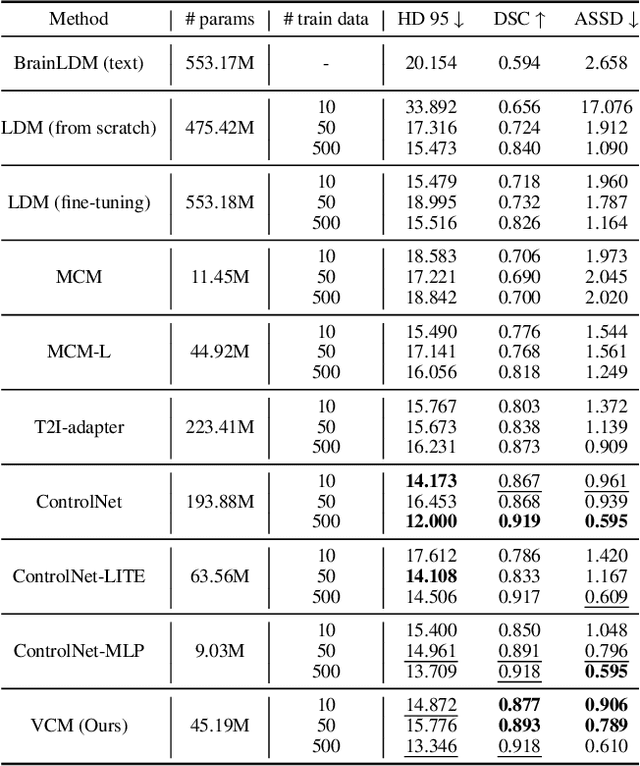
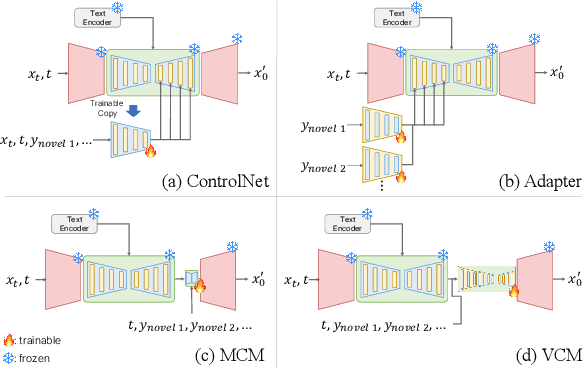
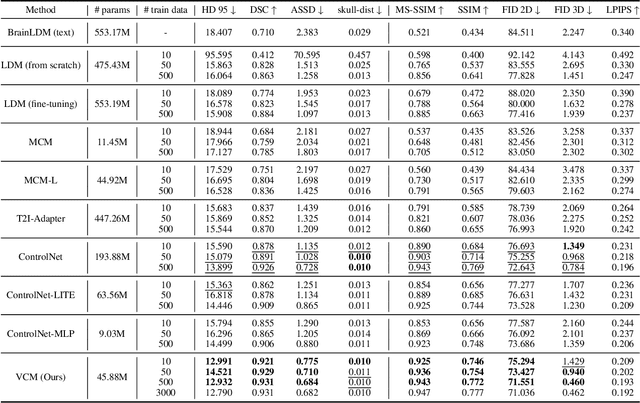

Spatial control methods using additional modules on pretrained diffusion models have gained attention for enabling conditional generation in natural images. These methods guide the generation process with new conditions while leveraging the capabilities of large models. They could be beneficial as training strategies in the context of 3D medical imaging, where training a diffusion model from scratch is challenging due to high computational costs and data scarcity. However, the potential application of spatial control methods with additional modules to 3D medical images has not yet been explored. In this paper, we present a tailored spatial control method for 3D medical images with a novel lightweight module, Volumetric Conditioning Module (VCM). Our VCM employs an asymmetric U-Net architecture to effectively encode complex information from various levels of 3D conditions, providing detailed guidance in image synthesis. To examine the applicability of spatial control methods and the effectiveness of VCM for 3D medical data, we conduct experiments under single- and multimodal conditions scenarios across a wide range of dataset sizes, from extremely small datasets with 10 samples to large datasets with 500 samples. The experimental results show that the VCM is effective for conditional generation and efficient in terms of requiring less training data and computational resources. We further investigate the potential applications for our spatial control method through axial super-resolution for medical images. Our code is available at \url{https://github.com/Ahn-Ssu/VCM}