 Add to Chrome
 Add to Firefox
 Add to Edge
POP: Online Structural Pruning Enables Efficient Inference of Large Foundation Models
Feb 06, 2026
Large foundation models (LFMs) achieve strong performance through scaling, yet current structural pruning methods derive fixed pruning decisions during inference, overlooking sparsity patterns that emerge in the autoregressive token generation. In this paper, we propose POP (Partition-guided Online Pruning), an efficient online structural pruning framework that enables context-conditioned dynamic pruning with minimal computational overhead. POP partitions model channels into retained, candidate, and pruned regions, where prefilling defines a coarse pruning partition, and the decoding stage generates a fine-grained mask within the candidate region, avoiding full-channel re-evaluation. The coarse pruning partition preserves consistently important weights, while the fine-grained masking provides context-conditioned variation during decoding. Moreover, POP is a lightweight, plug-and-play method that requires no preprocessing, including offline calibration, retraining, or learning predictors. Extensive evaluations across diverse LFMs, including large language models (LLMs), mixture-of-experts models (MoEs), and vision-language models (VLMs), demonstrate that POP consistently delivers higher accuracy than existing pruning approaches while incurring smaller computational overhead and minimizing inference latency.

V-Rex: Real-Time Streaming Video LLM Acceleration via Dynamic KV Cache Retrieval
Dec 24, 2025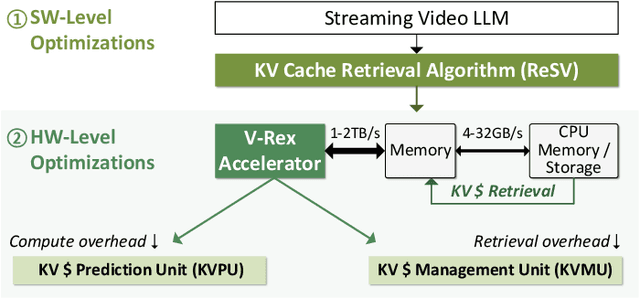
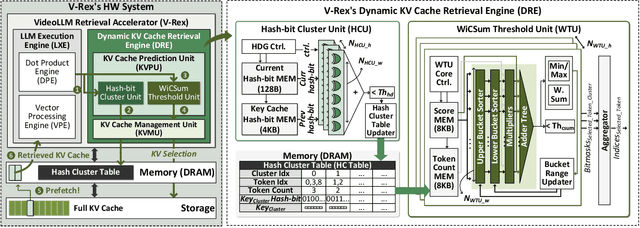
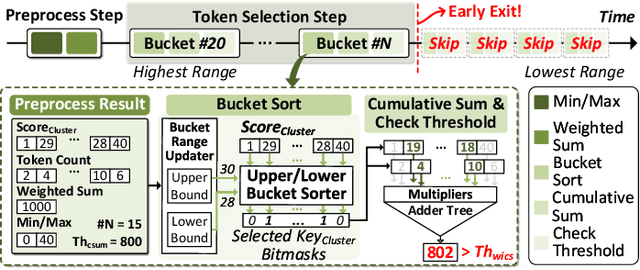
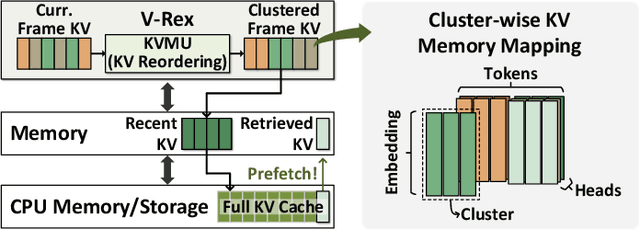
Streaming video large language models (LLMs) are increasingly used for real-time multimodal tasks such as video captioning, question answering, conversational agents, and augmented reality. However, these models face fundamental memory and computational challenges because their key-value (KV) caches grow substantially with continuous streaming video input. This process requires an iterative prefill stage, which is a unique feature of streaming video LLMs. Due to its iterative prefill stage, it suffers from significant limitations, including extensive computation, substantial data transfer, and degradation in accuracy. Crucially, this issue is exacerbated for edge deployment, which is the primary target for these models. In this work, we propose V-Rex, the first software-hardware co-designed accelerator that comprehensively addresses both algorithmic and hardware bottlenecks in streaming video LLM inference. At its core, V-Rex introduces ReSV, a training-free dynamic KV cache retrieval algorithm. ReSV exploits temporal and spatial similarity-based token clustering to reduce excessive KV cache memory across video frames. To fully realize these algorithmic benefits, V-Rex offers a compact, low-latency hardware accelerator with a dynamic KV cache retrieval engine (DRE), featuring bit-level and early-exit based computing units. V-Rex achieves unprecedented real-time of 3.9-8.3 FPS and energy-efficient streaming video LLM inference on edge deployment with negligible accuracy loss. While DRE only accounts for 2.2% power and 2.0% area, the system delivers 1.9-19.7x speedup and 3.1-18.5x energy efficiency improvements over AGX Orin GPU. This work is the first to comprehensively tackle KV cache retrieval across algorithms and hardware, enabling real-time streaming video LLM inference on resource-constrained edge devices.