 Add to Chrome
 Add to Firefox
 Add to Edge
MoNe: Modular Neural Memory for Efficient Long Context Inference
Aug 18, 2026
We present MoNe, a lightweight modular neural memory that attaches to any frozen pretrained Transformer to enable long-context inference without retraining. MoNe reads context in fixed-size segments via test-time learning of fast-weight neural memory networks with layer-localized gradient updates; at inference, the memory generates keys and values from the query tokens alone, with no context tokens re-read. This two-phase design decouples inference cost from context length, achieving $O(N)$ preprocessing and $O(1)$ query cost with peak GPU memory that does not grow with $N$. At 128K tokens, MoNe reduces both compute and peak GPU memory by approximately 80% compared to ICL with only 6.4% parameter overhead. MoNe generalizes to context lengths far beyond the backbone's native window, achieving strong performance on needle-in-a-haystack and word extraction benchmarks from RULER, where ICL degrades sharply.

ReCo: Reweighting GRPO Against Distributional Concentration
Jul 29, 2026Group Relative Policy Optimization (GRPO) has become a standard reinforcement learning method for post-training language models. Recent work shows that GRPO can reduce the base model's reasoning capacity and underperform it in Pass@k when k is large, indicating reduced coverage of reasoning paths. We find that this reduction is associated with GRPO concentrating on responses that the base model already generates with high probability. We trace this concentration to two mechanisms in the GRPO update. At the response level, high-probability responses dominate the group gradient through repeated occurrence. At the token level, GRPO's importance ratio scales gradients, further reinforcing tokens that become more likely under the current policy. We propose ReCo, a reweighting method that addresses both effects. Response contributions are normalized by their expected occurrence within the rollout group, and the token-level importance ratio is replaced with a variance-based ratio that gives larger update scale to non-saturated decision points where alternative token choices remain plausible. Across Qwen2.5-Math-1.5B/7B and Llama-3.1-8B-Instruct on five mathematical reasoning benchmarks, ReCo improves Pass@k for large values of k and is comparable to GRPO for small values of k.
Parameter-Efficient Fine-Tuning with Column Space Projection
May 26, 2025Fine-tuning large language models (LLMs) with minimal computational overhead is essential for efficiently adapting them to downstream tasks under resource constraints. Parameter-efficient fine-tuning (PEFT) methods, such as Low-Rank Adaptation (LoRA), facilitate this by updating only a small subset of parameters. However, recent studies show that LoRA diverges from full fine-tuning (Full FT) in its learning behavior, particularly in terms of spectral properties. Motivated by these findings, we propose PiCa, the first theoretically grounded PEFT method based on the spectral properties of fine-tuned weights. PiCa projects gradients onto the low-rank column subspace of pre-trained weights and exhibits learning patterns more closely aligned with Full FT. Furthermore, we show that combining PiCa with weight sharing drastically reduces the number of trainable parameters without compromising performance, enabling to achieve superior performance than LoRA using 13x fewer trainable parameters. Extensive experiments demonstrate PiCa achieves the state-of-the-art performance compared to existing PEFT methods.
Hollowed Net for On-Device Personalization of Text-to-Image Diffusion Models
Nov 02, 2024Recent advancements in text-to-image diffusion models have enabled the personalization of these models to generate custom images from textual prompts. This paper presents an efficient LoRA-based personalization approach for on-device subject-driven generation, where pre-trained diffusion models are fine-tuned with user-specific data on resource-constrained devices. Our method, termed Hollowed Net, enhances memory efficiency during fine-tuning by modifying the architecture of a diffusion U-Net to temporarily remove a fraction of its deep layers, creating a hollowed structure. This approach directly addresses on-device memory constraints and substantially reduces GPU memory requirements for training, in contrast to previous methods that primarily focus on minimizing training steps and reducing the number of parameters to update. Additionally, the personalized Hollowed Net can be transferred back into the original U-Net, enabling inference without additional memory overhead. Quantitative and qualitative analyses demonstrate that our approach not only reduces training memory to levels as low as those required for inference but also maintains or improves personalization performance compared to existing methods.
Overcoming Data Inequality across Domains with Semi-Supervised Domain Generalization
Mar 08, 2024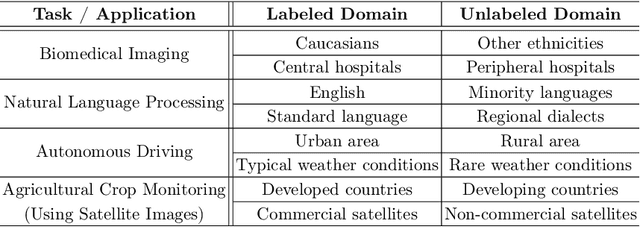
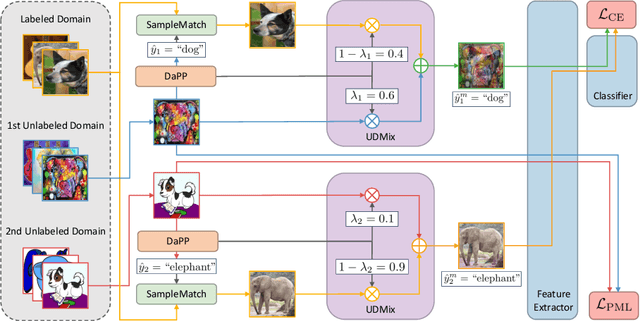

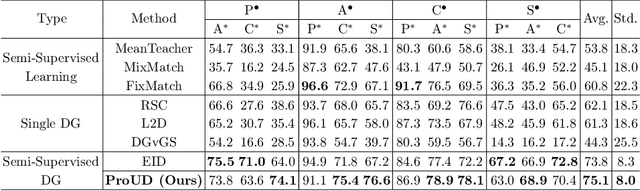
While there have been considerable advancements in machine learning driven by extensive datasets, a significant disparity still persists in the availability of data across various sources and populations. This inequality across domains poses challenges in modeling for those with limited data, which can lead to profound practical and ethical concerns. In this paper, we address a representative case of data inequality problem across domains termed Semi-Supervised Domain Generalization (SSDG), in which only one domain is labeled while the rest are unlabeled. We propose a novel algorithm, ProUD, which can effectively learn domain-invariant features via domain-aware prototypes along with progressive generalization via uncertainty-adaptive mixing of labeled and unlabeled domains. Our experiments on three different benchmark datasets demonstrate the effectiveness of ProUD, outperforming all baseline models including single domain generalization and semi-supervised learning. Source code will be released upon acceptance of the paper.
Complementary Domain Adaptation and Generalization for Unsupervised Continual Domain Shift Learning
Mar 28, 2023Continual domain shift poses a significant challenge in real-world applications, particularly in situations where labeled data is not available for new domains. The challenge of acquiring knowledge in this problem setting is referred to as unsupervised continual domain shift learning. Existing methods for domain adaptation and generalization have limitations in addressing this issue, as they focus either on adapting to a specific domain or generalizing to unseen domains, but not both. In this paper, we propose Complementary Domain Adaptation and Generalization (CoDAG), a simple yet effective learning framework that combines domain adaptation and generalization in a complementary manner to achieve three major goals of unsupervised continual domain shift learning: adapting to a current domain, generalizing to unseen domains, and preventing forgetting of previously seen domains. Our approach is model-agnostic, meaning that it is compatible with any existing domain adaptation and generalization algorithms. We evaluate CoDAG on several benchmark datasets and demonstrate that our model outperforms state-of-the-art models in all datasets and evaluation metrics, highlighting its effectiveness and robustness in handling unsupervised continual domain shift learning.