 Add to Chrome
 Add to Firefox
 Add to Edge
On Strong Equivalence Notions in Logic Programming and Abstract Argumentation
May 14, 2026
Strong equivalence between knowledge bases ensures the possibility of replacing one with the other without affecting reasoning outcomes, in any given context. This makes it a crucial property in nonmonotonic formalisms. In particular, the fields of logic programming and abstract argumentation provide primary examples in which this property has been subject to vast investigations. However, while (classes of) logic programs and abstract argumentation frameworks are known to be semantically equivalent in static settings, this alignment breaks in dynamic contexts due to differing notions of update. As a result, strong equivalence does not always carry over from one formalism to the other. In this paper, we carefully investigate this discrepancy and introduce a new notion of strong equivalence for logic programs. Our approach preserves strong equivalence under translation between certain classes of logic programs and both Dung-style and claim-augmented argumentation frameworks, thus restoring compatibility across these formalisms.

The Effect of Preferences in Abstract Argumentation Under a Claim-Centric View
Apr 28, 2022
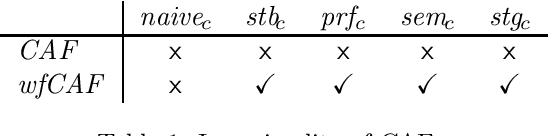
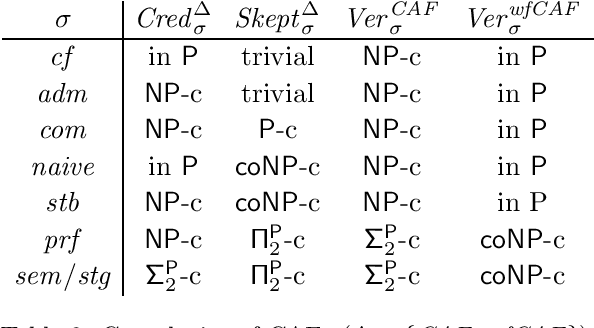
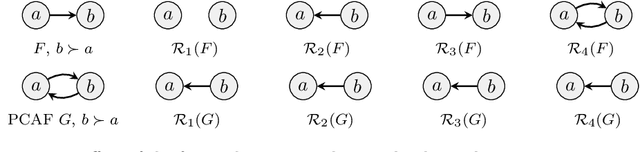
In this paper, we study the effect of preferences in abstract argumentation under a claim-centric perspective. Recent work has revealed that semantical and computational properties can change when reasoning is performed on claim-level rather than on the argument-level, while under certain natural restrictions (arguments with the same claims have the same outgoing attacks) these properties are conserved. We now investigate these effects when, in addition, preferences have to be taken into account and consider four prominent reductions to handle preferences between arguments. As we shall see, these reductions give rise to different classes of claim-augmented argumentation frameworks, and behave differently in terms of semantic properties and computational complexity. This strengthens the view that the actual choice for handling preferences has to be taken with care.
On the Intertranslatability of Argumentation Semantics
Jan 16, 2014


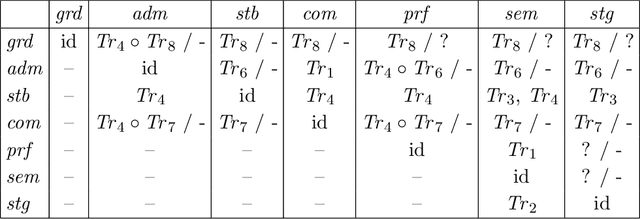
Translations between different nonmonotonic formalisms always have been an important topic in the field, in particular to understand the knowledge-representation capabilities those formalisms offer. We provide such an investigation in terms of different semantics proposed for abstract argumentation frameworks, a nonmonotonic yet simple formalism which received increasing interest within the last decade. Although the properties of these different semantics are nowadays well understood, there are no explicit results about intertranslatability. We provide such translations wrt. different properties and also give a few novel complexity results which underlie some negative results.