 Add to Chrome
 Add to Firefox
 Add to Edge
ASPaeroFlow: Decomposition Heuristics for Joint Air Traffic Flow & Capacity Management
Aug 10, 2026
While mathematical models act as vital decision support systems for operational Air Traffic Flow and Capacity Management (ATFCM), existing approaches isolate Air Traffic Flow Management (ATFM) from Dynamic Airspace Configuration (DAC). This separation introduces an unresolved circular dependency between fixed-demand and fixed-capacity assumptions. Although joint optimization resolves this gap, the enlarged search space renders exact models computationally intractable for medium- to large-scale instances. To bridge this gap, we propose ASPaeroFlow: a heuristic for the joint ATFCM; it combines instance-space decomposition heuristics with a local exact approach using Answer Set Programming. We benchmark ASPaeroFlow from small to industry-sized instances and compare it with exact and alternative approaches. The results indicate that (1) the heuristic provides a computational middle ground between exact methods and operational baselines; (2) simultaneous optimization can outperform sequential optimization on joint ATFCM; and (3) an ablation study indicates that DAC has a larger impact on solution quality than flow measures.

Joint Air Traffic Flow and Capacity Management via Answer Set Programming
Jun 22, 2026Operational Air Traffic Flow and Capacity Management (ATFCM) balances flight demand with available sector capacity, to ensure safe and efficient operations. Mathematical models enhance operational ATFCM performance by framing demand-capacity balancing as an optimization problem, maximizing efficiency while adhering to safety constraints. However, SOTA research optimizes the aircraft trajectories (called ATFM) or the sector configuration (called DAC) separately. This leaves a research gap of whether joint optimization of ATFM and DAC can bring benefits. We partially address this limitation by introducing a joint ATFCM model with an encoding in Answer Set Programming (ASP). The ASP implementation is evaluated against two baselines applied to our joint model: a SOTA Mixed Integer Programming (MIP) model and an iterative CASA-based heuristic. Computational experiments utilize an instance generator fitted to historical OpenSky Network flight data. Our results indicate that the ASP model outperforms the MIP model, while ASP remains competitive against heuristics on small instances. Furthermore, while DAC has the largest improvement on solving performance compared to rerouting and delaying, unrestricted variants of DAC or rerouting lead to search space thrashing.
* This is the version including the appendix/supplementary material
On Strong Equivalence Notions in Logic Programming and Abstract Argumentation
May 14, 2026Strong equivalence between knowledge bases ensures the possibility of replacing one with the other without affecting reasoning outcomes, in any given context. This makes it a crucial property in nonmonotonic formalisms. In particular, the fields of logic programming and abstract argumentation provide primary examples in which this property has been subject to vast investigations. However, while (classes of) logic programs and abstract argumentation frameworks are known to be semantically equivalent in static settings, this alignment breaks in dynamic contexts due to differing notions of update. As a result, strong equivalence does not always carry over from one formalism to the other. In this paper, we carefully investigate this discrepancy and introduce a new notion of strong equivalence for logic programs. Our approach preserves strong equivalence under translation between certain classes of logic programs and both Dung-style and claim-augmented argumentation frameworks, thus restoring compatibility across these formalisms.
Automated Hybrid Grounding Using Structural and Data-Driven Heuristics
Jul 23, 2025
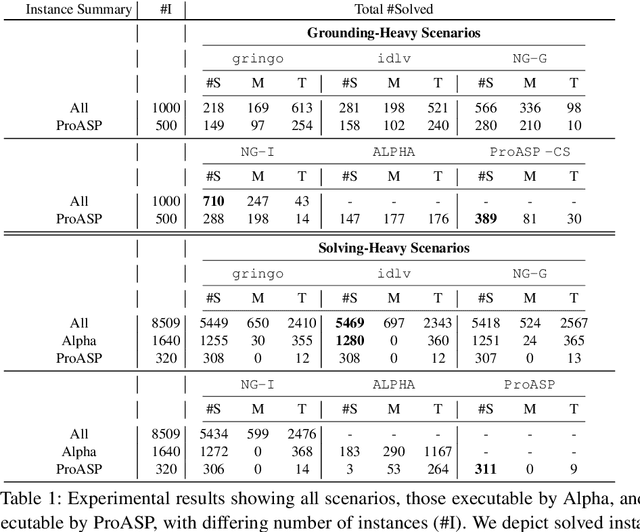
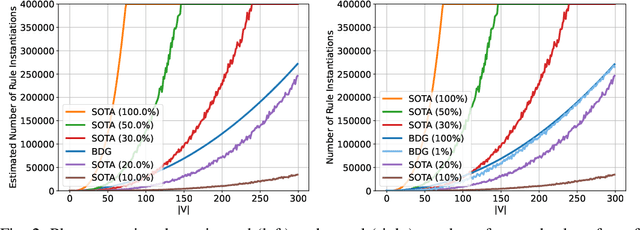
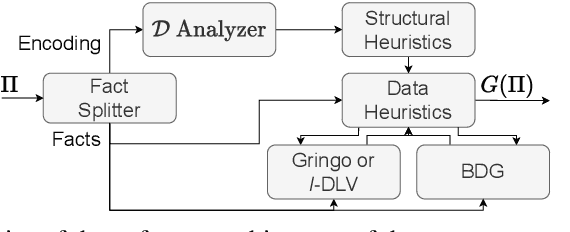
The grounding bottleneck poses one of the key challenges that hinders the widespread adoption of Answer Set Programming in industry. Hybrid Grounding is a step in alleviating the bottleneck by combining the strength of standard bottom-up grounding with recently proposed techniques where rule bodies are decoupled during grounding. However, it has remained unclear when hybrid grounding shall use body-decoupled grounding and when to use standard bottom-up grounding. In this paper, we address this issue by developing automated hybrid grounding: we introduce a splitting algorithm based on data-structural heuristics that detects when to use body-decoupled grounding and when standard grounding is beneficial. We base our heuristics on the structure of rules and an estimation procedure that incorporates the data of the instance. The experiments conducted on our prototypical implementation demonstrate promising results, which show an improvement on hard-to-ground scenarios, whereas on hard-to-solve instances we approach state-of-the-art performance.
Visualizing Extensions of Argumentation Frameworks as Layered Graphs
Sep 09, 2024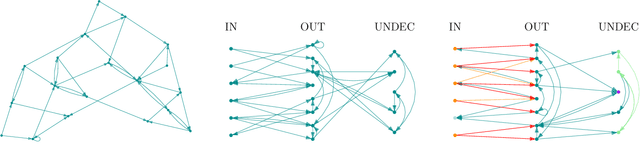
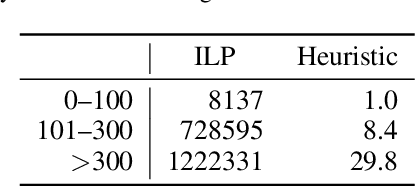
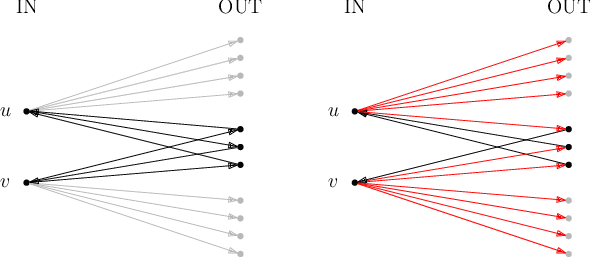

The visualization of argumentation frameworks (AFs) is crucial for enabling a wide applicability of argumentative tools. However, their visualization is often considered only as an accompanying part of tools for computing semantics and standard graphical representations are used. We introduce a new visualization technique that draws an AF, together with an extension (as part of the input), as a 3-layer graph layout. Our technique supports the user to more easily explore the visualized AF, better understand extensions, and verify algorithms for computing semantics. To optimize the visual clarity and aesthetics of this layout, we propose to minimize edge crossings in our 3-layer drawing. We do so by an exact ILP-based approach, but also propose a fast heuristic pipeline. Via a quantitative evaluation, we show that the heuristic is feasible even for large instances, while producing at most twice as many crossings as an optimal drawing in most cases.
A Unified View on Forgetting and Strong Equivalence Notions in Answer Set Programming
Dec 13, 2023Answer Set Programming (ASP) is a prominent rule-based language for knowledge representation and reasoning with roots in logic programming and non-monotonic reasoning. The aim to capture the essence of removing (ir)relevant details in ASP programs led to the investigation of different notions, from strong persistence (SP) forgetting, to faithful abstractions, and, recently, strong simplifications, where the latter two can be seen as relaxed and strengthened notions of forgetting, respectively. Although it was observed that these notions are related, especially given that they have characterizations through the semantics for strong equivalence, it remained unclear whether they can be brought together. In this work, we bridge this gap by introducing a novel relativized equivalence notion, which is a relaxation of the recent simplification notion, that is able to capture all related notions from the literature. We provide necessary and sufficient conditions for relativized simplifiability, which shows that the challenging part is for when the context programs do not contain all the atoms to remove. We then introduce an operator that combines projection and a relaxation of (SP)-forgetting to obtain the relativized simplifications. We furthermore present complexity results that complete the overall picture.
Solving Projected Model Counting by Utilizing Treewidth and its Limits
May 31, 2023In this paper, we introduce a novel algorithm to solve projected model counting (PMC). PMC asks to count solutions of a Boolean formula with respect to a given set of projection variables, where multiple solutions that are identical when restricted to the projection variables count as only one solution. Inspired by the observation that the so-called "treewidth" is one of the most prominent structural parameters, our algorithm utilizes small treewidth of the primal graph of the input instance. More precisely, it runs in time O(2^2k+4n2) where k is the treewidth and n is the input size of the instance. In other words, we obtain that the problem PMC is fixed-parameter tractable when parameterized by treewidth. Further, we take the exponential time hypothesis (ETH) into consideration and establish lower bounds of bounded treewidth algorithms for PMC, yielding asymptotically tight runtime bounds of our algorithm. While the algorithm above serves as a first theoretical upper bound and although it might be quite appealing for small values of k, unsurprisingly a naive implementation adhering to this runtime bound suffers already from instances of relatively small width. Therefore, we turn our attention to several measures in order to resolve this issue towards exploiting treewidth in practice: We present a technique called nested dynamic programming, where different levels of abstractions of the primal graph are used to (recursively) compute and refine tree decompositions of a given instance. Finally, we provide a nested dynamic programming algorithm and an implementation that relies on database technology for PMC and a prominent special case of PMC, namely model counting (#Sat). Experiments indicate that the advancements are promising, allowing us to solve instances of treewidth upper bounds beyond 200.
Rediscovering Argumentation Principles Utilizing Collective Attacks
May 06, 2022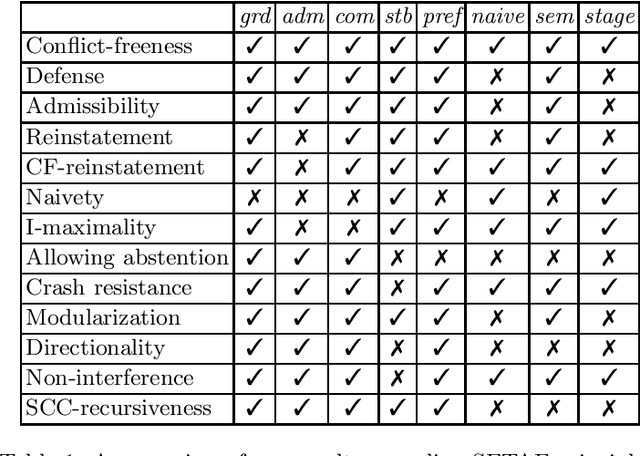
Argumentation Frameworks (AFs) are a key formalism in AI research. Their semantics have been investigated in terms of principles, which define characteristic properties in order to deliver guidance for analysing established and developing new semantics. Because of the simple structure of AFs, many desired properties hold almost trivially, at the same time hiding interesting concepts behind syntactic notions. We extend the principle-based approach to Argumentation Frameworks with Collective Attacks (SETAFs) and provide a comprehensive overview of common principles for their semantics. Our analysis shows that investigating principles based on decomposing the given SETAF (e.g. directionality or SCC-recursiveness) poses additional challenges in comparison to usual AFs. We introduce the notion of the reduct as well as the modularization principle for SETAFs which will prove beneficial for this kind of investigation. We then demonstrate how our findings can be utilized for incremental computation of extensions and give a novel parameterized tractability result for verifying preferred extensions.
The Effect of Preferences in Abstract Argumentation Under a Claim-Centric View
Apr 28, 2022
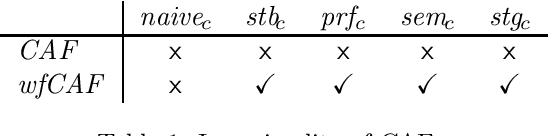
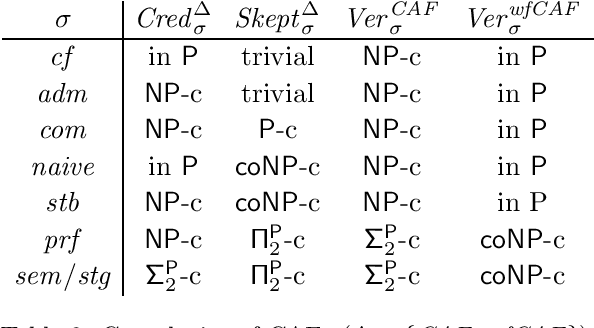
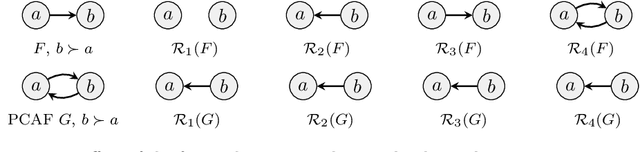
In this paper, we study the effect of preferences in abstract argumentation under a claim-centric perspective. Recent work has revealed that semantical and computational properties can change when reasoning is performed on claim-level rather than on the argument-level, while under certain natural restrictions (arguments with the same claims have the same outgoing attacks) these properties are conserved. We now investigate these effects when, in addition, preferences have to be taken into account and consider four prominent reductions to handle preferences between arguments. As we shall see, these reductions give rise to different classes of claim-augmented argumentation frameworks, and behave differently in terms of semantic properties and computational complexity. This strengthens the view that the actual choice for handling preferences has to be taken with care.
Aspartix-V21
Sep 07, 2021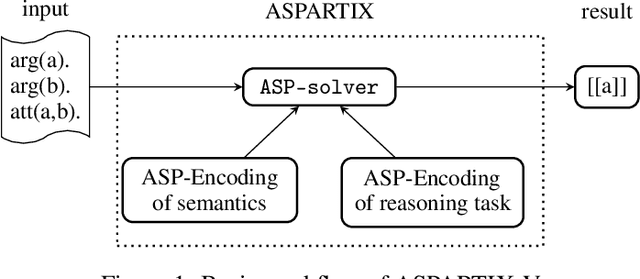
In this solver description we present ASPARTIX-V, in its 2021 edition, which participates in the International Competition on Computational Models of Argumentation (ICCMA) 2021. ASPARTIX-V is capable of solving all classical (static) reasoning tasks part of ICCMA'21 and extends the ASPARTIX system suite by incorporation of recent ASP language constructs (e.g. conditional literals), domain heuristics within ASP, and multi-shot methods. In this light ASPARTIX-V deviates from the traditional focus of ASPARTIX on monolithic approaches (i.e., one-shot solving via a single ASP encoding) to further enhance performance.