 Add to Chrome
 Add to Firefox
 Add to Edge
Asymmetric Peak-Aware Loss for Peak-Critical Time Series Forecasting
Jul 16, 2026
In many operational time-series forecasting applications, such as crowd demand forecasting, the risk related to under-prediction is substantially higher than that of over-prediction. Accurate prediction of rare demand spikes plays a critical role in downstream tasks. Yet most time-series forecasters are trained with symmetric objectives (e.g., MSE, MAE) and evaluated primarily on aggregate error, which can mask failures in extreme-values and peak-timing predictions. We introduce Asymmetric Peak-Aware Loss (APAL), a simple, model-agnostic objective that (i) penalizes under-predictions more heavily and (ii) increases the training weight of peak regions within each forecast window. We further propose a peak-critical evaluation protocol that complements MAE/MSE with channel-wise tail error (Top-10% and Top-1%) and peak metrics (precision, recall, F1 under timing tolerance, and peak timing error). We evaluate APAL on long-horizon multivariate forecasting across five state-of-the-art backbones, with a focus on pedestrian demand forecasting using (i) a production-ready subset of the City of Melbourne pedestrian hourly count dataset and (ii) a beach visitor count dataset. The generality of the loss function for time-series forecasting is tested on additional benchmarks. Across peak-critical datasets and settings, APAL improves tail accuracy and peak-prediction quality while exposing a controllable trade-off with aggregate error, making it a practical solution when peak-prediction failures are the dominant operational concern.

Flow Matching Policy with Entropy Regularization
Mar 19, 2026Diffusion-based policies have gained significant popularity in Reinforcement Learning (RL) due to their ability to represent complex, non-Gaussian distributions. Stochastic Differential Equation (SDE)-based diffusion policies often rely on indirect entropy control due to the intractability of the exact entropy, while also suffering from computationally prohibitive policy gradients through the iterative denoising chain. To overcome these issues, we propose Flow Matching Policy with Entropy Regularization (FMER), an Ordinary Differential Equation (ODE)-based online RL framework. FMER parameterizes the policy via flow matching and samples actions along a straight probability path, motivated by optimal transport. FMER leverages the model's generative nature to construct an advantage-weighted target velocity field from a candidate set, steering policy updates toward high-value regions. By deriving a tractable entropy objective, FMER enables principled maximum-entropy optimization for enhanced exploration. Experiments on sparse multi-goal FrankaKitchen benchmarks demonstrate that FMER outperforms state-of-the-art methods, while remaining competitive on standard MuJoco benchmarks. Moreover, FMER reduces training time by 7x compared to heavy diffusion baselines (QVPO) and 10-15% relative to efficient variants.
Framework for Network-Constrained Target Tracking
Mar 02, 2022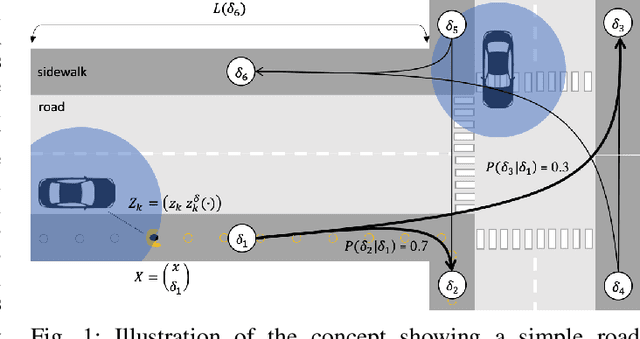
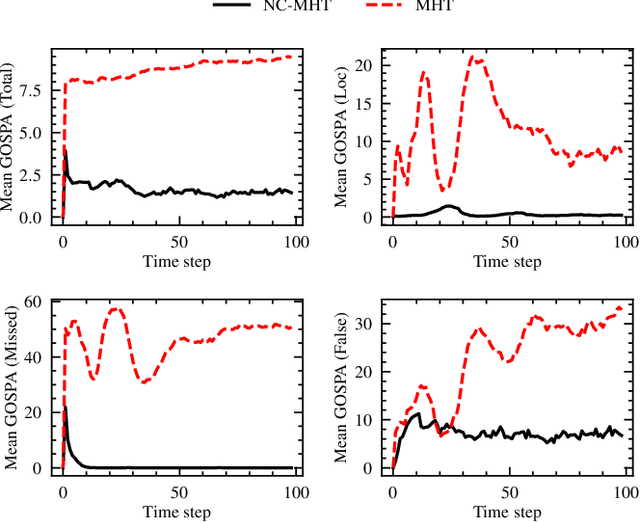
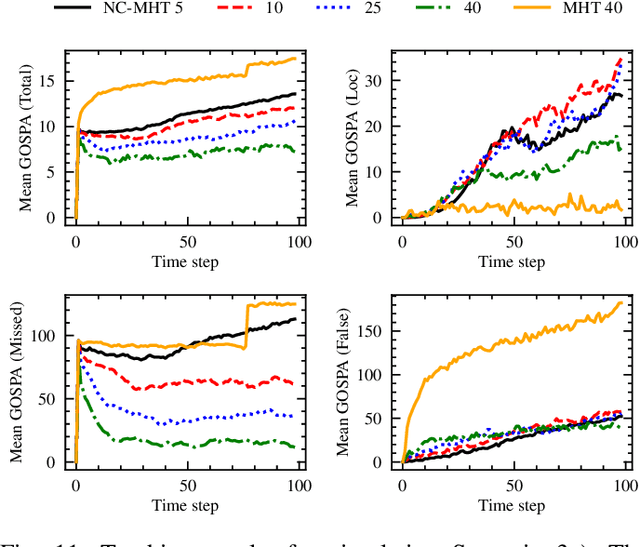
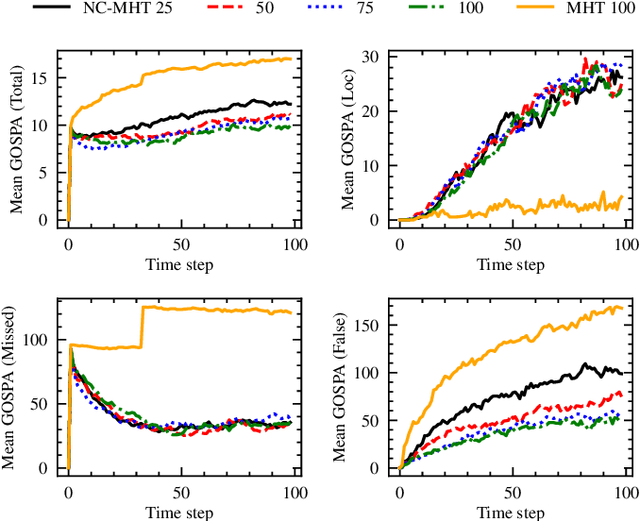
The increase in perception capabilities of connected mobile sensor platforms (e.g., self-driving vehicles, drones, and robots) leads to an extensive surge of sensed features at various temporal and spatial scales. Beyond their traditional use for safe operation, available observations could enable to see how and where people move on sidewalks and cycle paths, to eventually obtain a complete microscopic and macroscopic picture of the traffic flows in a larger area. This paper proposes a new method for advanced traffic applications, tracking an unknown and varying number of moving targets (e.g., pedestrians or cyclists) constrained by a road network, using mobile (e.g., vehicles) spatially distributed sensor platforms. The key contribution in this paper is to introduce the concept of network bound targets into the multi-target tracking problem, and hence to derive a network-constrained multi-hypotheses tracker (NC-MHT) to fully utilize the available road information. This is done by introducing a target representation, comprising a traditional target tracking representation and a discrete component placing the target on a given segment in the network. A simulation study shows that the method performs well in comparison to the standard MHT filter in free space. Results particularly highlight network-constraint effects for more efficient target predictions over extended periods of time, and in the simplification of the measurement association process, as compared to not utilizing a network structure. This theoretical work also directs attention to latent privacy concerns for potential applications.