 Add to Chrome
 Add to Firefox
 Add to Edge
Robust Reasoning and Learning with Brain-Inspired Representations under Hardware-Induced Nonlinearities
Apr 13, 2026
Traditional machine learning depends on high-precision arithmetic and near-ideal hardware assumptions, which is increasingly challenged by variability in aggressively scaled semiconductor devices. Compute-in-memory (CIM) architectures alleviate data-movement bottlenecks and improve energy efficiency yet introduce nonlinear distortions and reliability concerns. We address these issues with a hardware-aware optimization framework based on Hyperdimensional Computing (HDC), systematically compensating for non-ideal similarity computations in CIM. Our approach formulates encoding as an optimization problem, minimizing the Frobenius norm between an ideal kernel and its hardware-constrained counterpart, and employs a joint optimization strategy for end-to-end calibration of hypervector representations. Experimental results demonstrate that our method when applied to QuantHD achieves 84\% accuracy under severe hardware-induced perturbations, a 48\% increase over naive QuantHD under the same conditions. Additionally, our optimization is vital for graph-based HDC reliant on precise variable-binding for interpretable reasoning. Our framework preserves the accuracy of RelHD on the Cora dataset, achieving a 5.4$\times$ accuracy improvement over naive RelHD under nonlinear environments. By preserving HDC's robustness and symbolic properties, our solution enables scalable, energy-efficient intelligent systems capable of classification and reasoning on emerging CIM hardware.
* 8 pages, 7 figures, accepted to Great Lakes Symposium on VLSI (GLSVLSI) 2025

MERIT: Multi-domain Efficient RAW Image Translation
Mar 21, 2026RAW images captured by different camera sensors exhibit substantial domain shifts due to varying spectral responses, noise characteristics, and tone behaviors, complicating their direct use in downstream computer vision tasks. Prior methods address this problem by training domain-specific RAW-to-RAW translators for each source-target pair, but such approaches do not scale to real-world scenarios involving multiple types of commercial cameras. In this work, we introduce MERIT, the first unified framework for multi-domain RAW image translation, which leverages a single model to perform translations across arbitrary camera domains. To address domain-specific noise discrepancies, we propose a sensor-aware noise modeling loss that explicitly aligns the signal-dependent noise statistics of the generated images with those of the target domain. We further enhance the generator with a conditional multi-scale large kernel attention module for improved context and sensor-aware feature modeling. To facilitate standardized evaluation, we introduce MDRAW, the first dataset tailored for multi-domain RAW image translation, comprising both paired and unpaired RAW captures from five diverse camera sensors across a wide range of scenes. Extensive experiments demonstrate that MERIT outperforms prior models in both quality (5.56 dB improvement) and scalability (80% reduction in training iterations).
Geometric Priors for Generalizable World Models via Vector Symbolic Architecture
Feb 25, 2026A key challenge in artificial intelligence and neuroscience is understanding how neural systems learn representations that capture the underlying dynamics of the world. Most world models represent the transition function with unstructured neural networks, limiting interpretability, sample efficiency, and generalization to unseen states or action compositions. We address these issues with a generalizable world model grounded in Vector Symbolic Architecture (VSA) principles as geometric priors. Our approach utilizes learnable Fourier Holographic Reduced Representation (FHRR) encoders to map states and actions into a high dimensional complex vector space with learned group structure and models transitions with element-wise complex multiplication. We formalize the framework's group theoretic foundation and show how training such structured representations to be approximately invariant enables strong multi-step composition directly in latent space and generalization performances over various experiments. On a discrete grid world environment, our model achieves 87.5% zero shot accuracy to unseen state-action pairs, obtains 53.6% higher accuracy on 20-timestep horizon rollouts, and demonstrates 4x higher robustness to noise relative to an MLP baseline. These results highlight how training to have latent group structure yields generalizable, data-efficient, and interpretable world models, providing a principled pathway toward structured models for real-world planning and reasoning.
Are Hypervectors Enough? Single-Call LLM Reasoning over Knowledge Graphs
Dec 10, 2025Recent advances in large language models (LLMs) have enabled strong reasoning over both structured and unstructured knowledge. When grounded on knowledge graphs (KGs), however, prevailing pipelines rely on heavy neural encoders to embed and score symbolic paths or on repeated LLM calls to rank candidates, leading to high latency, GPU cost, and opaque decisions that hinder faithful, scalable deployment. We propose PathHD, a lightweight and encoder-free KG reasoning framework that replaces neural path scoring with hyperdimensional computing (HDC) and uses only a single LLM call per query. PathHD encodes relation paths into block-diagonal GHRR hypervectors, ranks candidates with blockwise cosine similarity and Top-K pruning, and then performs a one-shot LLM adjudication to produce the final answer together with cited supporting paths. Technically, PathHD is built on three ingredients: (i) an order-aware, non-commutative binding operator for path composition, (ii) a calibrated similarity for robust hypervector-based retrieval, and (iii) a one-shot adjudication step that preserves interpretability while eliminating per-path LLM scoring. On WebQSP, CWQ, and the GrailQA split, PathHD (i) attains comparable or better Hits@1 than strong neural baselines while using one LLM call per query; (ii) reduces end-to-end latency by $40-60\%$ and GPU memory by $3-5\times$ thanks to encoder-free retrieval; and (iii) delivers faithful, path-grounded rationales that improve error diagnosis and controllability. These results indicate that carefully designed HDC representations provide a practical substrate for efficient KG-LLM reasoning, offering a favorable accuracy-efficiency-interpretability trade-off.
Mitigating Bias in Graph Hyperdimensional Computing
Dec 08, 2025Graph hyperdimensional computing (HDC) has emerged as a promising paradigm for cognitive tasks, emulating brain-like computation with high-dimensional vectors known as hypervectors. While HDC offers robustness and efficiency on graph-structured data, its fairness implications remain largely unexplored. In this paper, we study fairness in graph HDC, where biases in data representation and decision rules can lead to unequal treatment of different groups. We show how hypervector encoding and similarity-based classification can propagate or even amplify such biases, and we propose a fairness-aware training framework, FairGHDC, to mitigate them. FairGHDC introduces a bias correction term, derived from a gap-based demographic-parity regularizer, and converts it into a scalar fairness factor that scales the update of the class hypervector for the ground-truth label. This enables debiasing directly in the hypervector space without modifying the graph encoder or requiring backpropagation. Experimental results on six benchmark datasets demonstrate that FairGHDC substantially reduces demographic-parity and equal-opportunity gaps while maintaining accuracy comparable to standard GNNs and fairness-aware GNNs. At the same time, FairGHDC preserves the computational advantages of HDC, achieving up to about one order of magnitude ($\approx 10\times$) speedup in training time on GPU compared to GNN and fairness-aware GNN baselines.
Continuous GNN-based Anomaly Detection on Edge using Efficient Adaptive Knowledge Graph Learning
Nov 13, 2024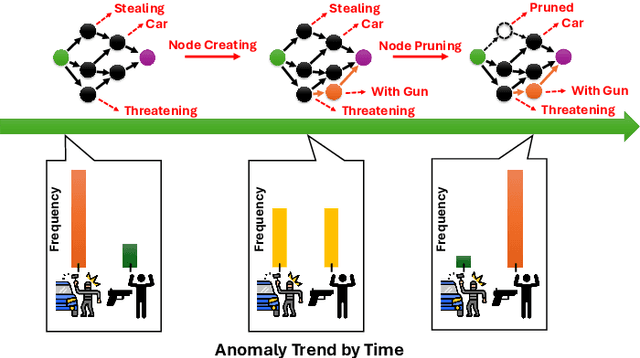

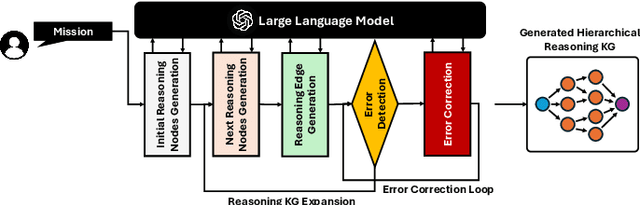
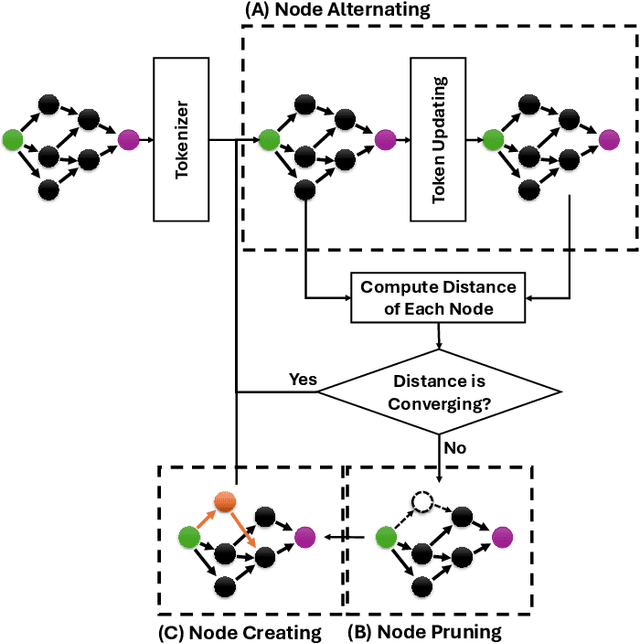
The increasing demand for robust security solutions across various industries has made Video Anomaly Detection (VAD) a critical task in applications such as intelligent surveillance, evidence investigation, and violence detection. Traditional approaches to VAD often rely on finetuning large pre-trained models, which can be computationally expensive and impractical for real-time or resource-constrained environments. To address this, MissionGNN introduced a more efficient method by training a graph neural network (GNN) using a fixed knowledge graph (KG) derived from large language models (LLMs) like GPT-4. While this approach demonstrated significant efficiency in computational power and memory, it faces limitations in dynamic environments where frequent updates to the KG are necessary due to evolving behavior trends and shifting data patterns. These updates typically require cloud-based computation, posing challenges for edge computing applications. In this paper, we propose a novel framework that facilitates continuous KG adaptation directly on edge devices, overcoming the limitations of cloud dependency. Our method dynamically modifies the KG through a three-phase process: pruning, alternating, and creating nodes, enabling real-time adaptation to changing data trends. This continuous learning approach enhances the robustness of anomaly detection models, making them more suitable for deployment in dynamic and resource-constrained environments.
HEAL: Brain-inspired Hyperdimensional Efficient Active Learning
Feb 17, 2024
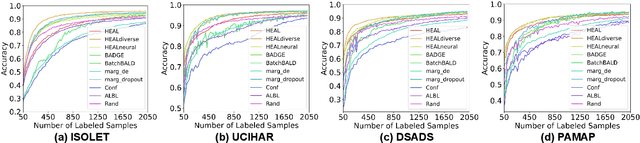
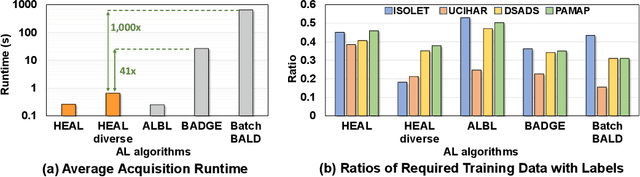
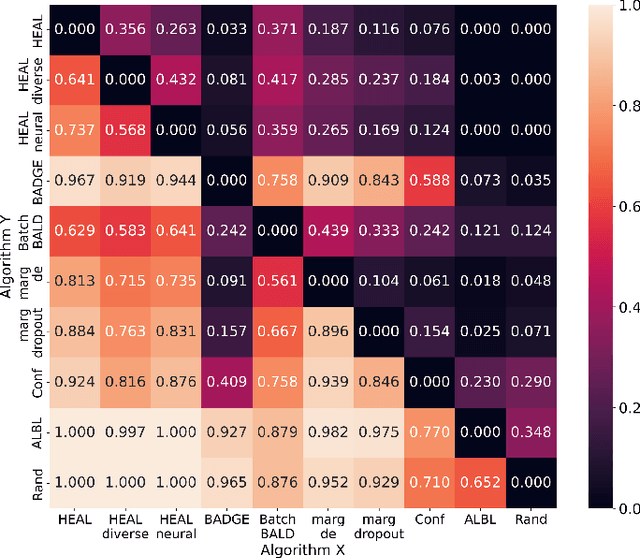
Drawing inspiration from the outstanding learning capability of our human brains, Hyperdimensional Computing (HDC) emerges as a novel computing paradigm, and it leverages high-dimensional vector presentation and operations for brain-like lightweight Machine Learning (ML). Practical deployments of HDC have significantly enhanced the learning efficiency compared to current deep ML methods on a broad spectrum of applications. However, boosting the data efficiency of HDC classifiers in supervised learning remains an open question. In this paper, we introduce Hyperdimensional Efficient Active Learning (HEAL), a novel Active Learning (AL) framework tailored for HDC classification. HEAL proactively annotates unlabeled data points via uncertainty and diversity-guided acquisition, leading to a more efficient dataset annotation and lowering labor costs. Unlike conventional AL methods that only support classifiers built upon deep neural networks (DNN), HEAL operates without the need for gradient or probabilistic computations. This allows it to be effortlessly integrated with any existing HDC classifier architecture. The key design of HEAL is a novel approach for uncertainty estimation in HDC classifiers through a lightweight HDC ensemble with prior hypervectors. Additionally, by exploiting hypervectors as prototypes (i.e., compact representations), we develop an extra metric for HEAL to select diverse samples within each batch for annotation. Our evaluation shows that HEAL surpasses a diverse set of baselines in AL quality and achieves notably faster acquisition than many BNN-powered or diversity-guided AL methods, recording 11 times to 40,000 times speedup in acquisition runtime per batch.