 Add to Chrome
 Add to Firefox
 Add to Edge
HRVConformer: Neonatal Hypoxic-Ischemic Encephalopathy Classification from the Heart Rate signals
May 25, 2026
This paper presents the HRVConformer, a novel deep learning architecture for the classification of hypoxic-ischemic encephalopathy (HIE) using the instantaneous heart rate (HR) signal. Unlike conventional approaches that rely on handcrafted features, HRVConformer directly processes raw HR signals in an end-to-end manner, capturing both local and long-range dependencies through a hybrid Convolution-Transformer framework. By integrating convolutional layers for local feature extraction and Transformer-based attention mechanisms for global context modelling, the architecture effectively enhances signal representation and classification performance. The model was trained using supervised learning on a large HR dataset consisting of 1,573 one-hour epochs, including 259 one-hour expert-annotated epochs and a substantial set of weakly labelled data. A 314-hour validation set provided a robust performance estimation, while an independent 215-hour dataset with expert annotations was reserved for final testing. HR signals were extracted from electrocardiogram (ECG) recordings using an improved Pan-Tompkins algorithm, which significantly enhanced both signal quality and data availability. Experimental results demonstrate that the HRVConformer achieves an AUC of 83.23\% and accuracy of 74.56\% on the test set. These results surpass the performance of the Transformer, ResNet50 and fully convolutional networks baselines, highlighting the advantages of integrating convolutional and Transformer-based components for HR-based HIE classification. The proposed method provides a promising step toward a more accurate and automated assessment of HIE using HR signals. The code is available at: https://github.com/syu-kylin/HRVConformer.

Neonatal EEG graded for severity of background abnormalities in hypoxic-ischaemic encephalopathy
Jun 09, 2022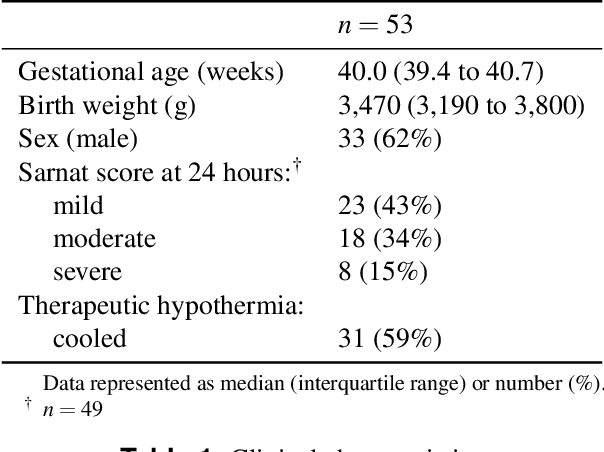
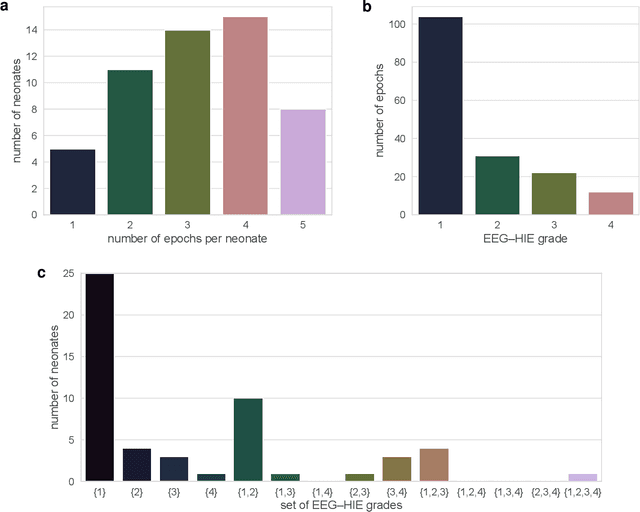
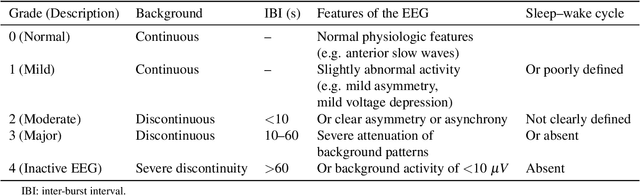
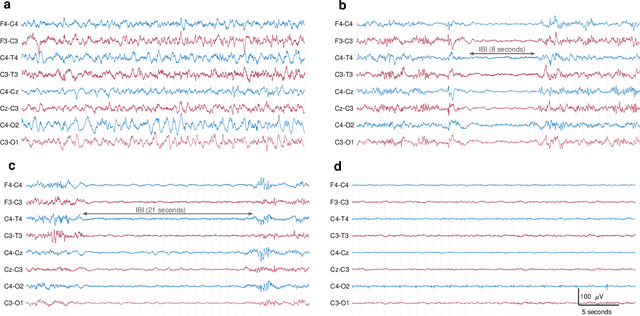
This report describes a set of neonatal electroencephalogram (EEG) recordings graded according to the severity of abnormalities in the background pattern. The dataset consists of 169 hours of multichannel EEG from 53 neonates recorded in a neonatal intensive care unit. All neonates received a diagnosis of hypoxic-ischaemic encephalopathy (HIE), the most common cause of brain injury in full term infants. For each neonate, multiple 1-hour epochs of good quality EEG were selected and then graded for background abnormalities. The grading system assesses EEG attributes such as amplitude and frequency, continuity, sleep-wake cycling, symmetry and synchrony, and abnormal waveforms. Background severity was then categorised into 4 grades: normal or mildly abnormal, moderately abnormal, severely abnormal, and inactive EEG. The data can be used as a reference set of multi-channel EEG for neonates with HIE, for EEG training purposes, or for developing and evaluating automated grading algorithms.