 Add to Chrome
 Add to Firefox
 Add to Edge
How much of an LLM-generated clinical corpus is actually new? A production-scale measurement of content redundancy for provenance classification
Jun 28, 2026
Clinical machine learning increasingly relies on training corpora generated by large language models (LLMs) rather than annotated by clinicians, and such corpora are described and reused largely on the basis of their reported scale. We test whether volume reflects information content. Analysing the complete output of a multi-agent clinical extraction pipeline applied to 167,034 patient narratives, 2.51 billion generated tokens across the ten text-bearing channels of an eleven-channel pipeline, we introduce Provenance-based Redundancy Decomposition, a token-level classification of the entire output by source. Only 10.9% of the output is trainable-unique content while 79.4% is redundant; raw token count overstates information content by roughly ninefold. The redundancy arises through two distinct mechanisms, verbatim copying of source context into per-item fields, and duplication of generated text across records, of which only the former is losslessly removable. An independent, model-free analysis based on lossless compression confirms the redundancy, recovering the two mechanisms without reference to the provenance labels. One pipeline channel carries almost no redundancy, showing that the level of redundancy depends on how each channel is structured rather than being a fixed property of LLM extraction. Because uncorrected redundancy up-weights the longer, more complex presentations that generate the most items, it skews the token-level training distribution of the corpus, a property we measure directly. In a controlled downstream test, de-duplicating the corpus before adaptation improved a clinical encoder on external disease-recognition benchmarks at equal token budget, robustly across adaptation depths and replicated on a second benchmark, confirming that the redundancy carries a measurable cost beyond storage. The classification tool is released openly.

Ecological Neural Architecture Search
Mar 13, 2025When employing an evolutionary algorithm to optimize a neural networks architecture, developers face the added challenge of tuning the evolutionary algorithm's own hyperparameters - population size, mutation rate, cloning rate, and number of generations. This paper introduces Neuvo Ecological Neural Architecture Search (ENAS), a novel method that incorporates these evolutionary parameters directly into the candidate solutions' phenotypes, allowing them to evolve dynamically alongside architecture specifications. Experimental results across four binary classification datasets demonstrate that ENAS not only eliminates manual tuning of evolutionary parameters but also outperforms competitor NAS methodologies in convergence speed (reducing computational time by 18.3%) and accuracy (improving classification performance in 3 out of 4 datasets). By enabling "greedy individuals" to optimize resource allocation based on fitness, ENAS provides an efficient, self-regulating approach to neural architecture search.
A new hybrid metric for verifying parallel corpora of Arabic-English
Feb 12, 2015

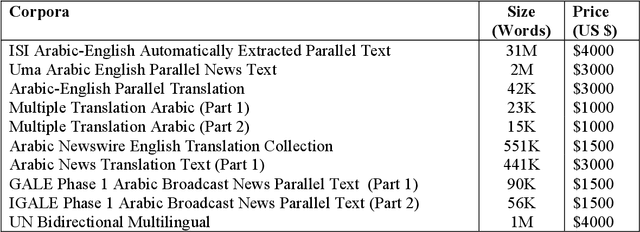

This paper discusses a new metric that has been applied to verify the quality in translation between sentence pairs in parallel corpora of Arabic-English. This metric combines two techniques, one based on sentence length and the other based on compression code length. Experiments on sample test parallel Arabic-English corpora indicate the combination of these two techniques improves accuracy of the identification of satisfactory and unsatisfactory sentence pairs compared to sentence length and compression code length alone. The new method proposed in this research is effective at filtering noise and reducing mis-translations resulting in greatly improved quality.