 Add to Chrome
 Add to Firefox
 Add to Edge
MONET -- Virtual Cell Painting of Brightfield Images and Time Lapses Using Reference Consistent Diffusion
Dec 12, 2025
Cell painting is a popular technique for creating human-interpretable, high-contrast images of cell morphology. There are two major issues with cell paint: (1) it is labor-intensive and (2) it requires chemical fixation, making the study of cell dynamics impossible. We train a diffusion model (Morphological Observation Neural Enhancement Tool, or MONET) on a large dataset to predict cell paint channels from brightfield images. We show that model quality improves with scale. The model uses a consistency architecture to generate time-lapse videos, despite the impossibility of obtaining cell paint video training data. In addition, we show that this architecture enables a form of in-context learning, allowing the model to partially transfer to out-of-distribution cell lines and imaging protocols. Virtual cell painting is not intended to replace physical cell painting completely, but to act as a complementary tool enabling novel workflows in biological research.

MUMU: Bootstrapping Multimodal Image Generation from Text-to-Image Data
Jun 26, 2024We train a model to generate images from multimodal prompts of interleaved text and images such as "a <picture of a man> man and his <picture of a dog> dog in an <picture of a cartoon> animated style." We bootstrap a multimodal dataset by extracting semantically meaningful image crops corresponding to words in the image captions of synthetically generated and publicly available text-image data. Our model, MUMU, is composed of a vision-language model encoder with a diffusion decoder and is trained on a single 8xH100 GPU node. Despite being only trained on crops from the same image, MUMU learns to compose inputs from different images into a coherent output. For example, an input of a realistic person and a cartoon will output the same person in the cartoon style, and an input of a standing subject and a scooter will output the subject riding the scooter. As a result, our model generalizes to tasks such as style transfer and character consistency. Our results show the promise of using multimodal models as general purpose controllers for image generation.
aMUSEd: An Open MUSE Reproduction
Jan 03, 2024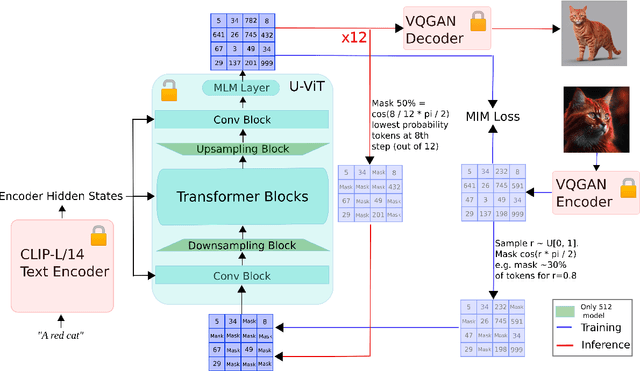
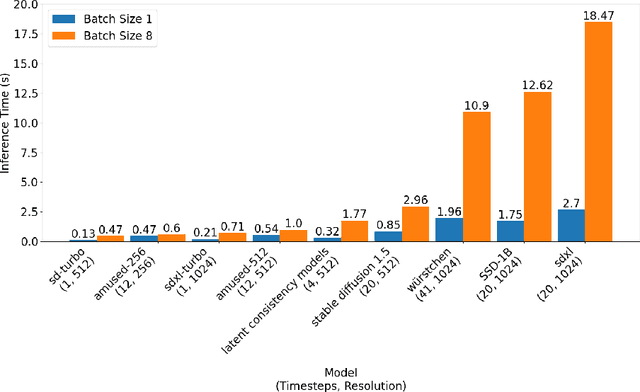
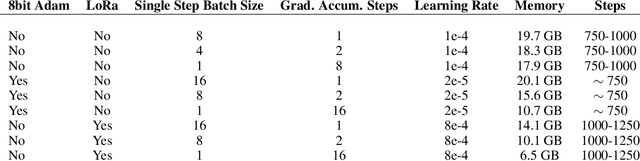

We present aMUSEd, an open-source, lightweight masked image model (MIM) for text-to-image generation based on MUSE. With 10 percent of MUSE's parameters, aMUSEd is focused on fast image generation. We believe MIM is under-explored compared to latent diffusion, the prevailing approach for text-to-image generation. Compared to latent diffusion, MIM requires fewer inference steps and is more interpretable. Additionally, MIM can be fine-tuned to learn additional styles with only a single image. We hope to encourage further exploration of MIM by demonstrating its effectiveness on large-scale text-to-image generation and releasing reproducible training code. We also release checkpoints for two models which directly produce images at 256x256 and 512x512 resolutions.