 Add to Chrome
 Add to Firefox
 Add to Edge
End-to-End Multi-Person Pose Estimation with Pose-Aware Video Transformer
Nov 17, 2025
Existing multi-person video pose estimation methods typically adopt a two-stage pipeline: detecting individuals in each frame, followed by temporal modeling for single-person pose estimation. This design relies on heuristic operations such as detection, RoI cropping, and non-maximum suppression (NMS), limiting both accuracy and efficiency. In this paper, we present a fully end-to-end framework for multi-person 2D pose estimation in videos, effectively eliminating heuristic operations. A key challenge is to associate individuals across frames under complex and overlapping temporal trajectories. To address this, we introduce a novel Pose-Aware Video transformEr Network (PAVE-Net), which features a spatial encoder to model intra-frame relations and a spatiotemporal pose decoder to capture global dependencies across frames. To achieve accurate temporal association, we propose a pose-aware attention mechanism that enables each pose query to selectively aggregate features corresponding to the same individual across consecutive frames.Additionally, we explicitly model spatiotemporal dependencies among pose keypoints to improve accuracy. Notably, our approach is the first end-to-end method for multi-frame 2D human pose estimation.Extensive experiments show that PAVE-Net substantially outperforms prior image-based end-to-end methods, achieving a \textbf{6.0} mAP improvement on PoseTrack2017, and delivers accuracy competitive with state-of-the-art two-stage video-based approaches, while offering significant gains in efficiency.Project page: https://github.com/zgspose/PAVENet

Multi-threshold Deep Metric Learning for Facial Expression Recognition
Jun 24, 2024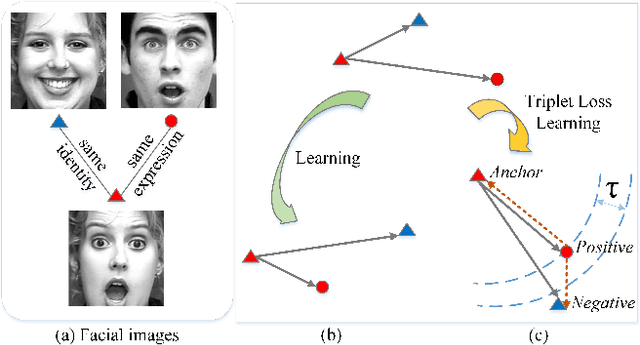
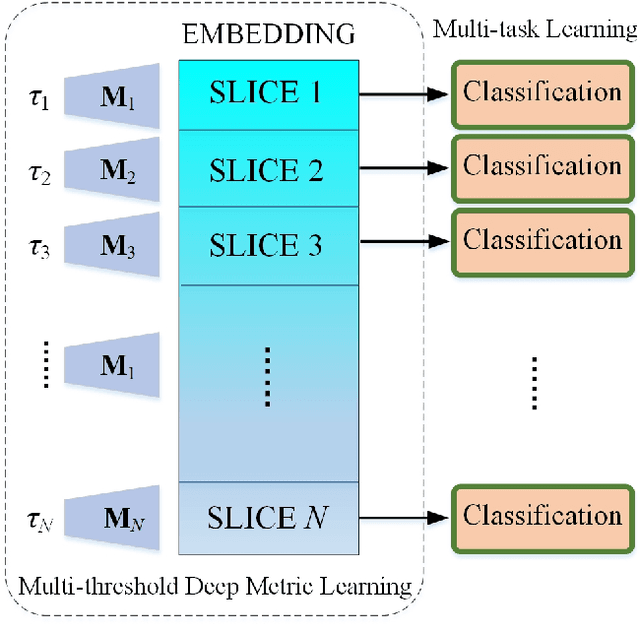
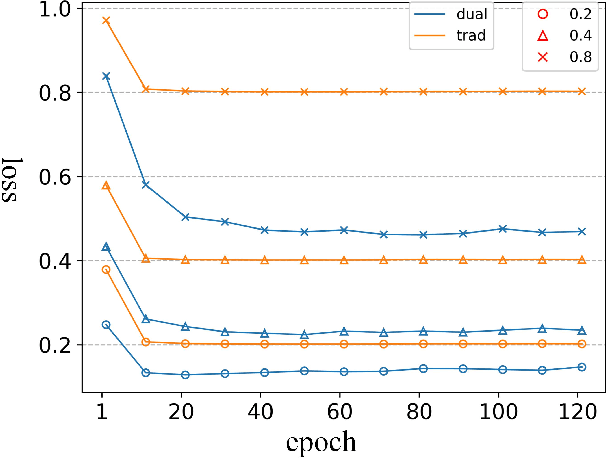
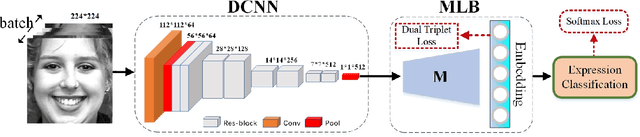
Effective expression feature representations generated by a triplet-based deep metric learning are highly advantageous for facial expression recognition (FER). The performance of triplet-based deep metric learning is contingent upon identifying the best threshold for triplet loss. Threshold validation, however, is tough and challenging, as the ideal threshold changes among datasets and even across classes within the same dataset. In this paper, we present the multi-threshold deep metric learning technique, which not only avoids the difficult threshold validation but also vastly increases the capacity of triplet loss learning to construct expression feature representations. We find that each threshold of the triplet loss intrinsically determines a distinctive distribution of inter-class variations and corresponds, thus, to a unique expression feature representation. Therefore, rather than selecting a single optimal threshold from a valid threshold range, we thoroughly sample thresholds across the range, allowing the representation characteristics manifested by thresholds within the range to be fully extracted and leveraged for FER. To realize this approach, we partition the embedding layer of the deep metric learning network into a collection of slices and model training these embedding slices as an end-to-end multi-threshold deep metric learning problem. Each embedding slice corresponds to a sample threshold and is learned by enforcing the corresponding triplet loss, yielding a set of distinct expression features, one for each embedding slice. It makes the embedding layer, which is composed of a set of slices, a more informative and discriminative feature, hence enhancing the FER accuracy. Extensive evaluations demonstrate the superior performance of the proposed approach on both posed and spontaneous facial expression datasets.
Video-Based Human Pose Regression via Decoupled Space-Time Aggregation
Apr 01, 2024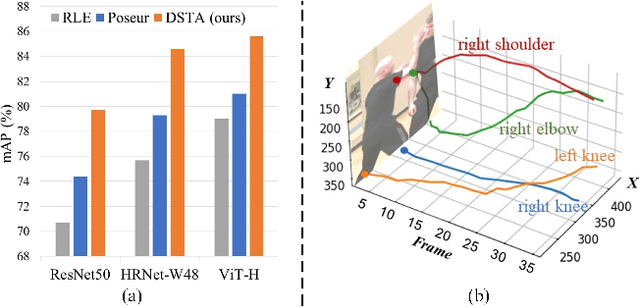
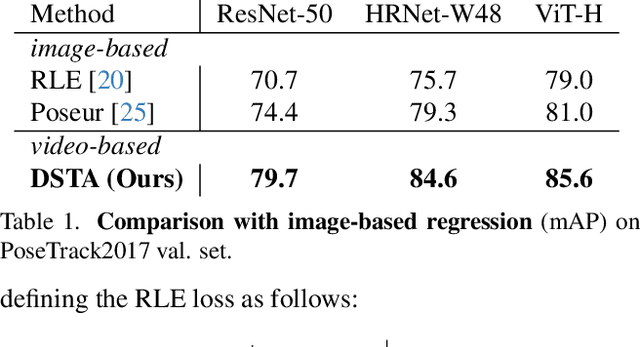
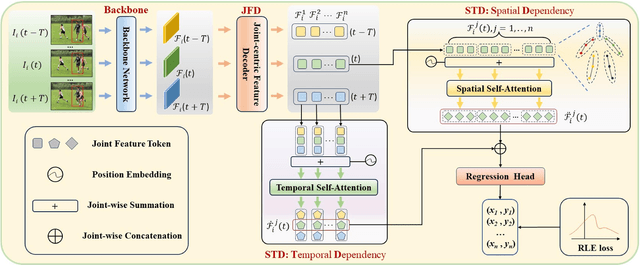
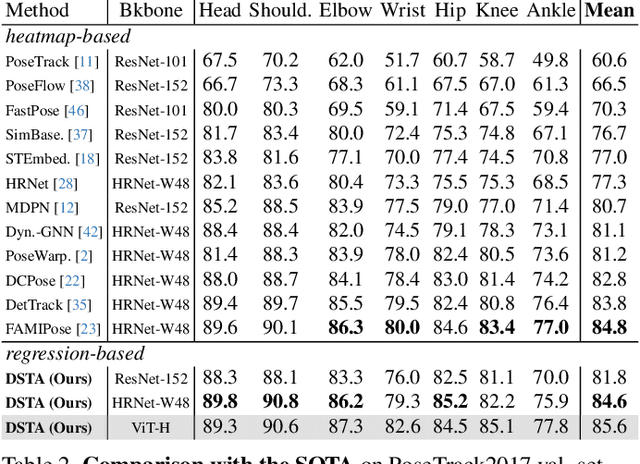
By leveraging temporal dependency in video sequences, multi-frame human pose estimation algorithms have demonstrated remarkable results in complicated situations, such as occlusion, motion blur, and video defocus. These algorithms are predominantly based on heatmaps, resulting in high computation and storage requirements per frame, which limits their flexibility and real-time application in video scenarios, particularly on edge devices. In this paper, we develop an efficient and effective video-based human pose regression method, which bypasses intermediate representations such as heatmaps and instead directly maps the input to the output joint coordinates. Despite the inherent spatial correlation among adjacent joints of the human pose, the temporal trajectory of each individual joint exhibits relative independence. In light of this, we propose a novel Decoupled Space-Time Aggregation network (DSTA) to separately capture the spatial contexts between adjacent joints and the temporal cues of each individual joint, thereby avoiding the conflation of spatiotemporal dimensions. Concretely, DSTA learns a dedicated feature token for each joint to facilitate the modeling of their spatiotemporal dependencies. With the proposed joint-wise local-awareness attention mechanism, our method is capable of efficiently and flexibly utilizing the spatial dependency of adjacent joints and the temporal dependency of each joint itself. Extensive experiments demonstrate the superiority of our method. Compared to previous regression-based single-frame human pose estimation methods, DSTA significantly enhances performance, achieving an 8.9 mAP improvement on PoseTrack2017. Furthermore, our approach either surpasses or is on par with the state-of-the-art heatmap-based multi-frame human pose estimation methods. Project page: https://github.com/zgspose/DSTA.