 Add to Chrome
 Add to Firefox
 Add to Edge
Ozone Cues Mitigate Reflected Downwelling Radiance in LWIR Absorption-Based Ranging
Feb 27, 2026
Passive long-wave infrared (LWIR) absorption-based ranging relies on atmospheric absorption to estimate distances to objects from their emitted thermal radiation. First demonstrated decades ago for objects much hotter than the air and recently extended to scenes with low temperature variations, this ranging has depended on reflected radiance being negligible. Downwelling radiance is especially problematic, sometimes causing large inaccuracies. In two new ranging methods, we use characteristic features from ozone absorption to estimate the contribution of reflected downwelling radiance. The quadspectral method gives a simple closed-form range estimate from four narrowband measurements, two at a water vapor absorption line and two at an ozone absorption line. The hyperspectral method uses a broader spectral range to improve accuracy while also providing estimates of temperature, emissivity profiles, and contributions of downwelling from a collection of zenith angles. Experimental results demonstrate improved ranging accuracy, in one case reducing error from over 100 m when reflected light is not modeled to 6.8 m with the quadspectral method and 1.2 m with the hyperspectral method.

Learning Cross-Video Neural Representations for High-Quality Frame Interpolation
Feb 28, 2022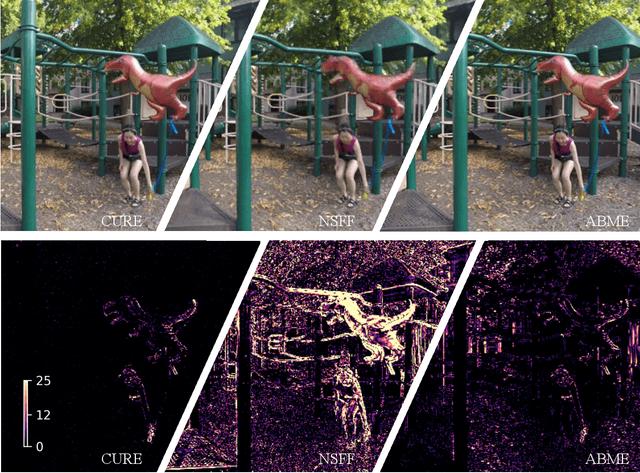
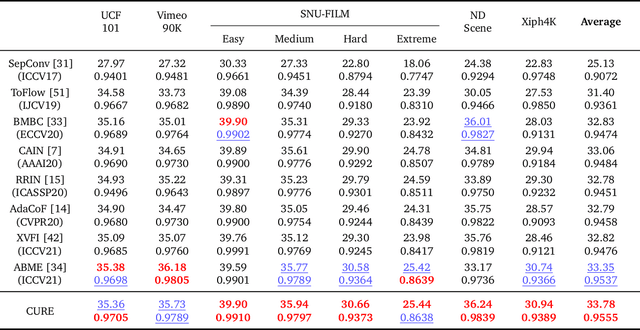
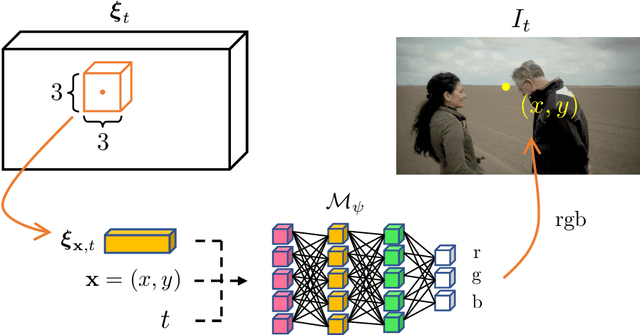
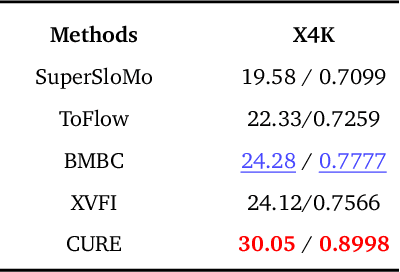
This paper considers the problem of temporal video interpolation, where the goal is to synthesize a new video frame given its two neighbors. We propose Cross-Video Neural Representation (CURE) as the first video interpolation method based on neural fields (NF). NF refers to the recent class of methods for the neural representation of complex 3D scenes that has seen widespread success and application across computer vision. CURE represents the video as a continuous function parameterized by a coordinate-based neural network, whose inputs are the spatiotemporal coordinates and outputs are the corresponding RGB values. CURE introduces a new architecture that conditions the neural network on the input frames for imposing space-time consistency in the synthesized video. This not only improves the final interpolation quality, but also enables CURE to learn a prior across multiple videos. Experimental evaluations show that CURE achieves the state-of-the-art performance on video interpolation on several benchmark datasets.