 Add to Chrome
 Add to Firefox
 Add to Edge
FlowCodec: One-Step Flow Prior for Generative Image Compression
Jun 19, 2026
Diffusion-based image compression methods, leveraging powerful generative priors, have demonstrated remarkable perceptual quality at ultra-low bitrates. However, adapting modern generative models to image compression often relies on carefully engineered conditioning or auxiliary branches, together with substantial retraining, and these costs grow as the models scale. This motivates an open question: Can stronger generative priors be integrated into compression through a simpler, more extensible design? To answer this, we propose FlowCodec, a streamlined framework that plugs pretrained large-scale text-to-image priors (e.g., Qwen-image-2512 and FLUX.1-dev) into ultra-low-bitrate codecs. FlowCodec decomposes the pipeline into two decoupled stages: (1) Latent Compression, which maps clean latents to bitrate-constrained noisy latents; and (2) Latent Transport, which leverages the pretrained prior to refine the noisy latents toward the clean ones in a single step. Notably, FlowCodec requires neither additional conditioning signals nor auxiliary networks. Furthermore, with lightweight adaptation, it can flexibly support multiple bitrates while keeping the number of trainable parameters below 0.54% of the generative backbone. Experiments show that FlowCodec preserves high visual quality at bitrates below 0.05 bits per pixel. The Qwen-image variant significantly outperforms existing methods in terms of LPIPS and DISTS, while both variants deliver higher PSNR and clearly faster encoding than existing one-step diffusion-based methods, with the FLUX variant also maintaining competitive decoding speed.

Efficient Learned Image Compression without Entropy Coding
May 22, 2026Entropy coding is widely used in typical learned image compression (LIC) that converts latents into a compact bitstream. However, entropy coding is typically sequential and becomes the coding latency bottleneck. To overcome it, we present Entropy-Coding Free Learned Image Compression (EF-LIC), a multi-rate framework that generates compact representation by removing statistical and correlation redundancy with low coding latency. First, we introduce unconstrained vector quantization and prove that its index distribution approaches the maximum-entropy bound, yielding minimal statistical redundancy. Second, we propose a context-conditioned autoregressive transform that directly reparameterizes the latents to reduce inter-dependency. Theoretical analysis shows that EF-LIC can remove correlation redundancy as effectively as typical LIC with entropy coding, leading to comparable compression performance. Experiments show EF-LIC achieves up to 67.86% bitrate reduction over MS-ILLM on Kodak with LPIPS. Ablation studies further show EF-LIC matches the compression performance of its entropy-coding based variant while achieving over $3\times$ faster encoding and $5\times$ faster decoding.
Generalizable 3D Gaussian Splatting enabled Semantic Coding for Real-Time Immersive Video Communications
Apr 28, 2026Real-time immersive video communications, particularly high-fidelity 3D telepresence, necessitates a synergistic balance between instantaneous dynamic scene reconstruction and high-efficiency data transmission. While recent advancements in feed-forward 3D Gaussian Splatting (3DGS) have enabled real-time rendering, performing multi-view video coding and 3D reconstruction in a decoupled manner leads to suboptimal compression efficiency and high computational complexity. To address this, we propose GS-SCNet, the first unified end-to-end framework that seamlessly integrates generalizable 3DGS reconstruction with a dedicated deep Semantic Coding pipeline. Our architecture is underpinned by two core technical contributions: (i) we introduce a Disparity-Guided Parallel Semantic Codec that exploits epipolar geometric priors to facilitate cross-view contextual interaction via disparity compensation and semantic fusion, thereby enabling real-time parallel processing of stereo streams while significantly enhancing rate-distortion performance, and (ii) we develop a Lightweight Gaussian Parameter Predictor which directly projects decoded semantic latents into 3DGS attributes, obviating the need for intermediate pixel-domain reconstruction. By coupling the codec with the task-specific predictor, our framework extracts geometric correlations only once, effectively eliminating the redundant computational bottleneck inherent in conventional decoupled paradigms. Extensive evaluations on both synthetic and real-world human datasets demonstrate that GS-SCNet achieves a superior trade-off across compression efficiency, rendering quality, and real-time performance. Notably, our framework exhibits strong cross-domain generalization and robustness against compression artifacts when applied to out-of-domain real-world data, significantly outperforming conventional decoupled transmission paradigms.
ProGIC: Progressive and Lightweight Generative Image Compression with Residual Vector Quantization
Mar 03, 2026Recent advances in generative image compression (GIC) have delivered remarkable improvements in perceptual quality. However, many GICs rely on large-scale and rigid models, which severely constrain their utility for flexible transmission and practical deployment in low-bitrate scenarios. To address these issues, we propose Progressive Generative Image Compression (ProGIC), a compact codec built on residual vector quantization (RVQ). In RVQ, a sequence of vector quantizers encodes the residuals stage by stage, each with its own codebook. The resulting codewords sum to a coarse-to-fine reconstruction and a progressive bitstream, enabling previews from partial data. We pair this with a lightweight backbone based on depthwise-separable convolutions and small attention blocks, enabling practical deployment on both GPUs and CPU-only devices. Experimental results show that ProGIC attains comparable compression performance compared with previous methods. It achieves bitrate savings of up to 57.57% on DISTS and 58.83% on LPIPS compared to MS-ILLM on the Kodak dataset. Beyond perceptual quality, ProGIC enables progressive transmission for flexibility, and also delivers over 10 times faster encoding and decoding compared with MS-ILLM on GPUs for efficiency.
FaceLinkGen: Rethinking Identity Leakage in Privacy-Preserving Face Recognition with Identity Extraction
Feb 02, 2026Transformation-based privacy-preserving face recognition (PPFR) aims to verify identities while hiding facial data from attackers and malicious service providers. Existing evaluations mostly treat privacy as resistance to pixel-level reconstruction, measured by PSNR and SSIM. We show that this reconstruction-centric view fails. We present FaceLinkGen, an identity extraction attack that performs linkage/matching and face regeneration directly from protected templates without recovering original pixels. On three recent PPFR systems, FaceLinkGen reaches over 98.5\% matching accuracy and above 96\% regeneration success, and still exceeds 92\% matching and 94\% regeneration in a near zero knowledge setting. These results expose a structural gap between pixel distortion metrics, which are widely used in PPFR evaluation, and real privacy. We show that visual obfuscation leaves identity information broadly exposed to both external intruders and untrusted service providers.
LangGas: Introducing Language in Selective Zero-Shot Background Subtraction for Semi-Transparent Gas Leak Detection with a New Dataset
Mar 06, 2025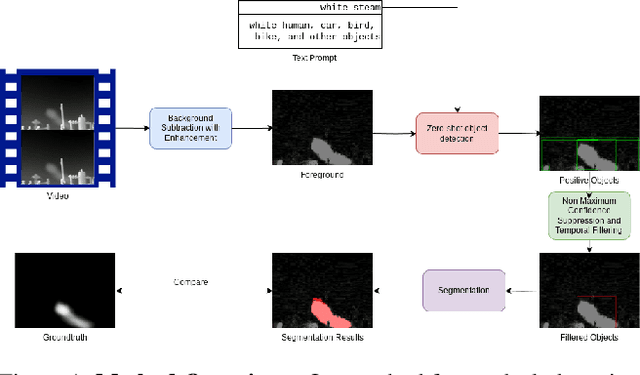
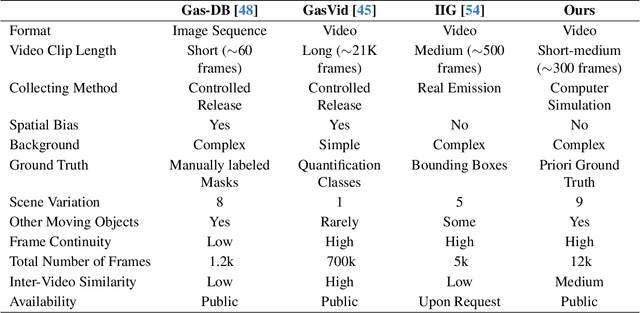


Gas leakage poses a significant hazard that requires prevention. Traditionally, human inspection has been used for detection, a slow and labour-intensive process. Recent research has applied machine learning techniques to this problem, yet there remains a shortage of high-quality, publicly available datasets. This paper introduces a synthetic dataset featuring diverse backgrounds, interfering foreground objects, diverse leak locations, and precise segmentation ground truth. We propose a zero-shot method that combines background subtraction, zero-shot object detection, filtering, and segmentation to leverage this dataset. Experimental results indicate that our approach significantly outperforms baseline methods based solely on background subtraction and zero-shot object detection with segmentation, reaching an IoU of 69\% overall. We also present an analysis of various prompt configurations and threshold settings to provide deeper insights into the performance of our method. The code and dataset will be released after publication.
Metric Search for Rank List Compatibility Matching with Applications
Mar 14, 2023As online dating has become more popular in the past few years, an efficient and effective algorithm to match users is needed. In this project, we proposed a new dating matching algorithm that uses Kendall-Tau distance to measure the similarity between users based on their ranking for items in a list. (e.g., their favourite sports, music, etc.) To increase the performance of the search process, we applied a tree-based searching structure, Cascading Metric Tree (CMT), on this metric. The tree is built on ranked lists from all the users; when a query target and a radius are provided, our algorithm can return users within the radius of the target. We tested the scaling of this searching method on a synthetic dataset by varying list length, population size, and query radius. We observed that the algorithm is able to query the best matching people for the user in a practical time, given reasonable parameters. We also provided potential future improvements that can be made to this algorithm based on the limitations. Finally, we offered more use cases of this search structure on Kendall-Tau distance and new insight into real-world applications of distance search structures.