 Add to Chrome
 Add to Firefox
 Add to Edge
In Depth We Trust: Reliable Monocular Depth Supervision for Gaussian Splatting
Apr 07, 2026
Using accurate depth priors in 3D Gaussian Splatting helps mitigate artifacts caused by sparse training data and textureless surfaces. However, acquiring accurate depth maps requires specialized acquisition systems. Foundation monocular depth estimation models offer a cost-effective alternative, but they suffer from scale ambiguity, multi-view inconsistency, and local geometric inaccuracies, which can degrade rendering performance when applied naively. This paper addresses the challenge of reliably leveraging monocular depth priors for Gaussian Splatting (GS) rendering enhancement. To this end, we introduce a training framework integrating scale-ambiguous and noisy depth priors into geometric supervision. We highlight the importance of learning from weakly aligned depth variations. We introduce a method to isolate ill-posed geometry for selective monocular depth regularization, restricting the propagation of depth inaccuracies into well-reconstructed 3D structures. Extensive experiments across diverse datasets show consistent improvements in geometric accuracy, leading to more faithful depth estimation and higher rendering quality across different GS variants and monocular depth backbones tested.

NeRF Director: Revisiting View Selection in Neural Volume Rendering
Jun 13, 2024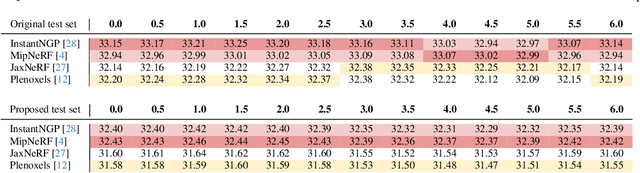
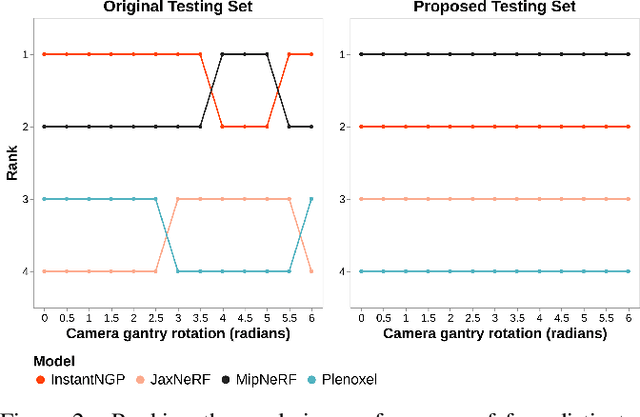
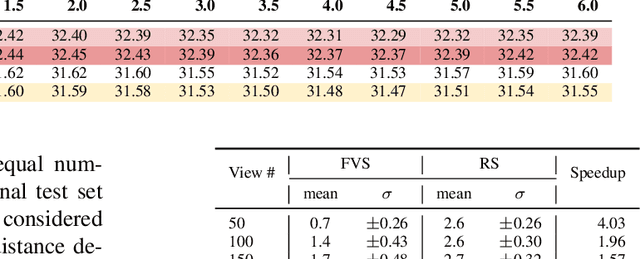
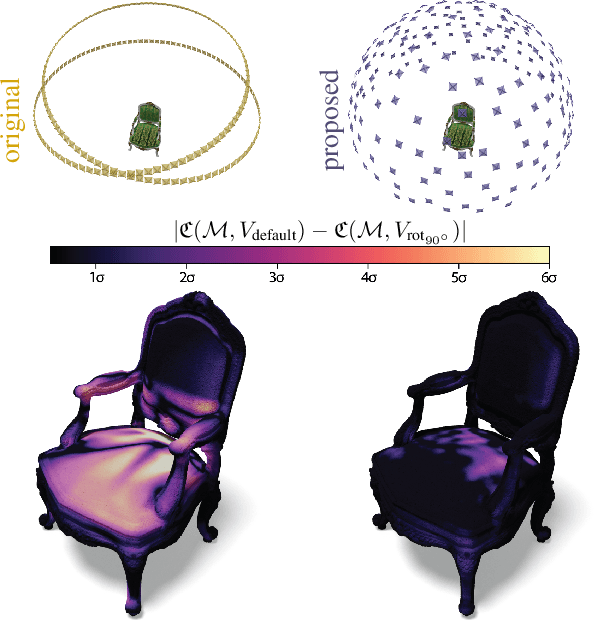
Neural Rendering representations have significantly contributed to the field of 3D computer vision. Given their potential, considerable efforts have been invested to improve their performance. Nonetheless, the essential question of selecting training views is yet to be thoroughly investigated. This key aspect plays a vital role in achieving high-quality results and aligns with the well-known tenet of deep learning: "garbage in, garbage out". In this paper, we first illustrate the importance of view selection by demonstrating how a simple rotation of the test views within the most pervasive NeRF dataset can lead to consequential shifts in the performance rankings of state-of-the-art techniques. To address this challenge, we introduce a unified framework for view selection methods and devise a thorough benchmark to assess its impact. Significant improvements can be achieved without leveraging error or uncertainty estimation but focusing on uniform view coverage of the reconstructed object, resulting in a training-free approach. Using this technique, we show that high-quality renderings can be achieved faster by using fewer views. We conduct extensive experiments on both synthetic datasets and realistic data to demonstrate the effectiveness of our proposed method compared with random, conventional error-based, and uncertainty-guided view selection.