 Add to Chrome
 Add to Firefox
 Add to Edge
A Camera-Cooperative ISAC Framework for Multimodal Non-Cooperative UAVs Sensing
May 21, 2026
The detection of non-cooperative unmanned aerial vehicles (UAVs) presents significant challenges for Integrated Sensing and Communication (ISAC) systems due to the inherent limitations of single-modal perception and the competition for shared communication and sensing resources. To address these challenges, this paper proposes a novel Camera-Cooperative ISAC (CC-ISAC) framework that employs multimodal sensing to enable efficient UAV beam steering and tracking. The proposed framework employs cameras for coarse-grained airspace monitoring and utilizes ISAC for fine-grained, high-precision sensing, forming a complementary perception loop that enhances both sensing accuracy and resource efficiency. Within this framework, two key modules are developed: (1) a Vision-to-Echo Data Alignment (V2EDA) model that aligns visual and echo-domain features through cross-attention mechanisms, and (2) a Multimodal Fusion-Based Estimation (MMFE) model that integrates historical multimodal data with current observations for robust state estimation. Extensive evaluations conducted on the DeepSense 6G dataset demonstrate that the proposed framework achieves an average reduction of 71% in beam steering overhead and 1.69-11.15% in tracking overhead while maintaining high angular estimation accuracy. The CC-ISAC framework effectively mitigates resource contention between sensing and communication, enabling reliable UAV surveillance while freeing substantial system resources for additional communication tasks, thereby representing a practical advancement in ISAC system design.

A Vision-Based Tactile Sensing System for Multimodal Contact Information Perception via Neural Network
Oct 03, 2023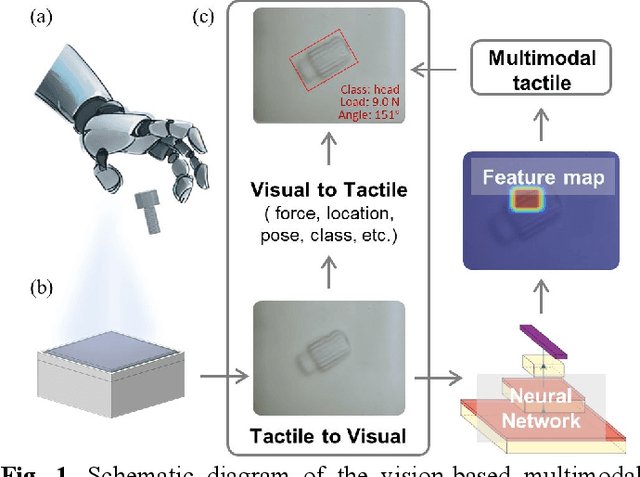
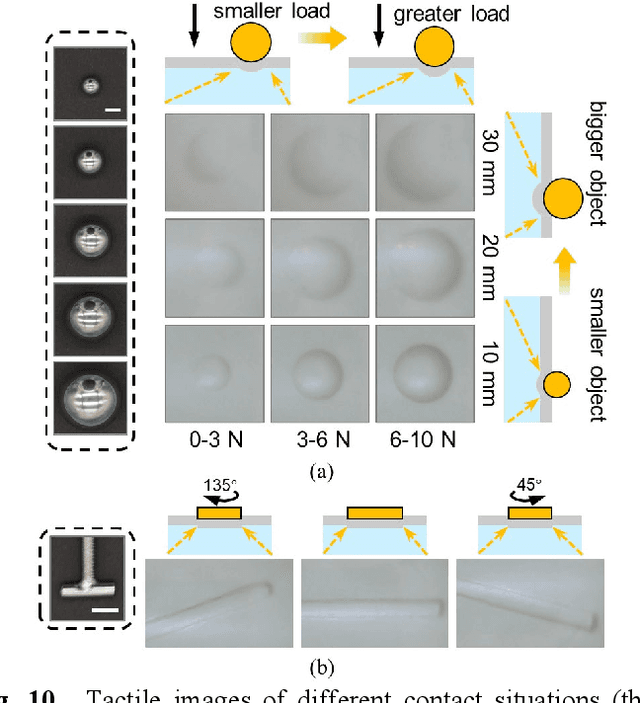
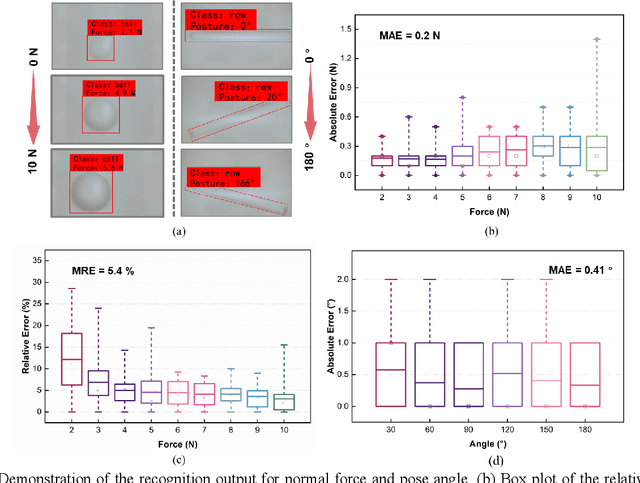
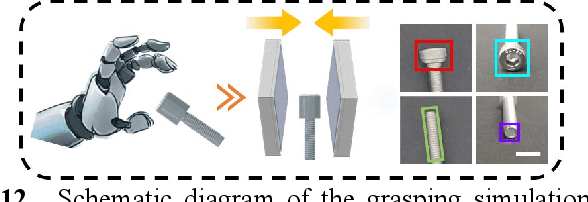
In general, robotic dexterous hands are equipped with various sensors for acquiring multimodal contact information such as position, force, and pose of the grasped object. This multi-sensor-based design adds complexity to the robotic system. In contrast, vision-based tactile sensors employ specialized optical designs to enable the extraction of tactile information across different modalities within a single system. Nonetheless, the decoupling design for different modalities in common systems is often independent. Therefore, as the dimensionality of tactile modalities increases, it poses more complex challenges in data processing and decoupling, thereby limiting its application to some extent. Here, we developed a multimodal sensing system based on a vision-based tactile sensor, which utilizes visual representations of tactile information to perceive the multimodal contact information of the grasped object. The visual representations contain extensive content that can be decoupled by a deep neural network to obtain multimodal contact information such as classification, position, posture, and force of the grasped object. The results show that the tactile sensing system can perceive multimodal tactile information using only one single sensor and without different data decoupling designs for different modal tactile information, which reduces the complexity of the tactile system and demonstrates the potential for multimodal tactile integration in various fields such as biomedicine, biology, and robotics.