 Add to Chrome
 Add to Firefox
 Add to Edge
Deep Psychovisual Image Representations
May 28, 2026
Psychovisual models suggest human vision decouples low-level feature extraction from higher cognition by first forming intermediate abstractions. In contrast, deep learning-based vision models routinely extract and aggregate features using homogeneous stacks of spatial layers, rendering their decision-making processes opaque. In this paper, we propose Deep Visual Coding, a learned frequency-domain representation inspired by 1990s image codes that quantised perceptually salient frequencies, which together with complex-valued image representations produces psychovisual-style abstractions. This approach enables the first psychovisual-based deep learning framework, utilizing data-driven spectral filters that learn to encode task-relevant semantic structures within distinct frequency sub-bands. Salience analyses reveal that our psychovisual models extract highly interpretable object parts compared to the amorphous regions produced by regular Convolutional Neural Networks (CNNs). Furthermore, we find that our models are less depth dependent than CNNs for model scaling, since our complex-valued representations and learned abstractions subsume the role of the deep spatial layers. Together, these findings demonstrate that psychovisual coding provides a promising path toward more efficient and transparent vision models.

Multi-scale MRI reconstruction via dilated ensemble networks
Oct 07, 2023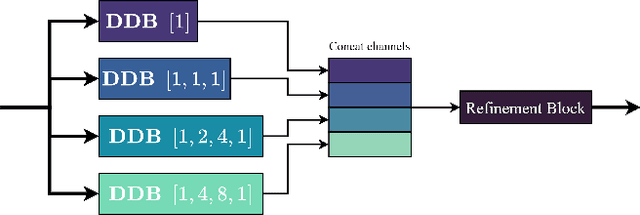


As aliasing artefacts are highly structural and non-local, many MRI reconstruction networks use pooling to enlarge filter coverage and incorporate global context. However, this inadvertently impedes fine detail recovery as downsampling creates a resolution bottleneck. Moreover, real and imaginary features are commonly split into separate channels, discarding phase information particularly important to high frequency textures. In this work, we introduce an efficient multi-scale reconstruction network using dilated convolutions to preserve resolution and experiment with a complex-valued version using complex convolutions. Inspired by parallel dilated filters, multiple receptive fields are processed simultaneously with branches that see both large structural artefacts and fine local features. We also adopt dense residual connections for feature aggregation to efficiently increase scale and the deep cascade global architecture to reduce overfitting. The real-valued version of this model outperformed common reconstruction architectures as well as a state-of-the-art multi-scale network whilst being three times more efficient. The complex-valued network yielded better qualitative results when more phase information was present.