 Add to Chrome
 Add to Firefox
 Add to Edge
Lynx: Progressive Speculative Quantization for accelerating KV Transfer in Long-Context Inference
Jul 02, 2026
Long-context inference is increasingly common in large language model (LLM) serving, driven by retrieval-augmented generation and agentic systems. In disaggregated inference, these workloads require transferring large Key-Value (KV) caches across the network, where decoding cannot begin until the transfer completes. Recent KV quantization techniques reduce data volume and alleviate this bottleneck, but existing schemes fail to achieve both low network-exposed latency and high inference accuracy. We challenge the assumption that the KV cache is an indivisible unit that must be fully received before use. We leverage the observation that different bits in the KV cache contribute unequally to attention computation and inference precision: the most significant bits capture the coarse structure of attention and the least significant bits refine precision. This property enables partial use of the KV cache during decoding. We present Lynx, a system that enables progressive, split-stream KV transfer by partitioning the KV cache into a high-priority Anchor stream carrying the most significant bits and a low-priority Residual stream carrying remaining precision. Decoding begins upon receipt of the Anchor stream and proceeds speculatively while the Residual stream is transferred concurrently, followed by verification that ensures equivalence to higher-precision decoding. Across multiple models and serving workloads, Lynx achieves Time-to-First-Token (TTFT) comparable to aggressive 4-bit KV quantization, while matching the accuracy of high-precision (BF16) inference, improving TTFT over standard 8-bit KV quantization by up to $1.43\times$ and improving accuracy over state-of-the-art by up to $5.1\%$.

DynamiQ: Accelerating Gradient Synchronization using Compressed Multi-hop All-reduce
Feb 09, 2026Multi-hop all-reduce is the de facto backbone of large model training. As the training scale increases, the network often becomes a bottleneck, motivating reducing the volume of transmitted data. Accordingly, recent systems demonstrated significant acceleration of the training process using gradient quantization. However, these systems are not optimized for multi-hop aggregation, where entries are partially summed multiple times along their aggregation topology. This paper presents DynamiQ, a quantization framework that bridges the gap between quantization best practices and multi-hop aggregation. DynamiQ introduces novel techniques to better represent partial sums, co-designed with a decompress-accumulate-recompress fused kernel to facilitate fast execution. We extended PyTorch DDP to support DynamiQ over NCCL P2P, and across different LLMs, tasks, and scales, we demonstrate consistent improvement of up to 34.2% over the best among state-of-the-art methods such as Omni-Reduce, THC, and emerging standards such as MXFP4, MXFP6, and MXFP8. Further, DynamiQ is the only evaluated method that consistently reaches near-baseline accuracy (e.g., 99.9% of the BF16 baseline) and does so while significantly accelerating the training.
Beyond Throughput and Compression Ratios: Towards High End-to-end Utility of Gradient Compression
Jul 01, 2024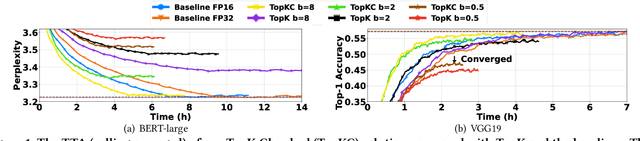
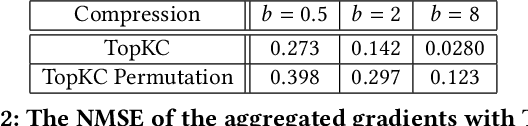
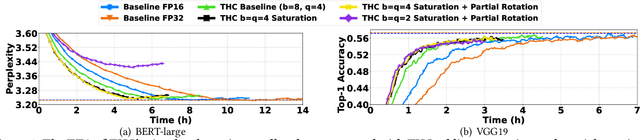
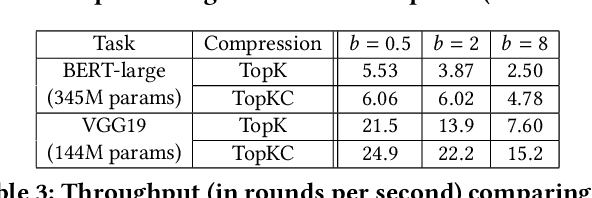
Gradient aggregation has long been identified as a major bottleneck in today's large-scale distributed machine learning training systems. One promising solution to mitigate such bottlenecks is gradient compression, directly reducing communicated gradient data volume. However, in practice, many gradient compression schemes do not achieve acceleration of the training process while also preserving accuracy. In this work, we identify several common issues in previous gradient compression systems and evaluation methods. These issues include excessive computational overheads; incompatibility with all-reduce; and inappropriate evaluation metrics, such as not using an end-to-end metric or using a 32-bit baseline instead of a 16-bit baseline. We propose several general design and evaluation techniques to address these issues and provide guidelines for future work. Our preliminary evaluation shows that our techniques enhance the system's performance and provide a clearer understanding of the end-to-end utility of gradient compression methods.