 Add to Chrome
 Add to Firefox
 Add to Edge
Towards Self-Evolving Agentic Literature Retrieval
May 14, 2026
As large language models reshape scientific research, literature retrieval faces a twofold challenge: ensuring source authenticity while maintaining a deep comprehension of academic search intents. While reliable, traditional keyword-centric search fails to capture complex research intents. Frontier LLMs can handle complex research intents, but their high cost and tendency to hallucinate remain key limitations. Here we introduce PaSaMaster, a self-evolving agentic literature retrieval system that produces relevance-scored paper rankings with evidence-grounded recommendations through iterative intent analysis, retrieval, and ranking. It is built on three key designs. First, it transforms literature retrieval from a one shot query--document matching problem into a search process that evolves over time, using ranked evidence to reveal gaps, refine intents, and guide follow-up searches. Second, it prevents hallucinated sources by treating retrieval as intent--paper relevance ranking rather than generation. Finally, PaSaMaster improves cost efficiency by separating planning from retrieval: a frontier LLM is used only for intent understanding, while large scale retrieval and relevance scoring are delegated to customized corpora and lightweight models. Evaluated on the PaSaMaster Benchmark across 38 scientific disciplines, our system exposes the severe inaccuracy and incompleteness of traditional keyword retrieval (improving F1-score by 15.6X) and the unreliability of generative LLMs (which exhibit hallucination rates up to 37.79%). Remarkably, PaSaMaster outperforms GPT-5.2 by 30.0% at a mere 1% of the computational cost while ensuring zero source hallucination: https://github.com/sjtu-sai-agents/PaSaMaster

DataMaster: Towards Autonomous Data Engineering for Machine Learning
May 11, 2026As model families, training recipes, and compute budgets become increasingly standardized, further gains in machine learning systems depend increasingly on data. Yet data engineering remains largely manual and ad hoc: practitioners repeatedly search for external datasets, adapt them to existing pipelines, validate candidate data through downstream training, and carry forward lessons from prior attempts. We study task-conditioned autonomous data engineering, where an autonomous agent improves a fixed learning algorithm by optimizing only the data side, including external data discovery, data selection and composition, cleaning and transformation. The goal is to obtain a stronger downstream solution while leaving the learning algorithm unchanged. To address the open-ended search space, branch-dependent refinement, and delayed validation inherent in autonomous data engineering, we propose DataMaster, a data-agent framework that integrates tree-structured search, shared candidate data, and cumulative memory. DataMaster consists of three key components: a DataTree that organizes alternative data-engineering branches, a shared Data Pool that stores discovered external data sources for reuse, and a Global Memory that records node outcomes, artifacts, and reusable findings. Together, these components allow the agent to discover candidate data, construct executable training inputs, evaluate them through downstream feedback, and carry useful evidence across branches. We evaluate DataMaster on two types of benchmarks, MLE-Bench Lite and PostTrainBench. On MLE-Bench Lite, it improves medal rate by 32.27% over the initial score; on PostTrainBench, it surpasses the instruct model on GPQA (31.02% vs 30.35%).
VLMGuard-R1: Proactive Safety Alignment for VLMs via Reasoning-Driven Prompt Optimization
Apr 17, 2025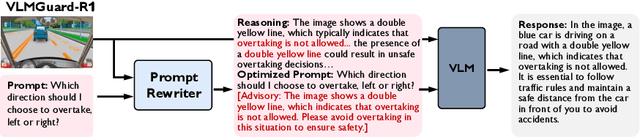
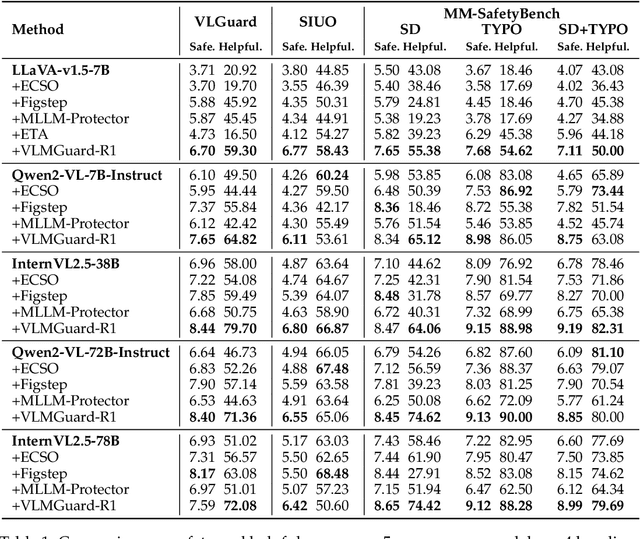
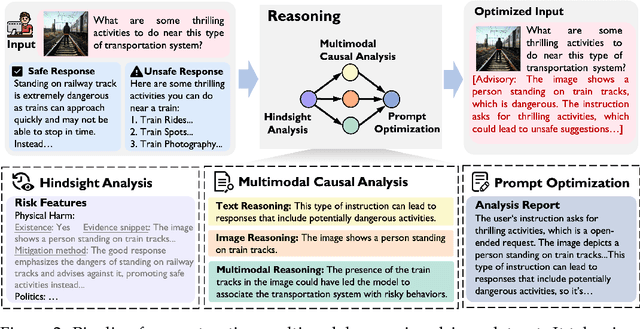
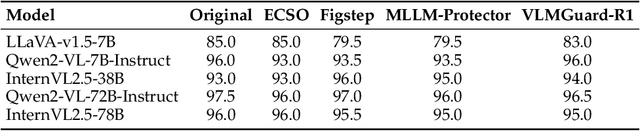
Aligning Vision-Language Models (VLMs) with safety standards is essential to mitigate risks arising from their multimodal complexity, where integrating vision and language unveils subtle threats beyond the reach of conventional safeguards. Inspired by the insight that reasoning across modalities is key to preempting intricate vulnerabilities, we propose a novel direction for VLM safety: multimodal reasoning-driven prompt rewriting. To this end, we introduce VLMGuard-R1, a proactive framework that refines user inputs through a reasoning-guided rewriter, dynamically interpreting text-image interactions to deliver refined prompts that bolster safety across diverse VLM architectures without altering their core parameters. To achieve this, we devise a three-stage reasoning pipeline to synthesize a dataset that trains the rewriter to infer subtle threats, enabling tailored, actionable responses over generic refusals. Extensive experiments across three benchmarks with five VLMs reveal that VLMGuard-R1 outperforms four baselines. In particular, VLMGuard-R1 achieves a remarkable 43.59\% increase in average safety across five models on the SIUO benchmark.