 Add to Chrome
 Add to Firefox
 Add to Edge
Towards Self-Evolving Agentic Literature Retrieval
May 14, 2026
As large language models reshape scientific research, literature retrieval faces a twofold challenge: ensuring source authenticity while maintaining a deep comprehension of academic search intents. While reliable, traditional keyword-centric search fails to capture complex research intents. Frontier LLMs can handle complex research intents, but their high cost and tendency to hallucinate remain key limitations. Here we introduce PaSaMaster, a self-evolving agentic literature retrieval system that produces relevance-scored paper rankings with evidence-grounded recommendations through iterative intent analysis, retrieval, and ranking. It is built on three key designs. First, it transforms literature retrieval from a one shot query--document matching problem into a search process that evolves over time, using ranked evidence to reveal gaps, refine intents, and guide follow-up searches. Second, it prevents hallucinated sources by treating retrieval as intent--paper relevance ranking rather than generation. Finally, PaSaMaster improves cost efficiency by separating planning from retrieval: a frontier LLM is used only for intent understanding, while large scale retrieval and relevance scoring are delegated to customized corpora and lightweight models. Evaluated on the PaSaMaster Benchmark across 38 scientific disciplines, our system exposes the severe inaccuracy and incompleteness of traditional keyword retrieval (improving F1-score by 15.6X) and the unreliability of generative LLMs (which exhibit hallucination rates up to 37.79%). Remarkably, PaSaMaster outperforms GPT-5.2 by 30.0% at a mere 1% of the computational cost while ensuring zero source hallucination: https://github.com/sjtu-sai-agents/PaSaMaster

PND-Net: Physics based Non-local Dual-domain Network for Metal Artifact Reduction
May 28, 2023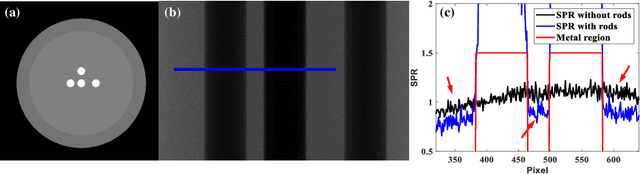
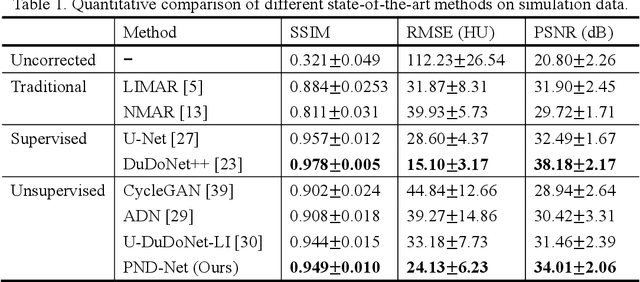
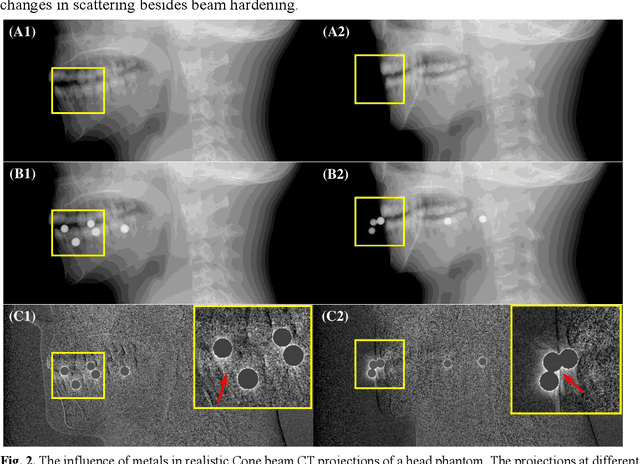
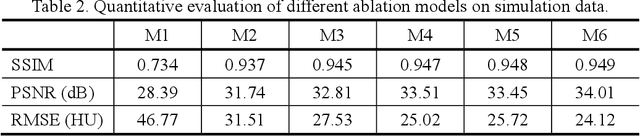
Metal artifacts caused by the presence of metallic implants tremendously degrade the reconstructed computed tomography (CT) image quality, affecting clinical diagnosis or reducing the accuracy of organ delineation and dose calculation in radiotherapy. Recently, deep learning methods in sinogram and image domains have been rapidly applied on metal artifact reduction (MAR) task. The supervised dual-domain methods perform well on synthesized data, while unsupervised methods with unpaired data are more generalized on clinical data. However, most existing methods intend to restore the corrupted sinogram within metal trace, which essentially remove beam hardening artifacts but ignore other components of metal artifacts, such as scatter, non-linear partial volume effect and noise. In this paper, we mathematically derive a physical property of metal artifacts which is verified via Monte Carlo (MC) simulation and propose a novel physics based non-local dual-domain network (PND-Net) for MAR in CT imaging. Specifically, we design a novel non-local sinogram decomposition network (NSD-Net) to acquire the weighted artifact component, and an image restoration network (IR-Net) is proposed to reduce the residual and secondary artifacts in the image domain. To facilitate the generalization and robustness of our method on clinical CT images, we employ a trainable fusion network (F-Net) in the artifact synthesis path to achieve unpaired learning. Furthermore, we design an internal consistency loss to ensure the integrity of anatomical structures in the image domain, and introduce the linear interpolation sinogram as prior knowledge to guide sinogram decomposition. Extensive experiments on simulation and clinical data demonstrate that our method outperforms the state-of-the-art MAR methods.