 Add to Chrome
 Add to Firefox
 Add to Edge
Comparative Characterization of KV Cache Management Strategies for LLM Inference
Apr 06, 2026
Efficient inference with Large Language Models (LLMs) increasingly relies on Key-Value (KV) caches to store previously computed key and value vectors at each layer. These caches are essential to minimize redundant computation during autoregressive token generation, lowering computational complexity from quadratic to linear. However, the growth of KV caches has posed significant system-level challenges, particularly as model sizes increase, context lengths grow, and concurrent requests compete for limited memory resources. Even though several recent frameworks for KV cache management have emerged, their comparative trade-offs in memory consumption and inference performance have not been fully understood, especially under varying request sizes and model configurations. In this work, we conduct an empirical study of three state-of-the-art KV cache management frameworks: vLLM, InfiniGen, and H2O. These frameworks employ techniques such as tensor offloading, token eviction heuristics, and speculative scheduling to balance memory usage and performance. We evaluate their performance in terms of a range of metrics such as latency, throughput, and memory usage across a spectrum of key parameters including request rates, model sizes, and sparsity levels. Our results pinpoint the conditions for each framework to perform the best, revealing the most suitable selection and configuration of KV cache strategies under memory and performance constraints.

O(1) Communication for Distributed SGD through Two-Level Gradient Averaging
Jun 16, 2020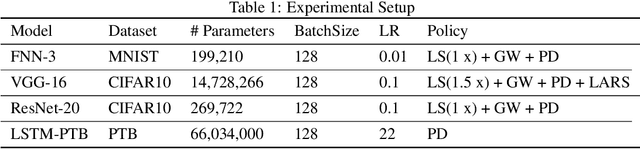
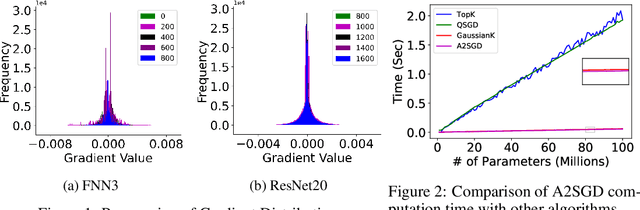

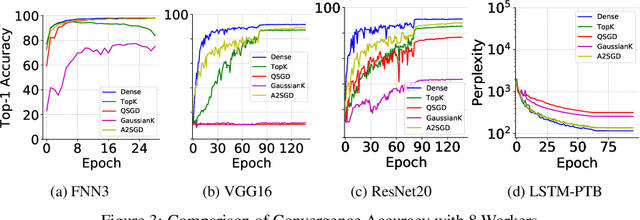
Large neural network models present a hefty communication challenge to distributed Stochastic Gradient Descent (SGD), with a communication complexity of O(n) per worker for a model of n parameters. Many sparsification and quantization techniques have been proposed to compress the gradients, some reducing the communication complexity to O(k), where k << n. In this paper, we introduce a strategy called two-level gradient averaging (A2SGD) to consolidate all gradients down to merely two local averages per worker before the computation of two global averages for an updated model. A2SGD also retains local errors to maintain the variance for fast convergence. Our theoretical analysis shows that A2SGD converges similarly like the default distributed SGD algorithm. Our evaluation validates the theoretical conclusion and demonstrates that A2SGD significantly reduces the communication traffic per worker, and improves the overall training time of LSTM-PTB by 3.2x and 23.2x, respectively, compared to Top-K and QSGD. To the best of our knowledge, A2SGD is the first to achieve O(1) communication complexity per worker for distributed SGD.