 Add to Chrome
 Add to Firefox
 Add to Edge
The Open Motion Planning Library 2.0
May 28, 2026
The Open Motion Planning Library (OMPL), first released in 2008, has become a cornerstone of the motion planning community, providing implementations of a wide range of state-of-the-art sampling-based algorithms. Over almost two decades of continuous development, we have steadily expanded the library with new planners, state spaces, and problem formulations. These additions range from asymptotically optimal and lazy planners to constrained motion planning and planning with temporal-logic goals. Building on this foundation, we introduce OMPL 2.0, a major evolution of the library that targets real-time motion planning through hardware acceleration and integrates seamlessly with modern AI research workflows. We also reflect on how OMPL and the field of motion planning have grown together over the years, and discuss the library's broader impact on the research community.

Python Bindings for a Large C++ Robotics Library: The Case of OMPL
Mar 04, 2026Python bindings are a critical bridge between high-performance C++ libraries and the flexibility of Python, enabling rapid prototyping, reproducible experiments, and integration with simulation and learning frameworks in robotics research. Yet, generating bindings for large codebases is a tedious process that creates a heavy burden for a small group of maintainers. In this work, we investigate the use of Large Language Models (LLMs) to assist in generating nanobind wrappers, with human experts kept in the loop. Our workflow mirrors the structure of the C++ codebase, scaffolds empty wrapper files, and employs LLMs to fill in binding definitions. Experts then review and refine the generated code to ensure correctness, compatibility, and performance. Through a case study on a large C++ motion planning library, we document common failure modes, including mismanaging shared pointers, overloads, and trampolines, and show how in-context examples and careful prompt design improve reliability. Experiments demonstrate that the resulting bindings achieve runtime performance comparable to legacy solutions. Beyond this case study, our results provide general lessons for applying LLMs to binding generation in large-scale C++ projects.
CaStL: Constraints as Specifications through LLM Translation for Long-Horizon Task and Motion Planning
Oct 29, 2024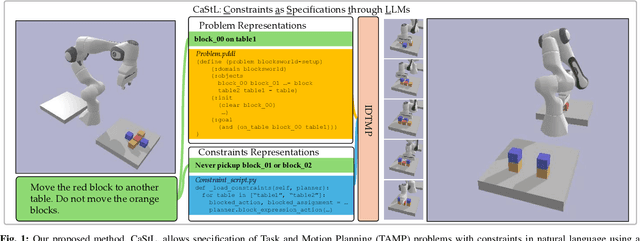
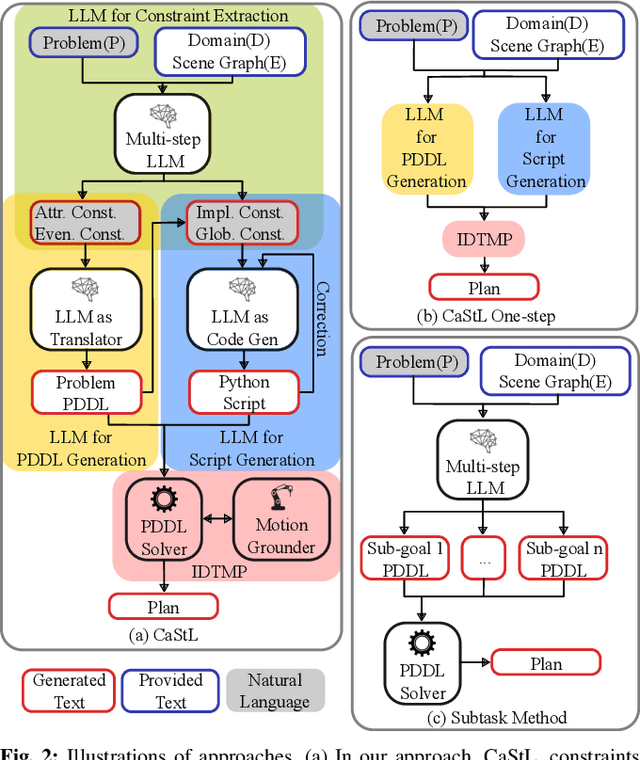
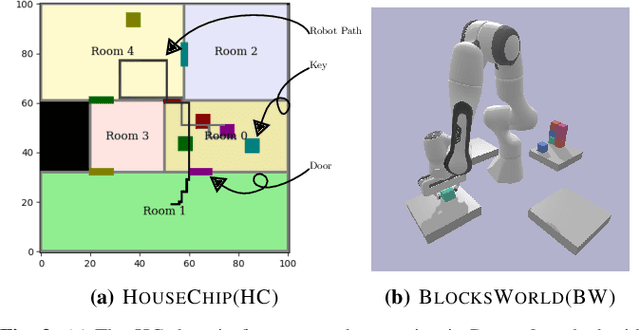
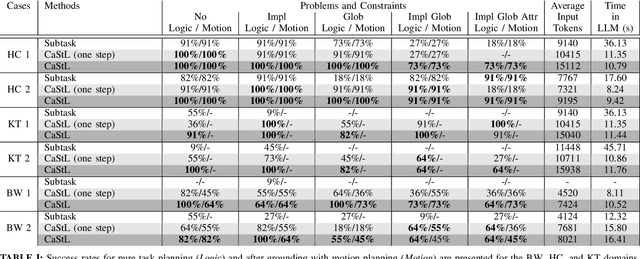
Large Language Models (LLMs) have demonstrated remarkable ability in long-horizon Task and Motion Planning (TAMP) by translating clear and straightforward natural language problems into formal specifications such as the Planning Domain Definition Language (PDDL). However, real-world problems are often ambiguous and involve many complex constraints. In this paper, we introduce Constraints as Specifications through LLMs (CaStL), a framework that identifies constraints such as goal conditions, action ordering, and action blocking from natural language in multiple stages. CaStL translates these constraints into PDDL and Python scripts, which are solved using an custom PDDL solver. Tested across three PDDL domains, CaStL significantly improves constraint handling and planning success rates from natural language specification in complex scenarios.