 Add to Chrome
 Add to Firefox
 Add to Edge
A Lightweight Multi-Agent Framework for Automated Concrete Barrier Design
Jun 11, 2026
The design of reinforced concrete highway barriers is a safety-critical process that requires strict compliance with regulatory provisions such as the AASHTO-LRFD bridge design guidelines. Current engineering practice relies heavily on manual, iterative, and heuristic calculations to satisfy complex nonlinear material and mechanics constraints. Although Large Language Models (LLMs) demonstrate strong generative capabilities, their direct application to structural engineering remains limited by hallucination risks and insufficient physical grounding. To address these challenges, this study proposes a novel "generation-evaluation-optimization" closed-loop framework for automated concrete barrier design using the multi-agent orchestration capabilities of AutoGen. Experimental results demonstrate that the proposed agentic framework achieves over 98% design accuracy, significantly outperforming standalone general-purpose LLMs. More importantly, the study reveals that design performance is not necessarily correlated with model scale, where an 8B-parameter lightweight model could outperform unconstrained 631B-parameter flagship models. This finding highlights the potential to substantially reduce computational costs while improving the accessibility of AI-assisted engineering tools for industry applications. The source code for the proposed multi-agent design framework is available at the project GitHub repository: https://github.com/MXY820/barrier-design. Keywords: Structural Engineering; Multi-Agent Systems; Large Language Models; Concrete Barrier Design; AutoGen; Design Automation.

brat: Aligned Multi-View Embeddings for Brain MRI Analysis
Dec 21, 2025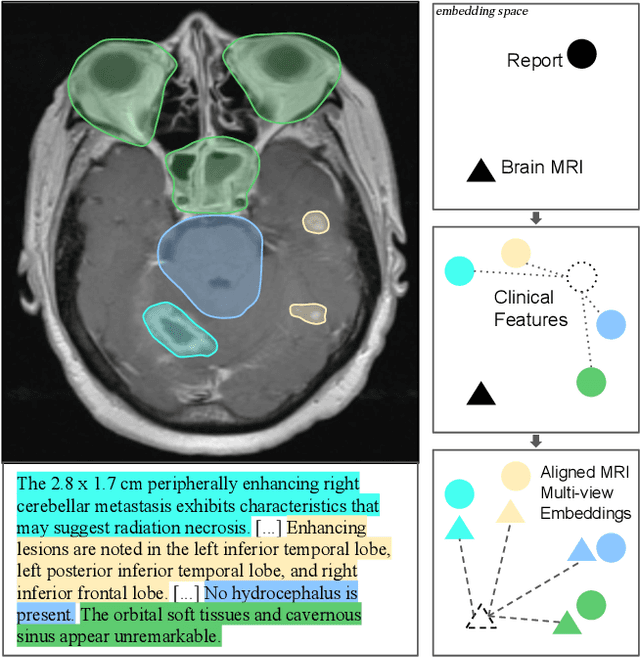
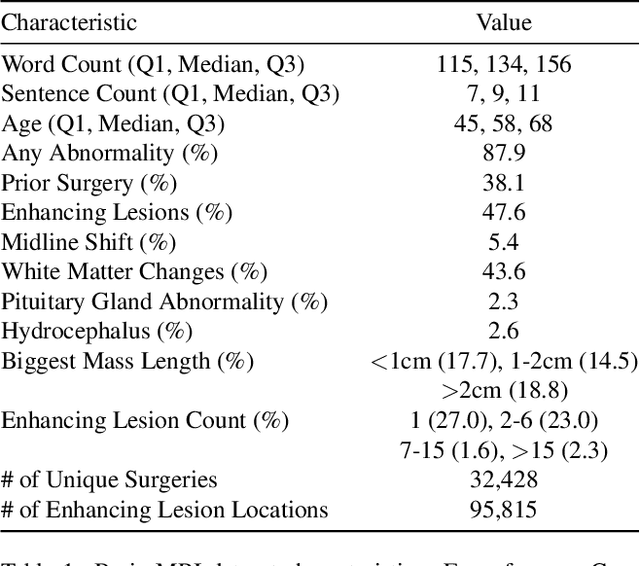
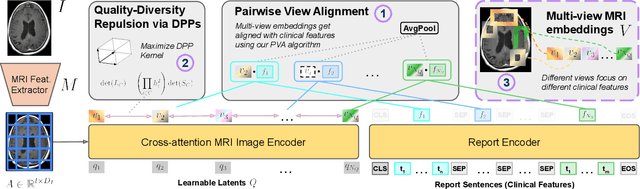
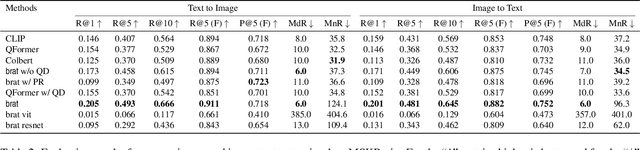
We present brat (brain report alignment transformer), a multi-view representation learning framework for brain magnetic resonance imaging (MRI) trained on MRIs paired with clinical reports. Brain MRIs present unique challenges due to the presence of numerous, highly varied, and often subtle abnormalities that are localized to a few slices within a 3D volume. To address these challenges, we introduce a brain MRI dataset $10\times$ larger than existing ones, containing approximately 80,000 3D scans with corresponding radiology reports, and propose a multi-view pre-training approach inspired by advances in document retrieval. We develop an implicit query-feature matching mechanism and adopt concepts from quality-diversity to obtain multi-view embeddings of MRIs that are aligned with the clinical features given by report sentences. We evaluate our approach across multiple vision-language and vision tasks, demonstrating substantial performance improvements. The brat foundation models are publicly released.
Zero-Shot Complex Question-Answering on Long Scientific Documents
Mar 04, 2025With the rapid development in Transformer-based language models, the reading comprehension tasks on short documents and simple questions have been largely addressed. Long documents, specifically the scientific documents that are densely packed with knowledge discovered and developed by humans, remain relatively unexplored. These documents often come with a set of complex and more realistic questions, adding to their complexity. We present a zero-shot pipeline framework that enables social science researchers to perform question-answering tasks that are complex yet of predetermined question formats on full-length research papers without requiring machine learning expertise. Our approach integrates pre-trained language models to handle challenging scenarios including multi-span extraction, multi-hop reasoning, and long-answer generation. Evaluating on MLPsych, a novel dataset of social psychology papers with annotated complex questions, we demonstrate that our framework achieves strong performance through combination of extractive and generative models. This work advances document understanding capabilities for social sciences while providing practical tools for researchers.