 Add to Chrome
 Add to Firefox
 Add to Edge
Geometric bias in eigenspace perturbation under random heterogeneous noise
Jun 09, 2026
Spectral methods rely fundamentally on the stability of principal eigenspaces under random perturbations. Classically, this stability is quantified by the Davis-Kahan and Wedin theorems, which bound the eigenspace error using the operator norm of the noise and the relevant spectral gaps. While these worst-case bounds are sharp for arbitrary deterministic perturbations, they can be wasteful in the low-rank signal-plus-random-noise setting, as they fail to capture the fine-grained interaction between the signal geometry and the noise distribution. In this paper, we study the spectral perturbation of signal-plus-noise matrices corrupted by sparse, random noise with an arbitrary, inhomogeneous variance profile. We demonstrate that under heterogeneous noise variances, the empirical eigenvectors suffer a systematic, deterministic geometric bias that is entirely invisible to classical perturbation bounds. By leveraging the Quadratic Vector Equation (QVE) and establishing fine-grained isotropic local laws, we derive near-optimal, non-asymptotic perturbation bounds for the leading eigenspaces in the operator and $2\to\infty$ norms. The bounds separate the usual signal-to-noise contribution, stochastic fluctuations, and structured geometric bias terms determined by the alignment between the signal eigenspaces and the row-wise variance profile.

Nonparametric undirected graphical model selection using diffusion models
Jun 07, 2026Undirected graphical models provide a fundamental framework for representing conditional independence structures among high-dimensional random variables. While undirected graphical model selection has become a central problem in high-dimensional statistics, most existing methods are restricted to parametric settings. In this paper, we develop a nonparametric approach to undirected graphical model selection based on diffusion models. Recent work has shown that diffusion models can adapt to the unknown graph structure of the underlying distribution, yet utilizing these models for explicit graph estimation remains unexplored. To bridge this gap, we introduce a novel diffusion-based method for nonparametric undirected graphical model selection. We establish the model selection consistency of the proposed method and demonstrate its empirical performance through extensive simulations and two real data analyses.
i-IF-Learn: Iterative Feature Selection and Unsupervised Learning for High-Dimensional Complex Data
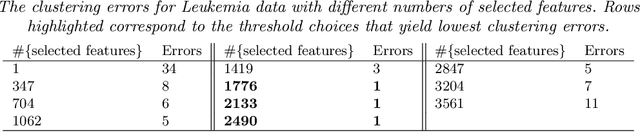
Mar 25, 2026Unsupervised learning of high-dimensional data is challenging due to irrelevant or noisy features obscuring underlying structures. It's common that only a few features, called the influential features, meaningfully define the clusters. Recovering these influential features is helpful in data interpretation and clustering. We propose i-IF-Learn, an iterative unsupervised framework that jointly performs feature selection and clustering. Our core innovation is an adaptive feature selection statistic that effectively combines pseudo-label supervision with unsupervised signals, dynamically adjusting based on intermediate label reliability to mitigate error propagation common in iterative frameworks. Leveraging low-dimensional embeddings (PCA or Laplacian eigenmaps) followed by $k$-means, i-IF-Learn simultaneously outputs influential feature subset and clustering labels. Numerical experiments on gene microarray and single-cell RNA-seq datasets show that i-IF-Learn significantly surpasses classical and deep clustering baselines. Furthermore, using our selected influential features as preprocessing substantially enhances downstream deep models such as DeepCluster, UMAP, and VAE, highlighting the importance and effectiveness of targeted feature selection.
Phase Transitions for High Dimensional Clustering and Related Problems
Jun 08, 2016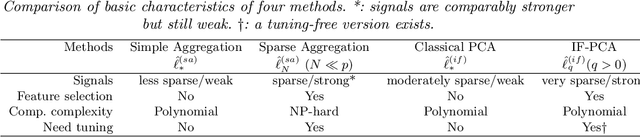
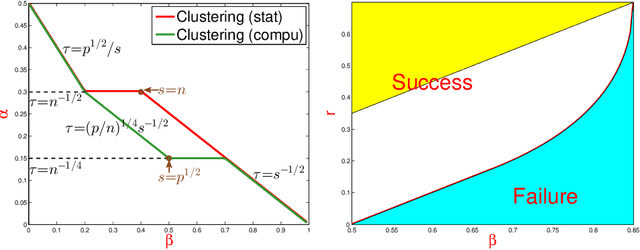
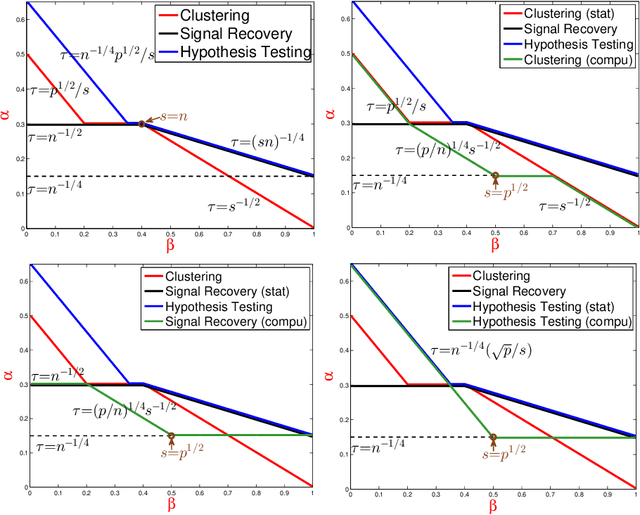
Consider a two-class clustering problem where we observe $X_i = \ell_i \mu + Z_i$, $Z_i \stackrel{iid}{\sim} N(0, I_p)$, $1 \leq i \leq n$. The feature vector $\mu\in R^p$ is unknown but is presumably sparse. The class labels $\ell_i\in\{-1, 1\}$ are also unknown and the main interest is to estimate them. We are interested in the statistical limits. In the two-dimensional phase space calibrating the rarity and strengths of useful features, we find the precise demarcation for the Region of Impossibility and Region of Possibility. In the former, useful features are too rare/weak for successful clustering. In the latter, useful features are strong enough to allow successful clustering. The results are extended to the case of colored noise using Le Cam's idea on comparison of experiments. We also extend the study on statistical limits for clustering to that for signal recovery and that for hypothesis testing. We compare the statistical limits for three problems and expose some interesting insight. We propose classical PCA and Important Features PCA (IF-PCA) for clustering. For a threshold $t > 0$, IF-PCA clusters by applying classical PCA to all columns of $X$ with an $L^2$-norm larger than $t$. We also propose two aggregation methods. For any parameter in the Region of Possibility, some of these methods yield successful clustering. We find an interesting phase transition for IF-PCA. Our results require delicate analysis, especially on post-selection Random Matrix Theory and on lower bound arguments.